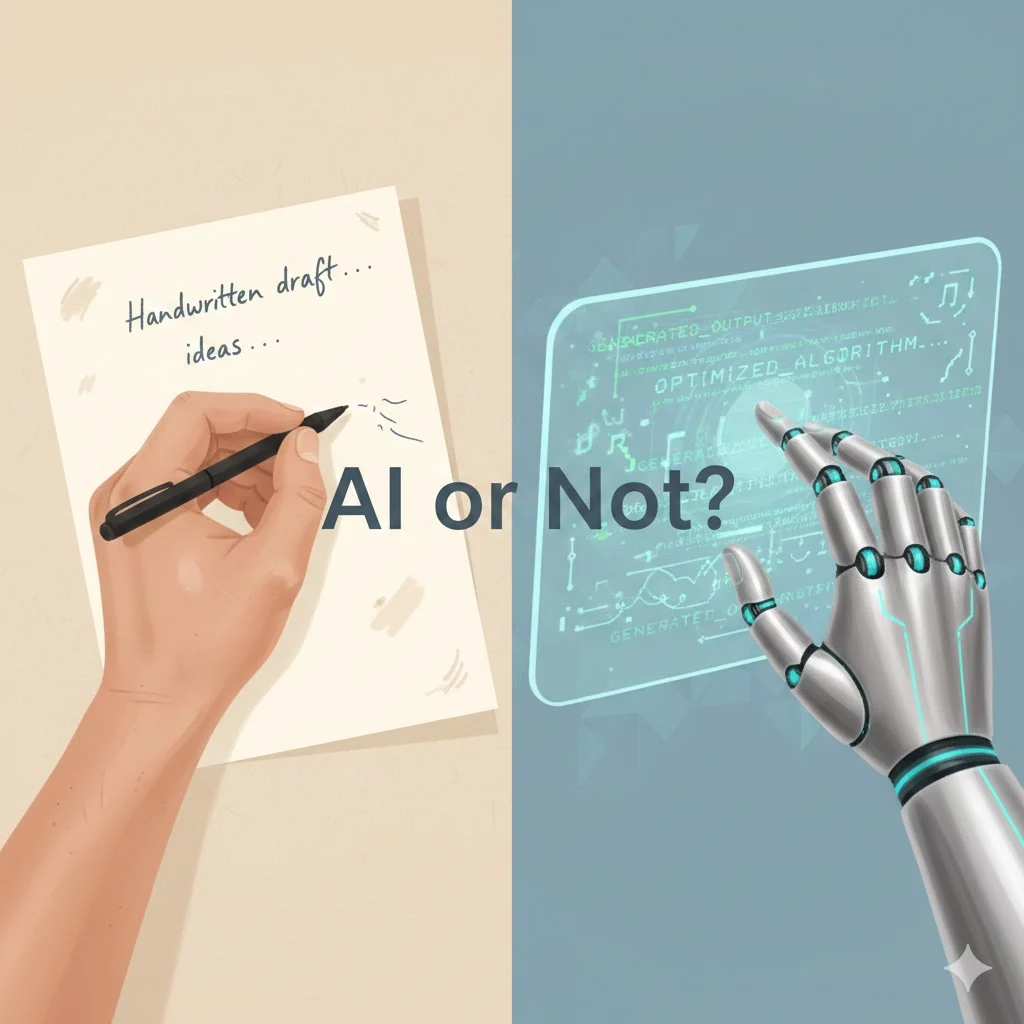
AI refers to content, images, or decisions created by artificial intelligence systems, while not AI means work created entirely by humans. To decide AI or not, look for patterns, lack of emotion, repetition, speed of creation, and context. Human work shows personal experience, natural variation, and emotional depth, while AI generated work often feels structured and predictable.
The question AI or not has become very common in today’s digital world. People now ask this question when reading articles, seeing images, watching videos, or even chatting online. Artificial intelligence is growing fast, and it is creating content that looks very close to human work. Because of this, many people feel confused and want to know whether something is created by AI or by a real person.
Students ask AI or not when checking assignments. Teachers ask it while grading work. Businesses ask it when reviewing content. Even regular users ask AI or not when reading posts on social media. The line between human and machine creation is becoming thin.
This article explains the difference between AI and not AI in a clear and simple way. You will learn what AI really is, how it works, why people struggle to tell the difference, real life examples, common signs, mistakes people make, exercises, and clear questions and answers. By the end, you will be confident in understanding AI or not.
AI or Not Quick Answer
AI means content or actions created by artificial intelligence systems.
Not AI means content or actions created by human thinking, effort, and experience.
Simple Examples
- A chatbot answering questions automatically is AI.
- A personal story written from life experience is not AI.
Easy Way to Think
If something feels fast, pattern based, and emotionless, it is often AI.
If something feels personal, imperfect, and emotional, it is usually not AI.
What AI Really Means
AI stands for artificial intelligence. It is a system designed to perform tasks that usually require human intelligence.
AI can write text, create images, analyze data, recognize voices, and even make decisions. It learns from large amounts of data and finds patterns to produce results.
AI does not think like humans. It does not feel emotions. It does not have personal experiences. Works based on probability and training data.
Common Forms of AI
- Text generators
- Image creators
- Voice assistants
- Recommendation systems
- Chatbots
These systems are built to act smart, but they do not understand meaning the way humans do.
What Not AI Means
Not AI refers to anything created fully by humans without machine generation.
Human work comes from thinking, emotions, memory, creativity, and lived experience. Even when humans use tools like computers, the thinking and decisions remain human.
Examples of Not AI
- A handwritten letter
- A personal diary entry
- A painting made by hand
- A speech based on personal belief
- A story inspired by real life events
Human work often includes mistakes, emotional depth, and unique expression.
Why People Ask AI or Not
The question AI or not appears everywhere because technology has changed how content is created.
Fast Growth of AI Tools
AI tools are easy to access and produce results quickly. This makes people suspicious.
Education Concerns
Teachers want to know if students used AI to complete assignments.
Trust Issues Online
People want to know if reviews, comments, or articles are genuine.
Job and Business Impact
Companies want original human ideas, not copied machine output.
Ethical and Legal Questions
Ownership and responsibility depend on whether something is AI or not.
Key Differences Between AI and Not AI
Speed of Creation
AI creates content very fast. Humans usually take more time.
Emotional Depth
Human work carries emotions. AI mimics emotion but does not feel it.
Personal Experience
Humans write from memory and life events. AI does not have personal life.
Repetition
AI often repeats sentence patterns. Humans vary naturally.
Context Awareness
Humans understand deep context. AI sometimes misses subtle meaning.
AI or Not in Writing
Writing is one of the most common areas where this question appears.
Signs of AI Writing
- Very structured paragraphs
- Balanced sentence length
- Neutral tone throughout
- Lack of personal opinion
- Generic examples
Signs of Human Writing
- Personal stories
- Strong opinions
- Emotional language
- Natural flow with small errors
- Cultural references
Example Comparison
AI style
This topic is important for many people. It has several aspects. It affects society.
Human style
This topic matters to me because I have seen its impact personally, and it changed how I think.
AI or Not in Images
Images created by AI are becoming very realistic.
Signs an Image Is AI
- Perfect lighting everywhere
- Unreal facial features
- Extra fingers or odd hands
- Too smooth skin
- Strange background details
Signs an Image Is Not AI
- Natural imperfections
- Uneven lighting
- Realistic shadows
- Authentic emotions
- Contextual background
AI or Not in Videos
Videos can also be AI generated.
AI Video Signs
- Lip sync errors
- Robotic voice tone
- Limited facial movement
- Repeating gestures
Human Video Signs
- Natural pauses
- Emotional expressions
- Real reactions
- Imperfect speech
AI or Not in Education
Education is heavily affected by AI.
Student Use of AI
Students may use AI for answers or essays.
Teacher Challenges
Teachers look for originality and personal understanding.
How Teachers Detect AI
- Asking follow up questions
- Checking writing style changes
- Looking for lack of personal insight
Common Mistakes When Judging AI or Not
Assuming Perfect Means AI
Humans can also produce clean work.
Assuming Mistakes Mean Human
AI can also make mistakes.
Overtrusting Detection Tools
No tool is fully accurate.
Ignoring Context
Always consider purpose and situation.
AI or Not in Business and Work
Businesses care deeply about this distinction.
Marketing Content
Human content builds trust. AI content scales faster.
Customer Support
AI handles speed. Humans handle emotion.
Decision Making
AI suggests options. Humans make final choices.
Ethical Questions Around AI or Not
Ownership
Who owns AI created work?
Responsibility
Who is responsible for errors?
Transparency
Should people disclose AI usage?
Fairness
Does AI replace human jobs?
How Humans and AI Can Work Together
The goal is not AI or not, but balance.
AI Strengths
- Speed
- Data analysis
- Consistency
Human Strengths
- Creativity
- Emotion
- Ethics
- Judgment
Together they produce better results.
AI or Not Practice Exercises
Exercise One
Decide if the following is AI or not.
A short story that includes personal childhood memories and emotional reflection.
Answer: Not AI
A product description written in a neutral tone with repeated structure.
Answer: AI
Exercise Two
Choose the correct option.
A hand painted portrait
AI or Not
Answer: Not AI
A chatbot replying instantly
AI or Not
Answer: AI
AI or Not in Daily Life Examples
- Voice assistants are AI
- Personal phone calls are not AI
- Recommendation feeds are AI
- Face to face conversations are not AI
Understanding this helps reduce confusion.
FAQs
What does AI or not mean?
It means deciding whether something is created by artificial intelligence or by a human.
Can AI feel emotions like humans?
No, AI can imitate emotion but does not feel it.
Is AI content always bad?
No, AI content can be helpful when used responsibly.
Can humans tell AI content easily?
Sometimes yes, sometimes no. It depends on context and quality.
Is using AI considered cheating?
It depends on rules and purpose. In some cases yes, in others no.
Will AI replace humans completely?
No, AI works best when supporting human skills.
Should people disclose AI usage?
Transparency is often recommended, especially in education and business.
Conclusion
The question AI or not is no longer rare. It is part of modern life. Artificial intelligence is powerful and fast, but it does not replace human thinking, emotion, or experience. Understanding the difference helps people make better decisions, build trust, and use technology responsibly.
AI creates patterns. Humans create meaning. When you know the signs, you can confidently tell whether something is AI or not. Instead of fearing AI, learning how it works allows people to use it wisely while preserving human creativity and values.
The future is not about choosing AI or not. It is about knowing when and how to use each.


