
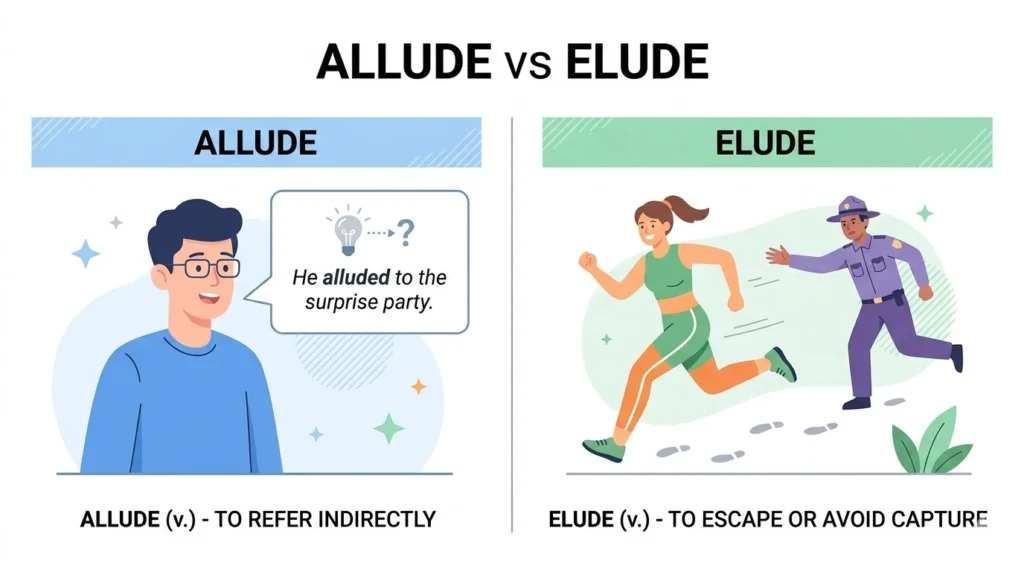
Allude and elude are two commonly confused English words, but they have very different meanings. Allude means to refer to something indirectly or hint at it. Elude means to escape from someone or something or to avoid being caught or understood. Writers often confuse these words because they sound similar and appear in similar contexts. However, choosing the correct word depends on whether you are referring to hinting at something or escaping from something.
Many English learners and even experienced writers confuse allude and elude because the two words look and sound similar. Despite their similarity, their meanings are completely different. Using the wrong word can change the meaning of a sentence and create confusion for readers.
The word allude is used when someone indirectly refers to something without mentioning it directly. It often appears in literature, speeches, and conversations where the speaker hints at an idea or reference. The word elude, on the other hand, describes escaping or avoiding something, such as danger, capture, or even understanding.
Understanding the difference between these two words helps improve writing clarity and communication. Whether you are writing essays, articles, emails, or creative work, knowing when to use allude and when to use elude ensures your message remains precise and professional.
This guide explains the meanings of both words, their origins, common mistakes people make, and real examples that show how to use them correctly.
Quick Answer
Allude means to refer to something indirectly without stating it openly.
Elude means to escape from something or avoid being caught or understood.
Simple Examples
Correct
The speaker alluded to past events without mentioning them directly.
Correct
The criminal eluded the police for several days.
Incorrect
The speaker eluded to the historical event.
Allude vs Elude Meaning Explained
To clearly understand the difference, it helps to examine the meanings separately.
Allude
The verb allude means to hint at or refer to something indirectly. It is often used in literature, speeches, and conversations where the speaker expects the audience to understand the reference.
Example
The author alluded to ancient mythology in the story.
Example
She alluded to a personal problem but did not explain it.
Elude
The verb elude means to escape, avoid, or evade something. It is commonly used when someone or something avoids capture, detection, or understanding.
Example
The thief eluded the police.
Example
The answer eluded the student during the exam.
Allude vs Elude Difference
| Word | Meaning | Usage |
|---|---|---|
| Allude | Refer to something indirectly | Used in speech, writing, and literature |
| Elude | Escape or avoid something | Used when something cannot be caught or understood |
Key Idea
Allude relates to mentioning something indirectly.
Elude relates to escaping or avoiding something.
The Origin of Allude
The word allude comes from the Latin word alludere, which means “to play with” or “to refer indirectly.”
Over time, the meaning evolved into referring to something in a subtle or indirect way. Writers and speakers began using the word when hinting at ideas without explaining them directly.
Today, allude is widely used in academic writing, literature, journalism, and public speaking.
The Origin of Elude
The word elude comes from the Latin word eludere, which means “to escape from” or “to evade.”
Historically, the word described situations where someone avoided capture or slipped away from danger. Over time, its meaning expanded to include avoiding detection or even avoiding understanding.
For example, a difficult concept may elude a student, meaning they cannot fully understand it.
Why People Confuse Allude and Elude
There are several reasons why these two words are often mixed up.
Similar Sound
Both words share a similar pronunciation. This makes it easy to confuse them when writing.
Similar Spelling
The words differ by only one letter. This visual similarity increases the chances of mistakes.
Similar Context
Both words often appear in formal writing, academic discussions, and literature. Because of this, writers sometimes substitute one for the other without noticing.
Grammar Rule Depth
Both allude and elude are verbs. However, they follow different grammatical patterns.
Allude Is Often Used With “To”
The verb allude frequently appears with the preposition to.
Example
The article alluded to political tensions.
Example
The professor alluded to an important theory.
Elude Usually Takes a Direct Object
The verb elude is usually followed directly by the thing being escaped.
Example
The suspect eluded the police.
Example
The solution eluded the scientist.
Recognizing this pattern helps prevent confusion.
Real World Usage of Allude
The word allude appears in many forms of communication.
Literature
Writers often allude to historical events or cultural ideas.
Example
The poem alludes to Greek mythology.
Public Speaking
Speakers sometimes hint at sensitive topics indirectly.
Example
The politician alluded to corruption without naming anyone.
Journalism
Journalists may reference previous events subtly.
Example
The article alluded to earlier controversies.
Real World Usage of Elude
The word elude often appears in discussions involving escape or difficulty.
Law Enforcement
Example
The suspect eluded authorities for several weeks.
Science and Research
Example
The explanation eluded scientists for decades.
Education
Example
The formula eluded the student during the test.
Allude vs Elude in Everyday Examples
Here are examples that highlight the difference.
The writer alluded to the novel in his speech.
The athlete eluded defenders on the field.
The professor alluded to an upcoming exam.
The meaning of the poem eluded many readers.
Each sentence shows a clear difference between hinting at something and escaping from something.
Allude vs Elude in Professional Writing
Academic Writing
Researchers may allude to earlier studies without explaining them in detail.
Example
The author alluded to previous research findings.
Business Writing
Executives sometimes hint at future plans.
Example
The CEO alluded to possible company expansion.
Technical Writing
Complex concepts may be difficult to understand.
Example
The solution eluded engineers for years.
Common Mistakes with Allude vs Elude
One of the most common mistakes is using elude instead of allude.
Incorrect
The article eluded to the historical event.
Correct
The article alluded to the historical event.
Another mistake happens when people try to add to after elude.
Incorrect
The suspect eluded to the police.
Correct
The suspect eluded the police.
Related Words and Similar Expressions
Learning related words helps strengthen understanding.
Words Related to Allude
refer
hint
mention indirectly
suggest
Words Related to Elude
escape
avoid
evade
slip away
These similar expressions help clarify the different meanings.
Tips to Remember the Difference
A simple memory trick can help.
Allude contains the letter A. Think of A for “association.”
When you allude to something, you associate your words with another idea.
Elude begins with E. Think of E for “escape.”
When something eludes you, it escapes from you.
Using these associations makes the difference easier to remember.
Allude vs Elude in Modern English
In modern English, both words appear frequently in journalism, academic writing, literature, and everyday conversation.
Because they sound similar, mistakes still occur regularly in online writing and social media posts. However, professional writing requires careful word choice.
Using allude correctly when referring to hints and elude correctly when referring to escape ensures accurate communication.
Google Trends and Usage Patterns
Language data shows that allude appears frequently in academic writing and journalism because writers often refer indirectly to events or ideas.
The word elude appears commonly in news stories involving police, investigations, and difficult problems that are hard to solve.
Although the two words appear in different contexts, their similar pronunciation still causes confusion among writers.
Exercise 1 Choose the Correct Word
Fill in the blanks with allude or elude.
The professor ______ to several historical events during the lecture.
Answer: alluded
The suspect managed to ______ the police during the chase.
Answer: elude
The author ______ to a famous poem in the novel.
Answer: alluded
The solution to the puzzle continued to ______ the scientist.
Answer: elude
Exercise 2 Correct the Sentence
Rewrite the sentence using the correct word.
The writer eluded to the historical event in the article.
Answer: The writer alluded to the historical event in the article.
The thief alluded the police during the escape.
Answer: The thief eluded the police during the escape.
The speaker eluded to earlier discussions in the meeting.
Answer: The speaker alluded to earlier discussions in the meeting.
FAQs
What is the difference between allude and elude?
Allude means to refer to something indirectly or hint at it. Elude means to escape from someone or something or to avoid being caught or understood.
When should I use allude in a sentence?
Use allude when you want to hint at something without mentioning it directly. The word is often used in literature, speeches, and academic writing.
When should I use elude in a sentence?
Use elude when something escapes capture, detection, or understanding. It is commonly used in contexts involving pursuit, difficulty, or mystery.
Why do people confuse allude and elude?
People confuse these words because they sound similar and have similar spelling. Both words also appear frequently in formal writing, which increases the chances of mixing them up.
Can elude be used with the word to?
No. Elude usually takes a direct object and does not require the word to. For example, you say “elude the police,” not “elude to the police.”
Is allude always followed by to?
Yes. In most cases, allude is followed by the preposition to, as in “allude to an idea” or “allude to an event.”
Can both words appear in the same context?
Yes. In some cases, both words can appear in the same discussion. For example, a writer might allude to a mystery whose solution eludes investigators.
Conclusion
The difference between allude and elude is an important distinction in English writing. Although the words look and sound similar, they express completely different ideas.
The verb allude refers to mentioning something indirectly. Writers, speakers, and journalists often use it when hinting at an idea, reference, or event without stating it directly.
The verb elude, on the other hand, describes escaping or avoiding something. It commonly appears in situations involving pursuit, mystery, or difficulty in understanding.
Many people confuse these words because of their similar pronunciation and spelling. However, remembering their core meanings makes the difference easier to understand. If a sentence involves hinting at something, the correct word is allude. If the sentence describes something escaping or avoiding capture, the correct word is elude.
Using these words correctly improves clarity and precision in writing. Whether you are writing academic essays, professional reports, or everyday communication, understanding the difference helps ensure that your message is accurate and effective.