
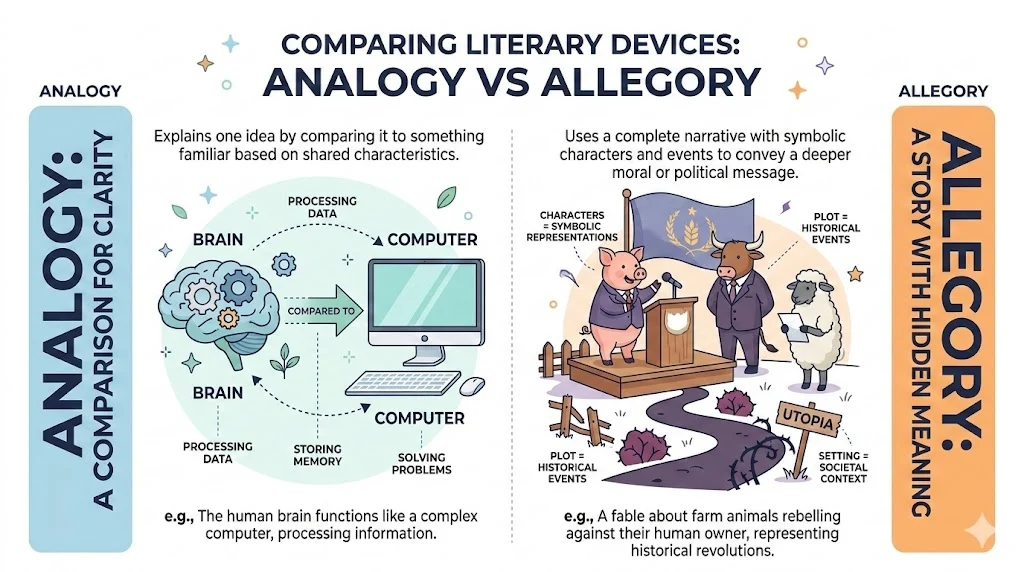
Analogy is a comparison between two things to explain an idea clearly.
Allegory is a story or narrative in which characters and events represent deeper meanings, often moral, political, or spiritual.
Use analogy when explaining. Use allegory when telling a symbolic story.
Many writers, students, and readers get confused about analogy vs allegory because both involve comparison and deeper meaning. At first glance, they seem similar. Both connect one idea to another. Both help explain complex concepts. However, their purpose and structure are very different.
People search for “analogy vs allegory” to understand literary terms, improve writing skills, prepare for exams, or analyze novels and speeches. Confusing these two words can lead to incorrect literary analysis and weak academic arguments. In essays and discussions, using the wrong term may reduce clarity and credibility.
This complete guide explains the difference between analogy and allegory in simple language. You will learn grammar and literary definitions, structural differences, historical origins, real-world examples, common mistakes, practice exercises with answers, and expert-level insights. By the end, you will confidently understand and explain analogy vs allegory without hesitation.
Quick Answer
Analogy is a comparison used to explain something.
Allegory is a full story where characters and events represent hidden meanings.
Simple Examples
- Analogy: The brain is like a computer.
- Allegory: A story about animals that represents political leaders.
Easy Memory Trick
Analogy explains.
Allegory symbolizes.
What Is an Analogy
An analogy is a comparison between two different things to highlight similarities and clarify an idea. It helps make complex ideas easier to understand.
Purpose of Analogy
- To simplify difficult concepts
- To teach or explain
- To persuade
- To illustrate relationships
Structure of an Analogy
An analogy usually compares:
A is to B as C is to D.
For example:
Hand is to glove as foot is to sock.
Types of Analogies
Literal Analogy
Based on real similarities.
Example:
The heart works like a pump.
Figurative Analogy
Based on imaginative comparison.
Example:
Life is like a journey.
Scientific Analogy
Used in education and research.
Example:
Electric current flows like water in a pipe.
Everyday Analogy Examples
- Learning a language is like building a house.
- Time is like money.
- A teacher is like a guide.
Analogy is usually short and direct.
What Is an Allegory
An allegory is a narrative in which characters, events, and settings represent deeper ideas or moral lessons. Allegory is extended symbolism throughout an entire story.
Purpose of Allegory
- To teach moral lessons
- To criticize society
- To express political ideas
- To explore spiritual themes
Structure of Allegory
In allegory:
- Characters represent abstract ideas
- Events symbolize larger concepts
- The entire story carries hidden meaning
Famous Allegory Examples
One of the most famous allegories is Animal Farm by George Orwell.
In this story, farm animals represent political leaders and historical events.
Another example is The Pilgrim’s Progress by John Bunyan, where characters represent spiritual ideas.
In ancient philosophy, Allegory of the Cave by Plato is a classic allegory about knowledge and reality.
Key Feature
Allegory is not just comparison. It is storytelling with symbolic meaning.
Core Difference Between Analogy vs Allegory
| Feature | Analogy | Allegory |
|---|---|---|
| Length | Short comparison | Full narrative |
| Purpose | Explain idea | Convey deeper meaning |
| Structure | Direct comparison | Symbolic story |
| Usage | Education, speeches | Literature, philosophy |
| Hidden Meaning | Usually no | Yes |
Analogy clarifies. Allegory represents.
Grammar and Literary Depth
Analogy in Rhetoric
In rhetoric, analogy strengthens arguments. Speakers use analogy to persuade audiences.
Example:
Freedom without responsibility is like driving without brakes.
This is not a story. It is a persuasive comparison.
Allegory in Literature
Allegory belongs mainly to literature. It often appears in novels, poetry, religious texts, and political writing.
In allegory:
- Every character may represent an idea.
- Events often mirror historical or moral situations.
Allegory requires interpretation.
Historical Origin of Analogy and Allegory
Origin of Analogy
The word analogy comes from the Greek word analogia, meaning proportion or correspondence.
Greek philosophers used analogy to explain logic and reasoning.
Origin of Allegory
The word allegory comes from the Greek word allegoria, meaning speaking otherwise or symbolic speech.
Ancient writers used allegory to hide political criticism and teach moral lessons safely.
Both words share Greek roots but developed differently in literary tradition.
Why People Confuse Analogy vs Allegory
Both Involve Comparison
Since both connect ideas, many assume they mean the same thing.
Academic Vocabulary Confusion
Students often mix up literary terms in exams.
Overlapping Usage
Sometimes allegories contain analogies within them.
Lack of Structural Awareness
People focus on meaning rather than structure.
Analogy vs Allegory in Real World Usage
In Education
Teachers use analogy to explain science and math concepts.
Allegory appears in literature classes when studying novels.
In Speeches
Politicians use analogy to simplify policies.
Example:
Running a country is like managing a household.
In Books
Writers use allegory to discuss politics, religion, or morality indirectly.
In Religious Texts
Many religious texts contain allegorical stories.
Deep Comparative Analysis
Scope
Analogy is limited and focused.
Allegory is broad and narrative.
Reader Involvement
Analogy requires simple understanding.
Allegory requires interpretation and critical thinking.
Emotional Impact
Analogy is logical.
Allegory is emotional and symbolic.
Duration
Analogy lasts one sentence.
Allegory may span hundreds of pages.
Advanced Examples
Analogy Example in Argument
The internet is like a library. You can find information, but you must choose wisely.
This helps explain digital literacy.
Allegory Example in Political Writing
In Animal Farm, the pigs represent political leaders. The farm represents a nation. The rebellion symbolizes revolution.
This is not a simple comparison. It is full symbolic storytelling.
Common Mistakes With Analogy vs Allegory
Mistake: Calling a simple comparison an allegory.
Correction: Short comparisons are analogies.
Mistake: Saying Animal Farm is an analogy.
Correction: It is an allegory.
Mistake: Using analogy when discussing symbolic novels.
Correction: Use allegory for symbolic stories.
Analogy vs Allegory in Academic Writing
In essays:
Use analogy to explain your thesis.
Use allegory when analyzing literature.
Example:
Incorrect: The author uses analogy throughout the novel.
Correct: The novel functions as an allegory.
Practice Exercises
Fill in the Blanks
- The teacher used an ______ to explain electricity.
Answer: analogy - Animal Farm is an example of an ______.
Answer: allegory - Comparing the brain to a computer is an ______.
Answer: analogy - A story where characters represent ideas is an ______.
Answer: allegory
Identify the Term
- Life is like a roller coaster.
Answer: analogy - A novel where a journey represents spiritual growth.
Answer: allegory
FAQs
What is the main difference between analogy and allegory?
Analogy is a short comparison used to explain an idea, while allegory is a full story with symbolic meaning.
Can an allegory contain analogies?
Yes, an allegorical story can include analogies within dialogue or narration.
Is Animal Farm an analogy or allegory?
It is an allegory because the entire story represents political events.
Are analogies always short?
Most analogies are brief comparisons, though some extended analogies may last several paragraphs.
Do analogies have hidden meanings?
No, analogies aim to clarify meaning, not hide it.
Is allegory only used in literature?
Mostly yes, though it can appear in film, art, and speeches.
Why do students confuse analogy vs allegory?
Because both involve comparison and symbolic thinking.
Conclusion
Understanding analogy vs allegory is essential for clear writing and strong literary analysis. Analogy is a tool for explanation. It compares two things to clarify meaning. Allegory is storytelling with symbolic depth. It represents complex ideas through characters and events.
If you remember one rule, remember this: analogy explains, allegory symbolizes. One is short and direct. The other is extended and narrative. Mastering this difference improves essays, speeches, and critical thinking skills.
By studying definitions, structures, examples, and historical roots, you now have a deep and complete understanding of analogy vs allegory. You can confidently use both terms correctly in academic and professional contexts.