
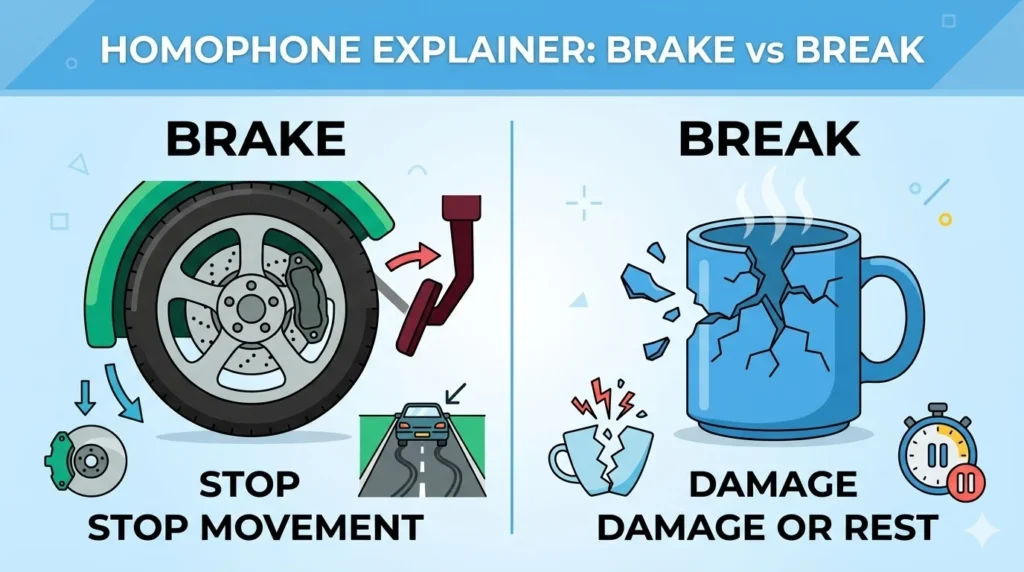
Brake and break are two words that sound the same but have different meanings. Brake usually refers to slowing or stopping movement, especially in vehicles. Break means to damage something, separate something into parts, or pause an activity.
Many English learners and even native speakers confuse brake and break. These two words sound exactly the same when spoken, but their meanings are very different. Because they are homophones, writers sometimes choose the wrong spelling when typing quickly or relying on pronunciation instead of meaning.
The confusion often appears in everyday writing such as emails, school assignments, social media posts, and even professional documents. For example, someone might write “take a brake” when they actually mean “take a break.” Small spelling mistakes like this can make writing look careless or confusing.
Understanding the difference between brake and break is important for clear communication. One word is related to stopping movement, especially in vehicles, while the other refers to damaging something, separating something into pieces, or pausing an activity. This guide explains the meanings, origins, common mistakes, and real world examples so you can confidently use the correct word every time.
Quick Answer
Brake refers to a device or action used to slow down or stop movement.
Break means to damage something, divide something into pieces, interrupt an activity, or take a rest.
Simple Examples
Correct
The driver pressed the brake to stop the car.
Correct
Let’s take a break after finishing this task.
Incorrect
The driver pressed the break to stop the car.
Incorrect
Let’s take a brake from work.
Brake vs Break Meaning Explained
Understanding each word separately makes the difference easier to remember.
Brake
A brake is a device that slows down or stops a moving vehicle, machine, or object.
Examples
The cyclist used the brake to avoid an accident.
The bus driver applied the brake at the traffic light.
The word can also be used as a verb.
Example
The driver braked suddenly to avoid hitting the animal.
Break
The word break has several meanings in English.
1 Damage something
2 Divide something into pieces
3 Interrupt an activity
4 Take a rest
Examples
She accidentally broke the glass.
Let’s take a break from studying.
The child broke the toy.
Brake vs Break Difference
| Word | Meaning | Example |
|---|---|---|
| Brake | Device or action used to stop movement | The driver hit the brake |
| Break | Damage, separate, or pause something | I need a break |
Key Idea
Think about vehicles when you see brake.
Think about damage or rest when you see break.
The Origin of the Word Brake
The word brake comes from an old term meaning a tool used to slow or crush objects. Over time, it became associated with mechanisms that reduce speed.
As transportation developed, the word began referring specifically to devices used in vehicles to slow or stop motion.
Today, brakes are essential safety features in cars, bicycles, trains, airplanes, and many machines.
Example
Modern cars use advanced brake systems for safety.
The Origin of the Word Break
The word break comes from Old English and originally meant to split or shatter something.
Over centuries, the meaning expanded to include many related ideas such as interrupting something, damaging objects, or pausing activities.
Examples
break a window
break a rule
break a habit
take a break
Because the word has many meanings, it appears frequently in everyday English.
Why People Confuse Brake and Break
Several reasons explain why these words cause confusion.
Same Pronunciation
Both words sound identical when spoken. This makes it easy to choose the wrong spelling when writing.
Frequent Use of Break
The word break appears more often in daily language than brake, so writers sometimes default to it even when referring to stopping a vehicle.
Typing Habits
People typing quickly may not pause to think about the correct spelling, especially in casual messages.
Grammar Rule Depth
From a grammar perspective, these words belong to different categories.
Brake
Can be used as both a noun and a verb.
Noun example
The car’s brake stopped working.
Verb example
The driver braked suddenly.
Break
Can be used as a verb or noun.
Verb example
Do not break the glass.
Noun example
Let’s take a break.
Understanding these grammatical roles helps prevent mistakes.
Real World Usage of Brake
The word brake appears most often in transportation and mechanical contexts.
Driving
Drivers must use brakes to control speed and stop safely.
Example
He pressed the brake when the light turned red.
Cycling
Cyclists rely on brakes to control downhill speed.
Example
She used the brake while riding down the hill.
Aviation
Airplanes also have braking systems.
Example
The pilot applied the brakes after landing.
Real World Usage of Break
The word break appears in many everyday situations.
Rest or Pause
Example
Let’s take a break after lunch.
Damaging Objects
Example
Be careful not to break the vase.
Interrupting Activities
Example
The meeting took a short break.
Brake vs Break in Sentences
Here are examples showing correct usage.
The driver pressed the brake to stop the car.
The cyclist checked the brakes before riding.
She dropped the plate and it broke.
Let’s take a break after finishing this report.
The child accidentally broke the toy.
Brake vs Break in Professional Writing
Using the correct word is important in formal communication.
Transportation Reports
Example
The accident happened when the vehicle’s brake system failed.
Workplace Communication
Example
Employees receive a 15 minute break during long shifts.
Safety Instructions
Example
Always check the brakes before driving.
Brake vs Break in Social Media and Conversation
These words also appear often in casual communication.
Example
I need a break from work today.
Example
The driver slammed the brake suddenly.
Even in casual writing, using the correct word improves clarity.
Common Mistakes with Brake vs Break
Many writers confuse the words in everyday sentences.
Incorrect Example
I need a quick brake from work.
Correct Version
I need a quick break from work.
Incorrect Example
The driver pressed the break.
Correct Version
The driver pressed the brake.
Related Words and Similar Expressions
Understanding related words can help strengthen vocabulary.
Words Related to Brake
stop
slow down
halt
decelerate
Words Related to Break
rest
pause
damage
shatter
Tips to Remember the Correct Word
A simple trick can help.
Think of brake as related to cars and vehicles.
The word break often means damage or rest.
Another memory trick
Brake contains the letter A, which can remind you of automobiles.
Break contains EA, which appears in words like rest or damage.
Brake vs Break in Modern English
In modern English, both words are widely used but in completely different contexts.
Brake appears mainly in mechanical or transportation discussions.
Break appears in daily communication because it has many meanings such as resting, damaging objects, or interrupting activities.
Understanding the difference helps improve writing accuracy.
Language Usage Patterns
Language data shows that break is used much more frequently than brake because it has several meanings.
However, in transportation or safety contexts, brake is the correct and necessary term.
Writers must choose the word based on context.
Exercise 1 Choose the Correct Word
Fill in the blank using brake or break.
The driver pressed the ______ to stop the car.
Answer: brake
Let’s take a short ______ after studying.
Answer: break
The cyclist checked the ______ before riding downhill.
Answer: brake
Exercise 2 Correct the Sentence
Rewrite the sentence using the correct word.
I need a quick brake from work.
Answer: I need a quick break from work.
The driver hit the break suddenly.
Answer: The driver hit the brake suddenly.
FAQs
What is the difference between brake and break?
Brake refers to a device or action used to slow down or stop movement, especially in vehicles. Break means to damage something, divide something into pieces, interrupt an activity, or take a rest.
When should I use brake in a sentence?
Use brake when talking about stopping or slowing down movement. It is commonly used when discussing cars, bicycles, trains, or machines.
When should I use break in a sentence?
Use break when referring to damaging something, dividing something into pieces, pausing an activity, or resting.
Why do people confuse brake and break?
People confuse these words because they sound the same when spoken. Since break is used more often in daily language, writers sometimes mistakenly use it when they mean brake.
Can brake be used as a verb?
Yes. Brake can be used as a verb when describing the act of slowing down or stopping a vehicle.
Example
The driver braked suddenly.
Is take a brake correct?
No. The correct phrase is take a break, which means to pause or rest.
Do brake and break mean the same thing?
No. Although they sound identical, they have completely different meanings and are used in different contexts.
Conclusion
The difference between brake and break is a classic example of homophones in English. These words sound the same when spoken but have completely different meanings and uses. Understanding this distinction helps improve writing clarity and prevents common spelling mistakes.
The word brake refers to a device or action used to slow down or stop movement. It is most commonly used when discussing vehicles, machines, and transportation systems. On the other hand, break has several meanings, including damaging something, dividing something into pieces, interrupting an activity, or taking a rest.
Because both words sound identical, writers often confuse them when typing quickly or relying on pronunciation. However, remembering the context makes the correct choice easier. If the sentence relates to stopping a vehicle, the correct word is brake. If the sentence refers to rest, damage, or interruption, the correct word is break.
Learning the difference between these two words not only improves grammar accuracy but also strengthens overall communication skills. Once you understand the meanings and examples, choosing the correct word becomes simple and natural.