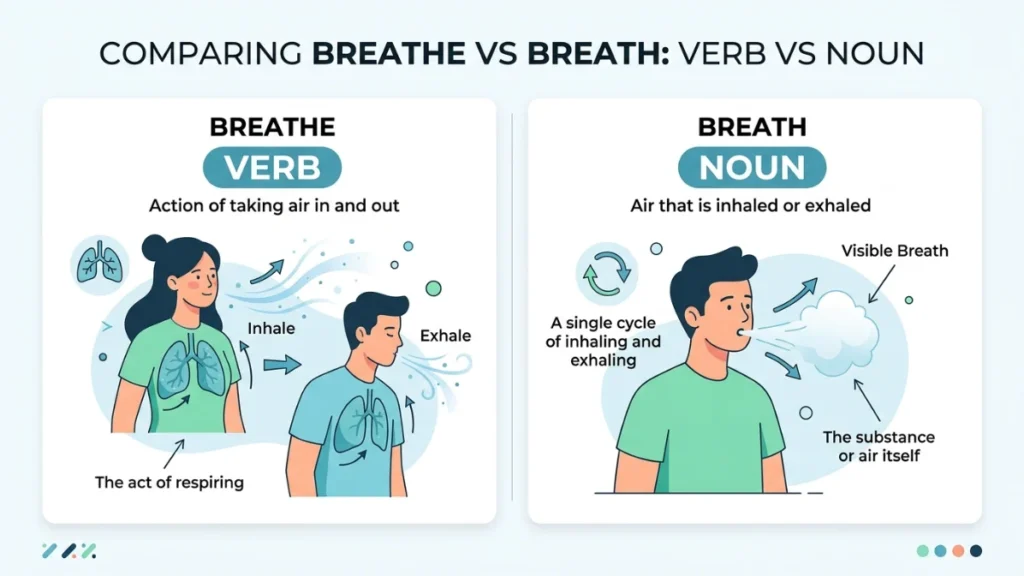

Breathe is a verb meaning to inhale and exhale air. Breath is a noun referring to the air you take in or out. Breathe is an action while breath is a thing.
I used to confuse breathe and breath more often than I expected. The problem usually appeared while writing quickly because both words look almost identical. I once wrote “take a deep breathe” in an email and immediately noticed something felt wrong.
That mistake pushed me to learn the real difference. After understanding one simple grammar rule, the confusion disappeared completely.
If you also mix up breathe or breath, this guide explains the difference clearly, shows how to remember each word, and gives practical examples so you can stop making this common mistake.
Quick Answer
The difference is simple.
Breathe is a verb.
Breath is a noun.
Correct Examples
I need to breathe slowly.
Take a deep breath.
Incorrect Examples
I need to breath slowly.
Take a deep breathe.
Breathe or Breath Difference
| Word | Part of Speech | Meaning | Example |
|---|---|---|---|
| Breathe | Verb | To inhale and exhale | Please breathe slowly |
| Breath | Noun | Air taken in or out | Take a deep breath |
Key Rule
Breathe is something you do.
Breath is something you have.
Breathe Meaning Explained
Breathe means:
To take air into your lungs
To release air from your lungs
To inhale and exhale
Because it is a verb, breathe describes an action.
Examples
Please breathe slowly.
He could barely breathe.
Take time to breathe deeply.
She stopped to breathe.
Common Situations Using Breathe
breathing exercises
sports training
medical instructions
meditation
daily conversation
Breath Meaning Explained
Breath is a noun.
It refers to air moving into or out of your body.
Examples
Take a deep breath.
His breath smelled like coffee.
She held her breath.
You could see your breath in winter.
Common Uses of Breath
deep breath
short breath
hold your breath
catch your breath
How to Pronounce Breathe and Breath
Pronunciation creates confusion because the words look similar.
Breathe Pronunciation
/briːð/
Sounds like:
bree-th
Long vowel sound
Breath Pronunciation
/breθ/
Sounds like:
breth
Short vowel sound
The pronunciation difference helps remember which word you need.
Why People Confuse Breathe and Breath
There are several reasons.
Similar Spelling
Only one letter changes.
Similar Meaning
Both relate to breathing.
Pronunciation Differences Are Small
Many learners do not notice the sound change.
Fast Typing
People often accidentally add or remove the final E.
Grammar Rule Depth
The easiest rule is:
Words ending with E are often verbs.
Breathe ends with E.
Therefore:
Breathe = action
Breath has no final E.
Therefore:
Breath = noun
Simple Formula
Breathe = Verb
Breath = Noun
Example Comparison
Correct:
I need to breathe.
Incorrect:
I need to breath.
Correct:
Take a breath.
Incorrect:
Take a breathe.
Why Is Breathe Difficult to Spell
The confusion happens because English rarely changes meaning with only one extra letter.
Consider:
breath
breathe
Both look almost identical.
However:
one is an action
one is a thing
That small difference causes many mistakes.
The Origin of Breathe and Breath
Both words come from Old English.
Earlier forms existed hundreds of years ago.
Originally:
Breath described air or respiration.
Breathe developed later as the action form.
English eventually separated them into:
noun form
verb form
This created the modern spelling difference.
Different Forms of Breathe and Breath
| Word | Type |
|---|---|
| Breathe | Verb |
| Breath | Noun |
| Breathing | Present participle |
| Breathed | Past tense |
| Breathless | Adjective |
| Breathable | Adjective |
Examples
I breathe slowly.
His breath is visible.
She is breathing deeply.
He breathed carefully.
The runner looked breathless.
Real World Usage of Breathe
In Everyday Conversation
Just breathe.
I cannot breathe properly.
Remember to breathe.
In Health Discussions
Doctors may tell patients:
Take deep breaths.
Breathe slowly.
In Sports
Athletes learn how to breathe correctly.
Good breathing improves performance.
In Meditation
Breathing exercises often focus on:
slow breathing
deep breathing
controlled breathing
Breathe and Breath in Emails
Examples:
Please breathe slowly during the exercise.
Take a deep breath before speaking.
I needed a moment to catch my breath.
Breathe and Breath in Professional Writing
Examples:
Employees should breathe normally during testing.
Participants were asked to take a deep breath.
Medical staff monitored breathing patterns.
Breathe and Breath in Social Media
Examples:
Just breathe.
Take a breath and relax.
Sometimes you simply need to breathe.
Common Phrases Using Breath
Take a breath
Hold your breath
Catch your breath
Out of breath
Under your breath
Examples
Hold your breath underwater.
He was out of breath.
Take a breath before answering.
Common Phrases Using Breathe
Breathe deeply
Breathe slowly
Breathe easier
Learn to breathe
Examples
Breathe deeply before sleeping.
Try to breathe slower.
Common Mistakes With Breathe or Breath
Mistake 1 Using Breath as a Verb
Incorrect:
Please breath slowly.
Correct:
Please breathe slowly.
Mistake 2 Using Breathe as a Noun
Incorrect:
Take a deep breathe.
Correct:
Take a deep breath.
Mistake 3 Adding Extra E Everywhere
Incorrect:
I lost my breathe.
Correct:
I lost my breath.
Words People Confuse Like Breathe and Breath
| Correct Pair | Common Confusion |
|---|---|
| Advice vs Advise | noun vs verb |
| Practice vs Practise | noun vs verb |
| Breath vs Breathe | noun vs verb |
| Choice vs Choose | noun vs verb |
Learning similar patterns helps improve grammar.
How Common Is This Mistake
Breathe and breath confusion is extremely common because:
spelling differences are small
pronunciation differences are subtle
both words appear frequently
typing errors happen often
Students and native speakers both make this mistake.
Memory Tricks to Remember Breathe and Breath
Trick 1
Breathe has an extra E
Think:
E for action
Therefore:
Breathe = verb
Trick 2
Breath is shorter.
A noun is shorter too.
Trick 3
Remember:
Take a breath.
You do not:
Take a breathe.
Trick 4
Say:
I breathe air.
I take a breath.
Breathe or Breath Summary
Breathe:
verb
action
contains E
Breath:
noun
thing
no final E
Exercise 1 Choose the Correct Word
I cannot ______ properly.
Answer:
breathe
Take a deep ______.
Answer:
breath
Remember to ______ slowly.
Answer:
breathe
Exercise 2 Correct the Sentence
Take a deep breathe.
Answer:
Take a deep breath.
Please breath slowly.
Answer:
Please breathe slowly.
He lost his breathe.
Answer:
He lost his breath.
FAQs
What is the difference between breathe and breath?
Breathe is a verb meaning to inhale and exhale. Breath is a noun referring to the air you take in or out.
Is breathe or breath correct?
Both are correct but used differently. Breathe is an action. Breath is a thing.
Why do people confuse breathe and breath?
People confuse them because the words look nearly identical and relate to the same topic.
How do I remember breathe and breath?
Remember that breathe has an extra E. Think E for action.
Is breath a noun or verb?
Breath is a noun.
Is breathe a noun?
No. Breathe is a verb.
What is the past tense of breathe?
The past tense is breathed.
Conclusion
Understanding breathe or breath becomes easy once you know the grammar rule. Breathe is the action word and functions as a verb, while breath is the noun describing the air moving in and out of your body.
The confusion happens because the words look similar and have closely related meanings. Fortunately, remembering simple rules makes the difference easier. If the word describes an action, use breathe. If it refers to air itself, use breath.
Using these words correctly improves writing, speaking, and professional communication. With practice and repetition, this common mistake quickly disappears.