
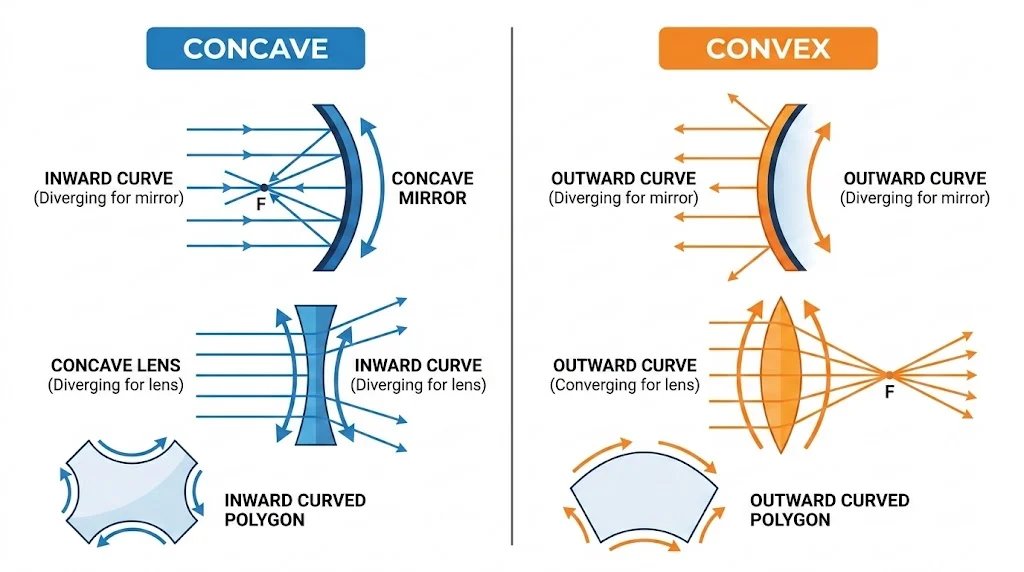
Concave means curved inward, like the inside of a bowl. Convex means curved outward, like the outside of a ball. In geometry, lenses, mirrors, and polygons, concave shapes bend inward while convex shapes bulge outward.
Many students and learners get confused between concave vs convex because both words describe curves, but in opposite directions. The difference looks small, yet it changes how shapes behave in geometry, optics, and real life. A concave mirror reflects light differently than a convex mirror. A concave polygon has different angle rules than a convex polygon. Even lenses in glasses depend on whether they are concave or convex.
People often search for “concave vs convex” when studying math, physics, design, or architecture. The confusion usually comes from similar spelling and opposite meanings. Understanding the difference clearly helps in exams, engineering problems, drawing shapes, and understanding how light works.
This guide explains concave vs convex in simple language. You will learn definitions, formulas, diagrams explained in words, real-life examples, common mistakes, geometry rules, optics behavior, practice questions with answers, and clear tips to remember the difference forever.
Quick Answer
Concave curves inward.
Convex curves outward.
Simple Examples
- A spoon’s inner side is concave.
- A football is convex on the outside.
- A cave opening is often concave.
- A balloon surface is convex.
Easy Memory Trick
Concave has the word “cave” inside it. A cave curves inward.
Convex sounds like “vexed cheeks puffed out,” meaning outward.
Concave and Convex in Geometry
In geometry, concave and convex describe the shape of lines, polygons, and surfaces.
Concave Shape in Geometry
A shape is concave if at least one interior angle is greater than 180 degrees.
It looks like part of the shape is pushed inward.
Key Properties
- At least one interior angle greater than 180 degrees
- A line drawn between two points inside may pass outside the shape
- Looks indented
Convex Shape in Geometry
A shape is convex if all interior angles are less than 180 degrees.
The shape has no inward dents.
Key Properties
- All interior angles less than 180 degrees
- A line drawn between any two points inside stays inside
- Looks fully outward
Concave vs Convex Polygons Explained
Concave Polygon
A polygon is concave if it has one inward angle.
Example shapes include certain irregular pentagons or stars.
Example:
If one angle measures 210 degrees, the polygon is concave.
Convex Polygon
A polygon is convex if every angle is less than 180 degrees.
Examples include:
- Square
- Rectangle
- Equilateral triangle
- Regular pentagon
Comparison Table
| Feature | Concave | Convex |
|---|---|---|
| Curve Direction | Inward | Outward |
| Interior Angles | At least one greater than 180° | All less than 180° |
| Shape Appearance | Dented inward | Smooth outward |
| Line Test | Line may exit shape | Line stays inside |
| Example | Star shape | Circle |
Concave vs Convex Mirrors in Physics
Mirrors behave differently depending on their curve.
Concave Mirror
A concave mirror curves inward like a bowl.
Behavior
- Converges light rays
- Can form real or virtual images
- Used in shaving mirrors
- Used in headlights
When light rays hit a concave mirror, they come together at a focal point.
Convex Mirror
A convex mirror curves outward.
Behavior
- Diverges light rays
- Always forms virtual images
- Used in security mirrors
- Used in vehicle side mirrors
Convex mirrors show a wider field of view.
Concave vs Convex Lenses
Lenses bend light differently.
Concave Lens
- Thinner in the center
- Spreads light rays outward
- Used for correcting nearsightedness
Convex Lens
- Thicker in the center
- Brings light rays together
- Used for magnifying glass
- Used for farsightedness correction
Mathematical Definitions and Formulas
Interior Angle Rule for Polygons
Sum of interior angles =
(n minus 2) multiplied by 180
If any interior angle is greater than 180 degrees, the polygon is concave.
Line Segment Test
If a line between two points inside a shape goes outside the boundary, the shape is concave.
Why Students Confuse Concave vs Convex
Similar Spelling
Both words start with “con” and look almost the same.
Opposite Meaning
They describe opposite curves, which increases confusion.
Visual Similarity
Without diagrams, it is hard to imagine inward vs outward curves.
Lack of Practical Examples
Many textbooks explain definitions but not real-life uses.
Real Life Examples of Concave and Convex
Concave Examples
- Inside of a bowl
- Satellite dish
- Cave entrance
- Spoon interior
- Reflector telescope
Convex Examples
- Soccer ball
- Outside of a spoon
- Dome roof
- Security mirror
- Planet surface
Concave vs Convex in Everyday Objects
Kitchen
Spoons have both concave and convex sides.
Architecture
Domes are convex from outside.
Arches can be concave from inside.
Medicine
Eyeglasses use concave or convex lenses.
Vehicles
Side mirrors are convex to show more area.
Common Mistakes and Corrections
Mistake: All curved shapes are convex.
Correction: A shape can curve inward and be concave.
Mistake: Concave always means hollow.
Correction: Concave means inward curve, not necessarily empty.
Mistake: Convex mirrors make objects larger.
Correction: Convex mirrors make objects appear smaller.
Mistake: A star is convex.
Correction: A star is usually concave because of inward angles.
Deep Comparison Table
| Aspect | Concave | Convex |
|---|---|---|
| Curve | Inward | Outward |
| Light Behavior | Converges | Diverges |
| Image Type | Real or virtual | Virtual only |
| Polygon Rule | One angle greater than 180° | All angles less than 180° |
| Example Mirror | Makeup mirror | Car side mirror |
| Example Lens | Nearsighted correction | Magnifying glass |
Practice Exercises
Fill in the Blanks
- A bowl is ______ in shape.
Answer: concave - A football is ______.
Answer: convex - A shape with an angle of 200 degrees is ______.
Answer: concave - Car side mirrors are ______.
Answer: convex
Multiple Choice
- Which mirror converges light?
Answer: Concave - Which lens is thicker in the center?
Answer: Convex - Which shape has no inward angles?
Answer: Convex
Advanced Understanding
In Calculus
A function is concave up if it curves upward.
A function is concave down if it curves downward.
Convex functions curve outward and have positive second derivatives.
In Economics
A convex curve represents increasing opportunity cost.
A concave curve shows decreasing marginal utility.
FAQs
What is the main difference between concave and convex?
Concave curves inward while convex curves outward.
Is a circle concave or convex?
A circle is convex because it curves outward.
Can a shape be both concave and convex?
No. A shape cannot be both at the same time.
Which mirror is used in cars?
Convex mirrors are used in vehicles.
Which lens corrects nearsightedness?
Concave lenses correct nearsightedness.
How do I remember concave vs convex?
Think of a cave for concave because caves curve inward.
Are all triangles convex?
Yes, all triangles are convex.
Conclusion
Understanding concave vs convex is important in geometry, physics, mathematics, architecture, and everyday life. Concave shapes curve inward, while convex shapes curve outward. This simple difference changes how light reflects, how lenses focus, how polygons behave, and how objects appear.
By learning the properties, rules, examples, and real-life uses, the confusion disappears. Whether studying mirrors, lenses, polygons, or functions, remembering the direction of the curve makes everything clear.
With practice and visual thinking, you can easily identify concave and convex shapes in any situation.