
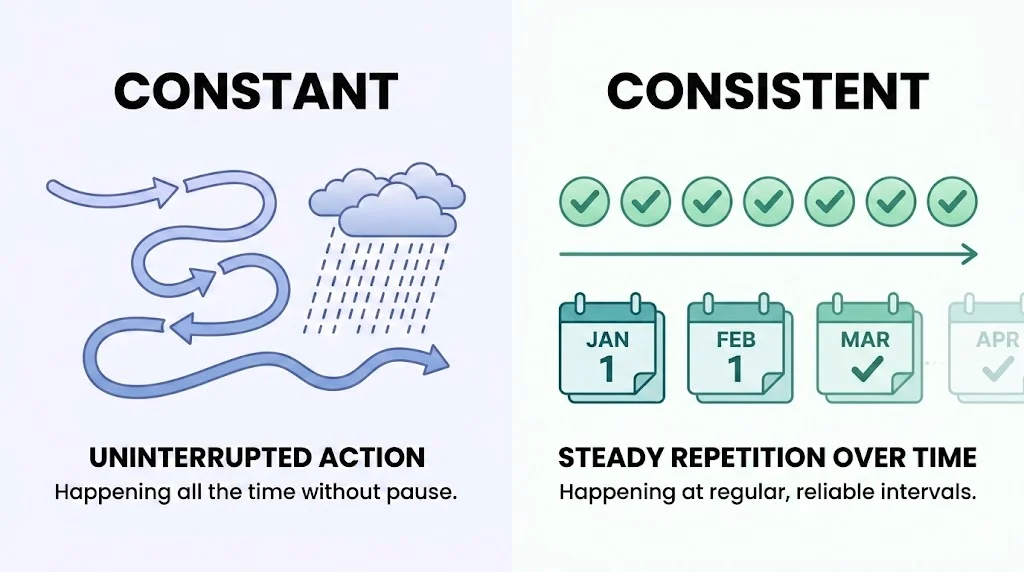
Constant means continuous, unchanging, or happening all the time without stopping. Consistent means regular, steady, or always behaving in the same way over time. Use constant for something that does not stop or change. Use consistent for something that shows reliability, stability, or repeated similar behavior.
Many people confuse constant vs consistent because both words relate to regularity and repetition. At first glance, they seem almost interchangeable. Both describe something that continues over time. Both can describe behavior, effort, noise, problems, or habits. However, their meanings are not the same.
Understanding the difference between constant and consistent is important for clear communication. Using the wrong word can change the meaning of your sentence and make your writing unclear. This confusion appears often in academic writing, business communication, motivational content, and everyday conversation.
In this complete guide, you will learn the exact difference between constant and consistent. We will explore definitions, grammar rules, practical examples, real-world usage, common mistakes, comparison charts, memory tricks, exercises with answers, and frequently asked questions. By the end, you will confidently know when to use constant and when to use consistent in any situation.
Quick Answer
Constant means continuous, unchanging, or happening without interruption.
Consistent means steady, reliable, or always acting in the same way.
Simple Examples
- There is constant noise outside.
- She is consistent with her daily exercise routine.
Quick Difference
Constant focuses on nonstop or continuous presence.
Consistent focuses on stable pattern or reliability over time.
Definitions Explained Clearly
What Does Constant Mean
The word constant refers to something that continues without stopping or remains unchanged.
It can describe:
- Continuous action
- Ongoing problems
- Unchanging values
- Nonstop noise
- Permanent conditions
Examples of Constant
- The baby was crying with constant noise.
- He faced constant pressure at work.
- The temperature remained constant throughout the experiment.
- She gave constant support during difficult times.
In all these examples, the idea is that something does not stop or does not change.
What Does Consistent Mean
The word consistent refers to something that behaves in the same way over time. It shows reliability and steady repetition.
It can describe:
- Regular habits
- Stable performance
- Reliable behavior
- Uniform quality
- Repeated effort
Examples of Consistent
- She is consistent with her workout routine.
- His performance has been consistent this year.
- The product quality remains consistent.
- She gives consistent effort in every project.
In these examples, the focus is on reliability and steady behavior rather than nonstop action.
Grammar and Word Form
Both words are adjectives.
Constant
Base noun: constancy
Adverb: constantly
Examples:
- The machine runs constantly.
- His constant complaints annoyed everyone.
Consistent
Base noun: consistency
Adverb: consistently
Examples:
- She works consistently every day.
- The team performed consistently well.
Understanding related word forms helps avoid mistakes in sentence structure.
Deep Comparison: Constant vs Consistent
Here is a clearer comparison.
Duration vs Pattern
Constant refers to something happening continuously without interruption.
Consistent refers to something happening regularly in the same way, even if there are breaks.
Example Comparison
Constant rain means it never stops raining.
Consistent rain means it rains regularly over a period, but not nonstop.
Constant effort means working nonstop.
Consistent effort means working regularly with discipline over time.
Real World Usage Examples
In Education
Constant studying means studying all the time without breaks.
Consistent studying means studying regularly every day or week.
In Fitness
Constant exercise means working out without stopping.
Consistent exercise means maintaining a steady routine over time.
In Business
Constant communication means nonstop messaging.
Consistent communication means reliable and regular updates.
In Relationships
Constant attention means continuous focus without breaks.
Consistent attention means dependable and steady care over time.
Why People Confuse Constant vs Consistent
Several reasons explain the confusion.
Similar Meaning
Both words relate to regularity, repetition, and time.
Similar Structure
Both begin with the same letters and have similar spelling.
Overlapping Context
Both can describe effort, noise, problems, and habits.
Informal Speech
In casual conversation, people sometimes use them interchangeably even though they are not exact synonyms.
Common Mistakes and Corrections
Wrong: She gives constant effort every day.
If she takes breaks but works daily, it should be:
Correct: She gives consistent effort every day.
Wrong: The alarm makes consistent noise.
If the noise never stops, it should be:
Correct: The alarm makes constant noise.
Wrong: His consistent headaches are painful.
If the headaches never stop, it should be:
Correct: His constant headaches are painful.
Wrong: She is constant with her routine.
Better wording:
Correct: She is consistent with her routine.
When to Use Constant
Use constant when describing:
- Something that never stops
- Something unchanging
- Continuous pressure
- Ongoing problems
- Permanent conditions
Examples:
- Constant criticism can hurt confidence.
- There was constant traffic noise.
- The pain was constant throughout the night.
- He faced constant challenges.
When to Use Consistent
Use consistent when describing:
- Regular habits
- Reliable performance
- Predictable behavior
- Stable results
- Uniform quality
Examples:
- She delivers consistent results.
- His behavior is consistent with his values.
- The brand maintains consistent quality.
- She is consistent in her efforts.
Memory Trick to Remember the Difference
Think of this simple trick:
Constant = Continuous
Consistent = Steady pattern
Another trick:
If it never stops, use constant.
If it repeats reliably over time, use consistent.
Advanced Context Examples
Academic Writing
- The experiment required constant monitoring.
- The results were consistent across all trials.
Medical Context
- He suffers from constant back pain.
- The symptoms are consistent with the diagnosis.
Workplace Context
- There is constant pressure in this role.
- She provides consistent leadership.
Sports Context
- The team faced constant attacks.
- The player showed consistent improvement.
Psychological and Emotional Context
Constant anxiety means feeling anxious nonstop.
Consistent anxiety means feeling anxious repeatedly over time, even if not nonstop.
Constant support means someone is always present.
Consistent support means someone reliably supports you over time.
Business and Productivity Perspective
Constant hustle can cause burnout.
Consistent effort builds long-term success.
Constant monitoring can feel stressful.
Consistent evaluation improves performance steadily.
Practice Exercises
Fill in the Blanks
- The machine makes ______ noise all day.
Answer: constant - She is ______ with her morning routine.
Answer: consistent - He faces ______ criticism at work.
Answer: constant - Her performance remains ______ every month.
Answer: consistent - The pain was ______ and unbearable.
Answer: constant - He shows ______ dedication to his goals.
Answer: consistent
Choose the Correct Word
- She makes (constant / consistent) progress each year.
Answer: consistent - The baby cried with (constant / consistent) noise.
Answer: constant - He provides (constant / consistent) updates every week.
Answer: consistent - There was (constant / consistent) rain all night.
Answer: constant
FAQs
What is the main difference between constant and consistent?
Constant means continuous and unchanging, while consistent means steady and reliable over time.
Can constant and consistent be used interchangeably?
No, they have related but different meanings and are not exact synonyms.
Is constant stronger than consistent?
Yes, constant usually suggests nonstop action, while consistent suggests repeated steady behavior.
What does consistent effort mean?
It means putting in steady and reliable effort over time.
What does constant pain mean?
It means pain that does not stop or go away.
Can someone be both constant and consistent?
Yes, but in different contexts. A person may give consistent support and show constant dedication in urgent situations.
Why do people confuse constant and consistent?
Because both describe repetition and regularity, and they look and sound similar.
Conclusion
Understanding the difference between constant vs consistent improves clarity in writing and speech. Constant describes something continuous, nonstop, or unchanging. Consistent describes something steady, reliable, and repeated in the same way over time.
Choosing the correct word depends on whether you want to emphasize nonstop presence or steady reliability. With practice and awareness, this confusion becomes easy to avoid. Clear language creates stronger communication in academic, professional, and personal settings.