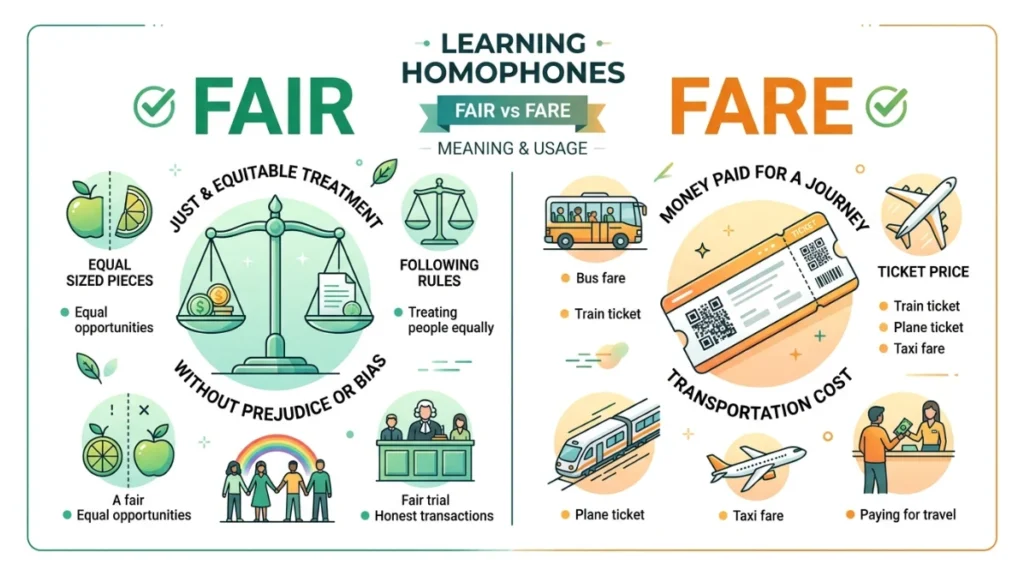

Fair and fare are different words with different meanings. Fair usually means just, reasonable, or light colored. Fare usually means price, food, or travel cost.
I used to confuse fair and fare when writing quickly because both words sound exactly the same. One day while writing an email, I accidentally wrote “bus fair” instead of “bus fare.” That small mistake made me realize how easy it is to mix these words up.
After learning their meanings and practicing simple memory tricks, the confusion disappeared. If you also struggle with fair or fare, this guide explains the differences clearly with examples, grammar rules, common mistakes, and easy ways to remember the correct word.
Fair or Fare Quick Answer
Fair usually means:
Just or equal
Reasonable
Light colored
An event or festival
Fare usually means:
Travel cost
Food
How something performs
Quick Examples
Correct:
The teacher was fair.
The bus fare increased.
Incorrect:
The teacher was fare.
The bus fair increased.
Fair or Fare Difference
| Feature | Fair | Fare |
|---|---|---|
| Meaning | Just, equal, reasonable | Cost, food, travel |
| Part of Speech | Noun, adjective | Noun, verb |
| Travel Related | Sometimes | Yes |
| Used for Prices | No | Yes |
| Used for Equality | Yes | No |
Key Rule
Use fair for equality or justice.
Use fare for cost, travel, or food.
Fair Meaning Explained
Fair has multiple meanings.
Meaning 1: Just or Equal
Example:
The teacher gave everyone a fair chance.
Meaning 2: Reasonable
Example:
That price seems fair.
Meaning 3: Light Colored
Example:
She has fair skin.
Meaning 4: Large Public Event
Example:
We visited the local fair.
Fare Meaning Explained
Fare also has multiple meanings.
Meaning 1: Travel Cost
Example:
The train fare increased.
Meaning 2: Food
Example:
The restaurant serves traditional fare.
Meaning 3: Performance or Progress
Example:
How did you fare during the exam?
How to Pronounce Fair and Fare
Pronunciation:
Fair
/fer/
Fare
/fer/
Both words sound identical.
Because pronunciation is identical, confusion happens frequently.
These words are called homophones.
Why People Confuse Fair and Fare
Several reasons create confusion.
Same Pronunciation
Both words sound exactly alike.
Similar Spelling
Only one letter changes.
Multiple Meanings
Each word has several meanings.
Fast Typing
Writers often choose the wrong spelling while typing quickly.
Grammar Rule Depth
Understanding grammar helps reduce mistakes.
Fair as an Adjective
Example:
The decision was fair.
Fair as a Noun
Example:
We visited the fair.
Fare as a Noun
Example:
The taxi fare was expensive.
Fare as a Verb
Example:
How did you fare yesterday?
The Origin of Fair
Fair comes from Old English.
Earlier meanings included:
beautiful
pleasant
just
equal
Over time, the word expanded into multiple meanings.
The Origin of Fare
Fare also comes from Old English.
Its earlier meaning related to:
traveling
moving
journeying
Over centuries, it developed meanings related to:
travel cost
food
performance
Is Fair Ever Used for Travel Costs
No.
Travel prices use fare, not fair.
Correct:
Air fare
Bus fare
Taxi fare
Incorrect:
Air fair
Bus fair
Taxi fair
Is Fare Ever Used for Equality
No.
Equality and justice use fair.
Correct:
Fair treatment
Fair rules
Fair decision
Incorrect:
Fare treatment
Fare rules
Fare decision
Real World Usage of Fair
Fair in Everyday Conversation
That seems fair.
Life is not always fair.
Fair in Business Writing
The company offers fair pricing.
Fair in Schools
Teachers should be fair.
Fair in News Writing
Citizens demanded fair elections.
Real World Usage of Fare
Fare in Transportation
The bus fare increased.
Fare in Travel
Air fare prices changed.
Fare in Restaurants
The restaurant offers local fare.
Fare as Performance
How did you fare during interviews?
Fair in Emails
Examples:
We believe this is a fair solution.
The pricing appears fair.
We want fair treatment for everyone.
Fare in Emails
Examples:
The travel fare increased.
Please submit your transportation fare receipts.
How did you fare during training?
Common Phrases Using Fair
Fair play
Fair enough
Fair chance
Fair treatment
Fair warning
Examples
That is fair enough.
Everyone deserves a fair chance.
Common Phrases Using Fare
Air fare
Bus fare
Taxi fare
Fare well
Standard fare
Examples
The air fare increased again.
This food is traditional fare.
Common Mistakes With Fair or Fare
Mistake 1 Writing Bus Fair
Incorrect:
The bus fair increased.
Correct:
The bus fare increased.
Mistake 2 Writing Fair Treatment Incorrectly
Incorrect:
Employees deserve fare treatment.
Correct:
Employees deserve fair treatment.
Mistake 3 Using Fare for Equality
Incorrect:
This is not fare.
Correct:
This is not fair.
Words Similar to Fair and Fare
These homophones also create confusion.
| Correct Word | Common Confusion |
|---|---|
| Fair | Fare |
| Their | There |
| To | Too |
| Your | You’re |
| Hear | Here |
Learning similar words improves accuracy.
How Common Is the Fair or Fare Confusion
Fair and fare confusion is common because:
they sound identical
they appear frequently
both have multiple meanings
typing errors happen quickly
This mistake appears often in emails, social media, and school writing.
Usage Trends and Popularity
Fair appears frequently in:
business writing
education
news
everyday speech
Fare appears frequently in:
travel
transportation
restaurants
tourism
Memory Tricks to Remember Fair and Fare
Trick 1
Fare contains car
Think:
fare → transportation
Trick 2
Fair contains:
air
Think:
fairness feels light and open.
Trick 3
Remember:
Travel = Fare
Equality = Fair
Trick 4
Create a phrase:
Fair people pay fare prices.
Fair or Fare Summary
Fair:
justice
equal
reasonable
events
Fare:
cost
travel
food
performance
Exercise 1 Choose the Correct Word
The taxi ______ was expensive.
Answer:
fare
The teacher was very ______.
Answer:
fair
How did you ______ during exams?
Answer:
fare
Exercise 2 Correct the Sentence
The bus fair increased.
Answer:
The bus fare increased.
Everyone deserves fare treatment.
Answer:
Everyone deserves fair treatment.
This restaurant serves excellent fair.
Answer:
This restaurant serves excellent fare.
FAQs
What is the difference between fair and fare?
Fair usually means equal, reasonable, or just. Fare usually means travel cost, food, or performance.
Is bus fair or bus fare correct?
Bus fare is correct because fare refers to transportation cost.
What does fair mean?
Fair usually means equal, reasonable, or impartial.
What does fare mean?
Fare usually means travel cost, food, or how someone performs.
Are fair and fare homophones?
Yes. They sound the same but have different meanings.
How can I remember fair vs fare?
Remember: Travel uses fare. Equality uses fair.
Is airfare or airfair correct?
Airfare is correct because it refers to travel cost.
Conclusion
Understanding fair or fare becomes easier once you learn their meanings and contexts. Fair relates to equality, justice, reasonableness, or public events, while fare relates to travel costs, food, or performance. Since both words sound identical, confusion happens naturally, especially during fast typing or casual writing.
The easiest way to remember the difference is simple. If the sentence involves transportation, cost, or food, use fare. If the sentence involves equality, honesty, or reasonableness, use fair.
Practicing these words with examples and memory tricks makes choosing the correct spelling much easier and improves writing accuracy over time.