
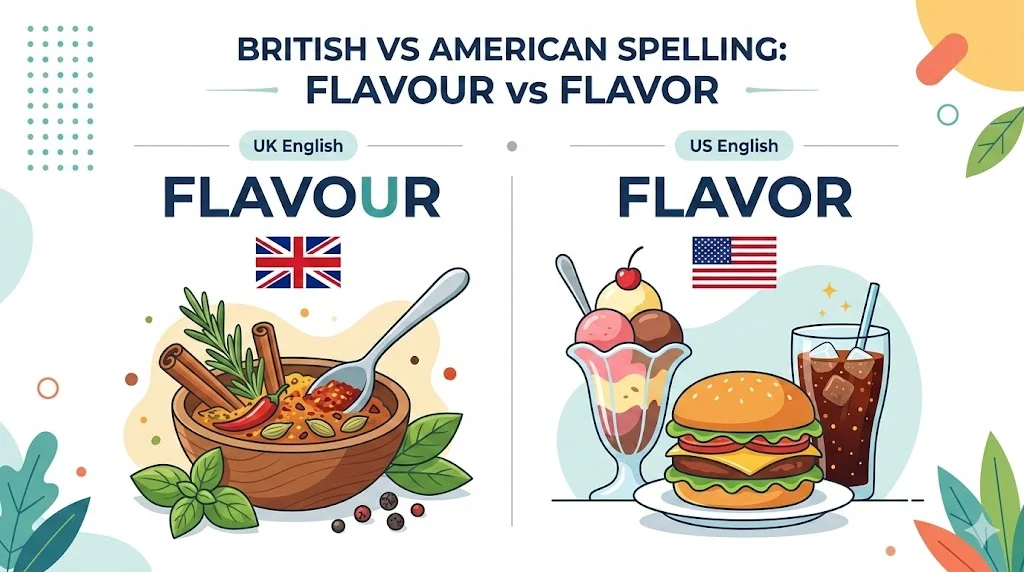
Flavour is the British English spelling. Flavor is the American English spelling. Both words mean the same thing. The difference depends on whether you follow UK or US spelling conventions.
Many people feel confused when writing flavour or flavor. The words look different, but they sound the same and mean exactly the same thing. The only difference is spelling. This confusion often happens in emails, blogs, product descriptions, academic writing, and social media posts.
People search for “flavour or flavor” because they want to know which spelling is correct. The answer depends on the version of English they are using. British English prefers flavour, while American English uses flavor. Choosing the wrong spelling for your audience can make your writing look inconsistent or unprofessional.
This guide explains everything clearly. You will learn the spelling difference, history behind the change, grammar rules, global usage patterns, common mistakes, real world examples, related spelling pairs, exercises with answers, and practical advice. By the end, you will confidently know when to use flavour and when to use flavor.
Quick Answer
Both spellings are correct.
- Flavour is used in British English.
- Flavor is used in American English.
They have the same meaning. They refer to the taste of food or drink, or the special quality of something.
Simple Examples
- The soup has a rich flavour.
- The ice cream has a strong flavor.
The meaning does not change. Only the spelling changes.
What Does Flavour or Flavor Mean
The word refers to taste. It describes how food or drink feels on the tongue. It can also describe a special quality, style, or atmosphere.
Meaning in Food
- The curry has a spicy flavour.
- The coffee has a bitter flavor.
Meaning in Style or Character
- The festival has a traditional flavour.
- The movie has a romantic flavor.
So whether you write flavour or flavor, the meaning remains the same.
Grammar Rules and Spelling Difference
The difference between flavour and flavor is part of a larger spelling pattern.
British English keeps the letter u in many words that end in our.
American English removes the u and uses or instead.
British English Pattern
- Flavour
- Colour
- Honour
- Favourite
- Behaviour
American English Pattern
- Flavor
- Color
- Honor
- Favorite
- Behavior
This pattern applies to many words.
The History Behind Flavour and Flavor
The spelling difference comes from history.
The word originally came from Old French. In French, it included the letter u. British English kept this traditional spelling.
In the early 1800s, American dictionary writer Noah Webster wanted to simplify English spelling in the United States. He removed silent letters to make spelling easier. That is why American English dropped the u in words like colour and flavour.
So:
- British English kept the original form flavour.
- American English simplified it to flavor.
Both spellings are historically correct within their systems.
Why People Get Confused
There are several reasons for confusion.
Global Internet Influence
Online content mixes American and British English. A website may use both forms by mistake.
Spell Check Settings
If your device uses US English, it marks flavour as wrong. If it uses UK English, it marks flavor as wrong.
Mixed Education Systems
Some countries teach British English but consume American media. This creates spelling confusion.
Copy and Paste Writing
Writers sometimes copy content from different sources, causing inconsistency.
British English vs American English Usage
The difference is only regional preference.
Countries That Use Flavour
- United Kingdom
- Australia
- New Zealand
- India
- Pakistan
- South Africa
Countries That Use Flavor
- United States
Canada sometimes uses both, depending on context.
Example Sentences
UK: The ice cream has a unique flavour.
US: The ice cream has a unique flavor.
UK: This dish adds a Mediterranean flavour.
US: This dish adds a Mediterranean flavor.
The meaning remains identical.
Which Spelling Should You Use
Choose based on your audience.
If your readers are mainly from the United States, use flavor.
If your readers are from the UK or Commonwealth countries, use flavour.
The most important rule is consistency. Do not mix both spellings in the same document.
Flavour or Flavor in Everyday Writing
In Emails
UK: I loved the flavour of your cake.
US: I loved the flavor of your cake.
In Food Blogs
UK: This recipe brings out the natural flavour of tomatoes.
US: This recipe enhances the natural flavor of tomatoes.
In Product Descriptions
UK: Available in vanilla flavour.
US: Available in vanilla flavor.
In Academic Writing
UK: Researchers studied flavour perception.
US: Researchers studied flavor perception.
Common Mistakes With Flavour or Flavor
Mixing Both Spellings
Incorrect: The flavor of this flavour drink is unique.
Correct: Use one system consistently.
Wrong Regional Use
Using flavor in a UK academic journal may look incorrect.
Using flavour in a US company document may look inconsistent.
Incorrect Derivatives
British forms:
- Flavoured
- Flavouring
American forms:
- Flavored
- Flavoring
Do not mix these forms.
Related Spelling Pairs
The flavour or flavor difference follows the same pattern as many other words.
British vs American Examples:
- Colour vs Color
- Honour vs Honor
- Favourite vs Favorite
- Behaviour vs Behavior
- Neighbour vs Neighbor
- Labour vs Labor
- Humour vs Humor
Learning this pattern helps avoid mistakes.
Flavour or Flavor in Media and Branding
Large global brands adjust spelling based on region.
A UK advertisement will say “new strawberry flavour.”
A US advertisement will say “new strawberry flavor.”
Food packaging changes spelling depending on the market.
Academic and Scientific Context
In science, especially food science and chemistry, the spelling depends on publication location.
British journals use flavour compounds.
American journals use flavor compounds.
The technical meaning remains identical.
Google Trends and Global Usage Patterns
Search interest shows a clear regional divide.
- The United States mostly searches for flavor.
- The United Kingdom and Australia search for flavour.
Both keywords have high global search volume because food and taste are universal topics.
Flavour or Flavor in Formal Writing
In formal documents, consistency is essential.
Choose one spelling style and follow it throughout.
Switching between flavour and flavor in professional documents reduces credibility.
Practice Exercises
Fill in the Blanks
- This soup has a strong ______.
Answer UK: flavour
Answer US: flavor - I like the chocolate ______ of this cake.
Answer UK: flavour
Answer US: flavor - The recipe improves the natural ______ of vegetables.
Answer UK: flavour
Answer US: flavor
Choose the Correct Option
- The dish has a unique (flavour / flavor).
Answer depends on region - The company introduced a new mango (flavour / flavor).
Answer depends on region - Scientists study taste and (flavour / flavor) perception.
Answer depends on region
FAQs
Is flavour or flavor correct?
Both are correct. Flavour is British English. Flavor is American English.
Why does American English remove the letter u?
American English simplified spelling in the 1800s to make writing easier.
Can I use flavour in the United States?
It is understandable, but flavor is preferred in American writing.
Is there a difference in meaning?
No, the meaning is exactly the same.
Which spelling is more popular globally?
Flavor is more common worldwide due to American media influence.
Do derivatives follow the same rule?
Yes. British uses flavoured and flavouring. American uses flavored and flavoring.
Should I mix both spellings in one article?
No. Always stay consistent with one system.
Conclusion
The difference between flavour and flavor is purely regional. British English keeps the traditional spelling with the letter u, while American English removes it. The meaning stays the same in both cases. The word refers to taste or a distinctive quality.
The key to correct usage is knowing your audience and maintaining consistency. If writing for American readers, use flavor. If writing for British or Commonwealth readers, use flavour. Avoid mixing both forms in the same document.
Understanding this spelling pattern also helps with similar words like colour or color, honour or honor, and favourite or favorite. Once you recognize the rule, choosing between flavour and flavor becomes simple and automatic.
Clear spelling builds credibility and improves writing quality in emails, blogs, product descriptions, and academic papers.