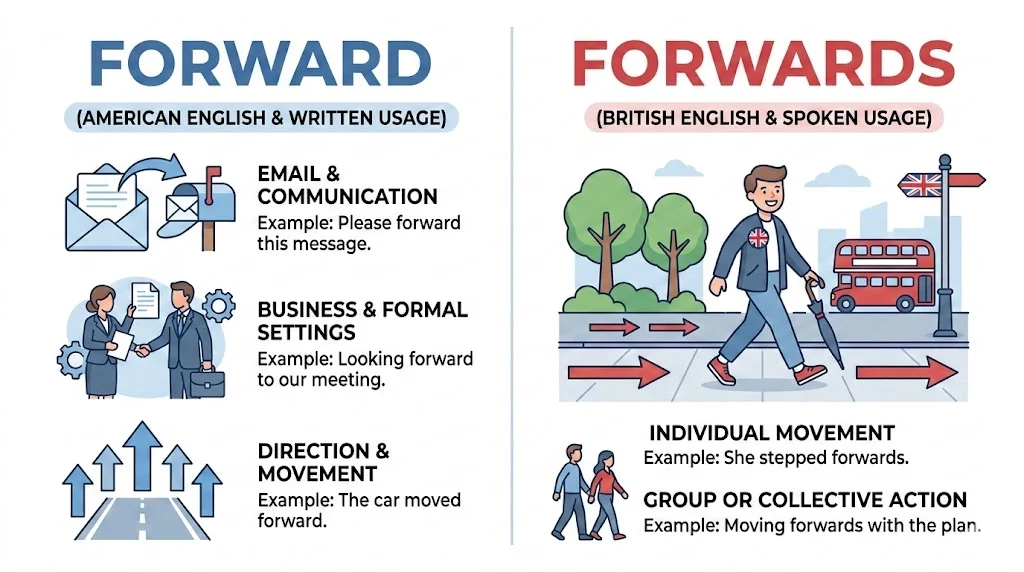
Forward and forwards both mean moving toward the front. The key difference is usage by region and context. In American English, forward is standard in almost all cases. In British English, forwards is often used as an adverb. In modern writing, forward is more widely accepted globally.
Many writers pause when typing and wonder whether to use forward or forwards. The words look almost identical. They sound similar. Both relate to movement toward the front. So why are there two versions?
The confusion comes from regional usage and grammar structure. In some cases, both words are correct. In other cases, only one is acceptable. This creates uncertainty for students, bloggers, professionals, and even native speakers.
People search for “forward vs forwards” because they want clarity. Using the wrong form can make writing inconsistent or regionally awkward. It may not always be grammatically incorrect, but it can signal the wrong dialect.
This guide explains the full difference between forward and forwards, including grammar depth, regional variations, real-world usage, common mistakes, advanced examples, and practice exercises. By the end, you will know exactly which form to use in every situation.
Quick Answer
Both words relate to movement toward the front.
Forward is more common in American English and formal writing.
Forwards is mainly used in British English as an adverb.
Simple Examples
- She stepped forward.
- She stepped forwards.
Both are correct in British English. In American English, forward is preferred.
Grammar Rules Explained in Depth
Understanding parts of speech makes this difference clear.
Forward as an Adverb
An adverb describes movement or direction.
Examples:
- Move forward.
- Step forward slowly.
- The car rolled forward.
In American English, forward is almost always used.
In British English, both forward and forwards are acceptable as adverbs.
Forwards as an Adverb
Forwards is also an adverb meaning toward the front.
Examples:
- He walked forwards.
- She leaned forwards to listen.
This usage is common in British English but rare in American English.
Forward as an Adjective
Forward can describe a noun.
Examples:
- The forward movement continued.
- He made a forward pass in football.
Forwards is not used as an adjective.
Forward as a Verb
Forward can also be a verb meaning to send something onward.
Examples:
- Please forward the email.
- She forwarded the message to her manager.
Forwards is never used as a verb.
Forward as a Noun
In sports, especially soccer and hockey, a forward is an attacking player.
Examples:
- The forward scored two goals.
- He plays as a forward.
Forwards can be used as a plural noun in British English sports contexts, but forward is more standard internationally.
Why People Confuse Forward vs Forwards
Regional Differences
The main reason is the difference between British and American English.
American English prefers forward.
British English often uses forwards in casual speech.
Similar Meaning
Both words express direction toward the front, making the difference subtle.
Lack of Clear Rules in School
Many learners are not taught regional distinctions in detail.
Influence of Media
Movies, news, and online content mix both versions depending on origin.
British English vs American English Usage
This is where the distinction matters most.
American English
American English strongly prefers forward in almost all contexts.
Examples:
- Move forward.
- Look forward to meeting you.
- Please forward the document.
Using forwards in American writing may sound unusual.
British English
British English allows both forms as adverbs.
Examples:
- She stepped forward.
- She stepped forwards.
However, in formal writing, even British English often prefers forward.
Comparison Table
| Usage Type | Forward | Forwards |
|---|---|---|
| Adverb | Yes | Yes in UK |
| Adjective | Yes | No |
| Verb | Yes | No |
| Noun | Yes | Rare plural use |
| American English | Preferred | Rare |
| British English | Common | Common in speech |
Which One Should You Use
If your audience is American or international, use forward.
If writing for British readers, both may be acceptable in casual writing, but forward is still safer in formal contexts.
When unsure, choose forward. It is more universally accepted.
Forward vs Forwards in Real World Usage
In Emails
- Please forward this message.
- I look forward to your reply.
Forwards would be incorrect in these examples.
In Business Writing
- The company plans to move forward.
- We look forward to future collaboration.
Forward is standard in professional communication.
In News
- The government moved forward with reforms.
- The player passed the ball forward.
American news uses forward almost exclusively.
In British Conversation
- He leaned forwards.
- She moved forwards carefully.
Both are acceptable in UK speech.
Common Mistakes and Corrections
Wrong: Please forwards this email.
Correct: Please forward this email.
Wrong: The forward movement was strongs.
Correct: The forward movement was strong.
Wrong in American English: She stepped forwards.
Correct: She stepped forward.
Advanced Usage Notes
Look Forward To
Always use forward.
- I look forward to hearing from you.
Never use forwards in this phrase.
Move Forward
Standard phrase globally.
- We need to move forward.
Forwards is rarely used here.
Sports Context
In soccer, a forward is an attacking player.
Plural forms:
- The forwards played well.
- The forward scored.
British sports commentary may use forwards as plural noun.
Related Word Confusions
- Backward vs backwards
- Toward vs towards
- Afterward vs afterwards
These follow similar regional patterns.
American English prefers:
- Backward
- Toward
- Afterward
British English often uses:
- Backwards
- Towards
- Afterwards
Practice Exercises
Fill in the Blanks
- Please ______ this email to the team.
Answer: forward - She stepped ______ carefully.
Answer: forward - He leaned ______ to hear better.
Answer: forwards - I look ______ to meeting you.
Answer: forward
Choose the Correct Word
- Move (forward / forwards).
Answer: forward - She walked (forward / forwards).
Answer: forward or forwards in UK - Please (forward / forwards) the document.
Answer: forward - The (forward / forwards) scored a goal.
Answer: forward
FAQs
What is the difference between forward and forwards?
Forward is preferred in American English and formal writing. Forwards is mainly used as an adverb in British English.
Is forwards incorrect?
No, it is correct in British English as an adverb.
Can forwards be used as a verb?
No, only forward can function as a verb.
Which is more formal, forward or forwards?
Forward is more formal and more widely accepted globally.
Should I use forward in emails?
Yes, always use forward in professional emails.
Do Americans use forwards?
Rarely. American English strongly prefers forward.
Is look forwards to correct?
No. The correct phrase is look forward to.
Conclusion
The difference between forward and forwards mainly depends on region and grammar function. Forward is more versatile. It works as a noun, verb, adjective, and adverb. Forwards works mainly as an adverb in British English.
If you write for a global or American audience, always choose forward. It is the safer and more professional option. In British casual speech, forwards may sound natural, but forward remains widely accepted.
Understanding this distinction improves clarity and consistency. When in doubt, use forward. It is correct in nearly all contexts.