
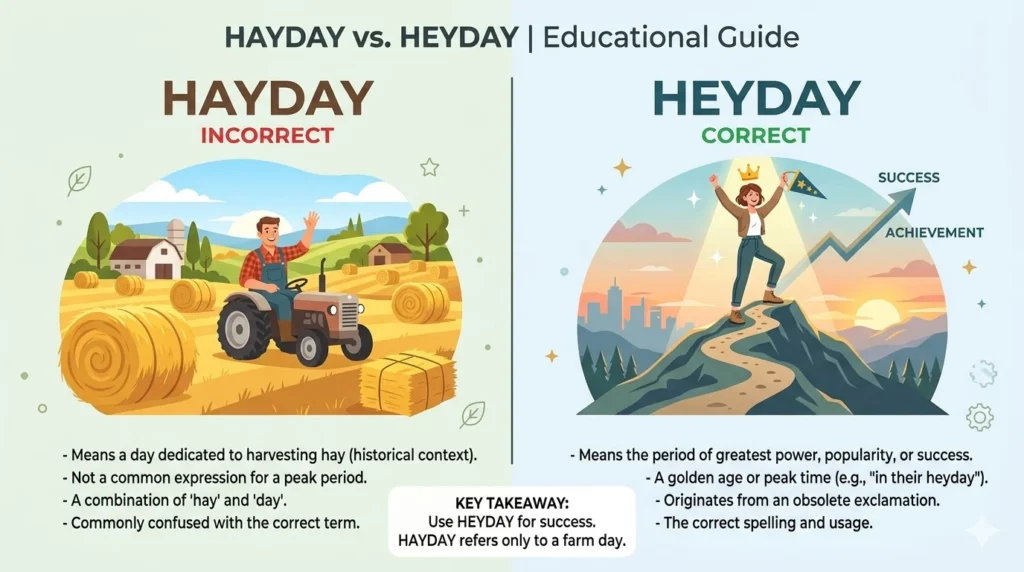
Heyday means the peak or most successful time, while hayday is an incorrect spelling. The correct word is heyday, commonly used to describe someone’s best period or prime.
Many people confuse hayday and heyday because both words sound the same when spoken. This confusion often appears in writing, especially in blogs, social media posts, and informal communication. People usually search this keyword to find out which spelling is correct and how to use it properly in sentences.
The correct word is heyday, which means the peak or most successful period of something. On the other hand, hayday is simply a misspelling and has no proper meaning in English. The mistake happens because the word hay is familiar, while heyday looks unusual to some writers.
Understanding the difference is important for clear and professional writing. In this guide, you will learn the meaning, origin, usage, and common mistakes related to hayday vs heyday, along with simple examples to help you remember the correct form.
Quick Answer
The correct word is heyday.
It means the time when someone or something is most successful, popular, or powerful.
The spelling hayday is incorrect and should not be used in standard English.
Examples
Correct
The singer was in her heyday during the 1990s.
Incorrect
The singer was in her hayday during the 1990s.
Hayday vs Heyday Meaning
Heyday
Heyday means the peak or best period of success, strength, or popularity.
It is often used to describe:
A person’s career peak
A company’s most successful time
A trend or era at its highest point
Hayday
Hayday has no meaning in standard English. It is a spelling mistake caused by confusion.
Hayday vs Heyday Difference
| Word | Meaning | Correct Usage |
|---|---|---|
| Heyday | Peak time or prime | Correct |
| Hayday | No meaning | Incorrect |
Key Point
Always use heyday when talking about a peak or golden period.
The Origin of Heyday
The word heyday comes from an old English exclamation “heyda,” which was used to express excitement, surprise, or joy.
In earlier times, it described a feeling of high energy or enthusiasm. Over time, the meaning evolved to represent a period of peak success or activity.
This shift in meaning explains why heyday is now used to describe someone’s prime or golden years.
Why People Write Hayday Instead of Heyday
Similar Sound
Both words sound the same when spoken, which leads to confusion.
Familiar Word
The word hay is common in English, so people assume it is correct.
Unfamiliar Spelling
The word heyday looks unusual, so writers often replace it with a more familiar spelling.
Grammar Rule Depth
Heyday is a noun.
It is used to describe a period of time, not an action.
Example
That company is no longer in its heyday.
Because it is a fixed word, changing its spelling to hayday makes it incorrect.
Which Spelling Should You Use
You should always use heyday.
Global English
Heyday is the standard spelling in both American and British English.
Professional Writing
In articles, reports, and academic writing, only heyday is acceptable.
Simple Rule
If you are describing a peak period, use heyday.
Common Mistakes with Hayday vs Heyday
Mistake 1 Using Hayday
Incorrect
This brand is in its hayday.
Correct
This brand is in its heyday.
Mistake 2 Misunderstanding Meaning
Some people think heyday refers to happiness only, but it actually means peak success or prime time.
Hayday vs Heyday in Everyday Examples
Emails
Our company was in its heyday during the early 2000s.
News
The team is trying to return to its heyday.
Social Media
That game was in its heyday ten years ago.
Formal Writing
The artist reached his creative heyday in his later years.
Heyday in Real World Contexts
Business
Companies often have a peak period of growth.
Example
The company enjoyed its heyday before market competition increased.
Entertainment
Actors and musicians experience career peaks.
Example
The actor’s heyday was during the 1990s.
Sports
Athletes have peak performance years.
Example
The player was unbeatable in his heyday.
Usage Trends and Language Patterns
Data shows that heyday is widely used across books, news articles, and online content.
The spelling hayday appears mainly in informal writing and is considered incorrect.
Search patterns clearly favor heyday, making it the only reliable choice.
Exercise 1 Choose the Correct Word
Fill in the blank with hayday or heyday.
The company was in its ______ during the early 2000s.
Answer: heyday
The athlete reached his ______ at age 28.
Answer: heyday
This brand is no longer in its ______.
Answer: heyday
Exercise 2 Correct the Sentence
Rewrite the sentence using the correct word.
The singer was in her hayday during the 1990s.
Answer: The singer was in her heyday during the 1990s.
That company is past its hayday now.
Answer: That company is past its heyday now.
FAQs
What is the difference between hayday and heyday?
Heyday means the peak or most successful period, while hayday is an incorrect spelling with no meaning in English.
Is hayday a real word?
No, hayday is not a correct word in standard English. It is a common spelling mistake.
What does heyday mean?
Heyday means the time when someone or something is at their highest level of success, popularity, or performance.
Why do people write hayday?
People confuse it because it sounds like heyday and the word hay is more familiar in English.
Is heyday formal or informal?
Heyday can be used in both formal and informal writing.
Can heyday be used in professional writing?
Yes, heyday is widely used in professional, academic, and journalistic writing.
How can I remember the correct spelling?
Think of heyday as a special word meaning peak time. Avoid linking it to hay, which has no connection to the meaning.
Conclusion
The confusion between hayday and heyday is common, but the correct choice is simple once you understand the meaning. The word heyday refers to the peak or most successful period of a person, company, or activity. It is widely used in both everyday and professional English.
On the other hand, hayday is not a real word in standard English. It appears only as a spelling mistake caused by pronunciation similarity and familiarity with the word hay. Using this incorrect form can reduce the quality and professionalism of your writing.
To write clearly and correctly, always choose heyday when describing a period of success or prime performance. Remembering this simple rule will help you avoid mistakes and improve your communication.