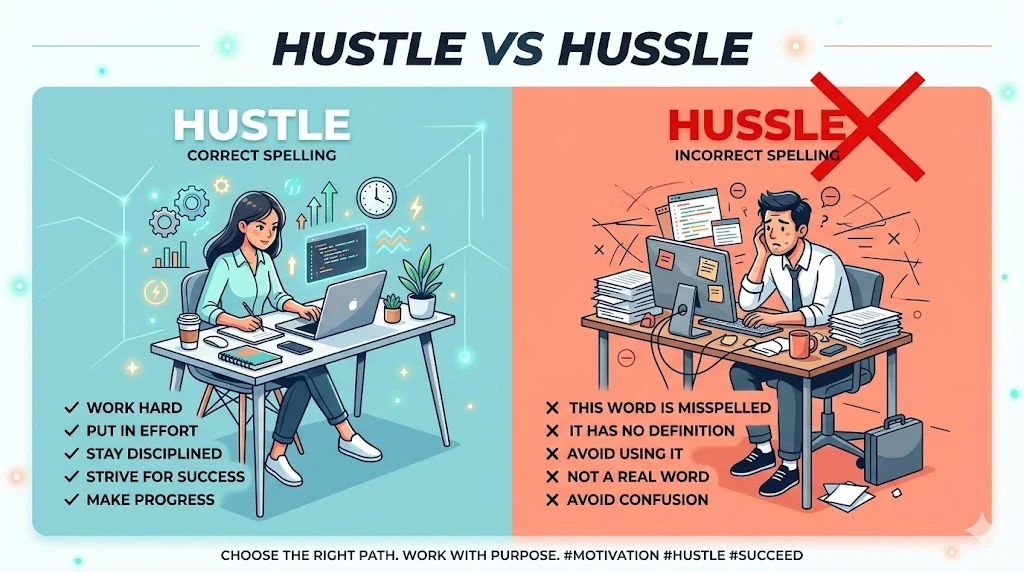
Hustle is the correct spelling and means to work hard or move quickly. Hussle is incorrect in standard English and should not be used in formal writing or communication.
I once used hussle in a social media post, thinking it was just a casual spelling of hustle. Later, I noticed it looked unprofessional and even incorrect in certain contexts. That pushed me to check dictionaries and real usage examples.
I learned that hustle is the only correct spelling, while hussle is a common mistake people make due to pronunciation or informal typing habits. After correcting this in my own writing, my content looked more polished and credible.
If you’ve made the same mistake, this guide will help you clearly understand hustle vs hussle and use the correct form with confidence.
Quick Answer
Hustle is the correct word. It means to work hard, move quickly, or push with energy.
Hussle is incorrect and not accepted in standard English.
Examples
- She works hard and knows how to hustle.
- He built his business through pure hustle.
- Incorrect: She believes in hussle.
Hustle vs Hussle Meaning
Hustle
Hustle has several meanings depending on context.
- To work hard with energy and determination
- To move quickly or push forward
- To promote or sell something actively
Examples
- Entrepreneurs must hustle to succeed.
- He hustled to catch the bus.
- She hustled her products online.
Hussle
Hussle is not a correct English word. It appears mainly due to spelling mistakes or informal usage.
Hustle vs Hussle Difference
| Word | Meaning | Correct Usage | Example |
|---|---|---|---|
| Hustle | Work hard or move fast | Yes | Keep hustling every day |
| Hussle | Misspelling | No | Incorrect usage |
Key Point: Always use hustle in writing.
Grammar Rule Depth
Hustle as a Verb
Hustle can act as a verb.
Examples
- She hustles every day to grow her business.
- He hustled to finish the project on time.
Hustle as a Noun
Hustle can also be used as a noun.
Examples
- Success requires hustle.
- His hustle paid off.
Verb Forms
| Form | Word |
|---|---|
| Base | hustle |
| Past | hustled |
| Past participle | hustled |
| Present participle | hustling |
The Origin of Hustle
The word hustle comes from Dutch origins, meaning to shake or push. Over time, it evolved in English to describe energetic movement or effort.
Later, especially in American culture, hustle gained a stronger meaning related to hard work, ambition, and determination. Today, it is widely used in business, entrepreneurship, and motivational content.
Why People Write Hussle Instead of Hustle
1. Pronunciation Confusion
The sound of hustle makes people think it is spelled with double “s”.
2. Fast Typing
People often type quickly and make spelling errors.
3. Social Media Influence
Informal writing sometimes spreads incorrect spellings.
4. Lack of Awareness
Many users simply do not know that hussle is incorrect.
Real World Usage of Hustle
Business
- Entrepreneurs must hustle to grow their startups.
- He hustled day and night to build his company.
Career
- She hustled her way to the top position.
- Success comes from consistent hustle.
Daily Life
- I had to hustle to catch my train.
- They hustled through the crowd.
Hustle in Different Contexts
Positive Meaning
Hustle often means hard work and determination.
Example
She built her career through pure hustle.
Neutral Meaning
It can mean moving quickly.
Example
He hustled across the street.
Negative Meaning
Sometimes hustle can mean forcing or pushing.
Example
The crowd was hustled out of the building.
Hustle in Everyday Examples
Emails
We need to hustle to meet the deadline.
News
The team hustled hard to win the match.
Social Media
Keep hustling and stay focused.
Formal Writing
The company’s growth reflects consistent hustle and effort.
Hustle in Modern Culture
The word hustle has become very popular in modern culture, especially in business and motivation.
Entrepreneurship
Hustle means working smart and hard to achieve success.
Social Media
Influencers often promote “hustle culture” as a way to achieve goals.
Motivation
Quotes often include hustle as a key to success.
Example
Hustle until your goals become reality.
Hustle Culture Explained
Hustle culture promotes the idea of working constantly to achieve success.
Advantages
- Encourages hard work
- Builds discipline
- Helps achieve goals
Disadvantages
- Can lead to burnout
- May reduce work life balance
- Encourages overworking
Understanding hustle in this context helps use the word correctly.
Common Mistakes with Hustle vs Hussle
Mistake 1 Using Hussle
Incorrect
Success comes from hussle.
Correct
Success comes from hustle.
Mistake 2 Wrong Verb Form
Incorrect
She hustle every day.
Correct
She hustles every day.
Mistake 3 Overusing the Word
Using hustle too much can reduce clarity.
Better
Use it where it fits naturally.
Related Words and Expressions
Similar Words
- grind
- work hard
- push forward
- strive
Related Expressions
- side hustle
- hustle culture
- daily hustle
Example
He started a side hustle to earn extra income.
Usage Trends
The word hustle is widely used across the world, especially in
Business
Entrepreneurship
Social media
Motivational content
The incorrect spelling hussle appears mainly in informal or mistaken usage and is not accepted in professional writing.
Exercise 1 Choose the Correct Word
Fill in the blanks with hustle or hussle.
She believes in hard ______.
Answer: hustle
He had to ______ to finish on time.
Answer: hustle
They built their success through ______.
Answer: hustle
Exercise 2 Correct the Sentence
Rewrite the sentence correctly.
Success comes from hussle.
Answer: Success comes from hustle.
She hussles every day to grow her business.
Answer: She hustles every day to grow her business.
FAQs
What is the difference between hustle and hussle?
Hustle is the correct word meaning to work hard or move quickly. Hussle is a spelling mistake and not accepted in standard English.
Is hussle a real word?
No, hussle is not a correct English word. It is a common misspelling of hustle.
What does hustle mean?
Hustle means to work hard, move quickly, or act with energy and determination.
Why do people write hussle?
People write hussle due to pronunciation confusion, typing errors, and informal writing habits.
Can hustle be used as a noun?
Yes, hustle can be used as both a noun and a verb.
Is hustle used in professional writing?
Yes, hustle is commonly used in business, motivation, and professional contexts.
What is hustle culture?
Hustle culture refers to working constantly and pushing hard to achieve success.
Conclusion
Understanding hustle vs hussle is simple once you know the correct spelling. Hustle is the only correct word, and it carries powerful meanings related to hard work, energy, and determination. On the other hand, hussle is a common mistake that should be avoided in all types of writing, especially professional and formal communication.
The popularity of hustle in modern culture has made it an important word in business, entrepreneurship, and motivation. However, using the correct spelling is essential for maintaining credibility and clarity. By learning the meaning, grammar rules, and real world usage, you can confidently use hustle in your writing.
Remember this simple rule: Always choose hustle, never hussle. This small correction can significantly improve the quality and professionalism of your language.