
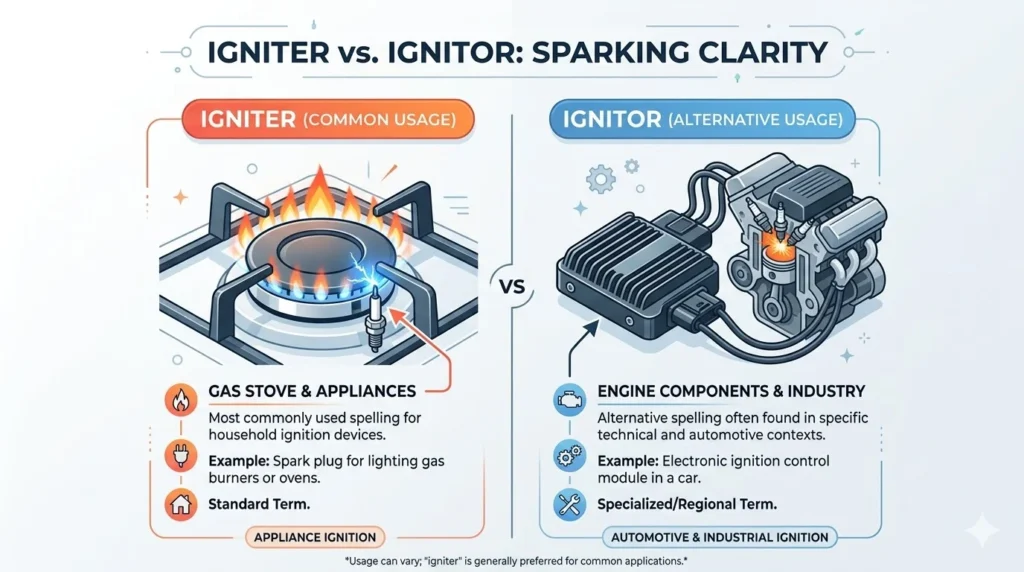
Igniter and ignitor both mean a device that starts combustion. Igniter is more common in modern English, while ignitor is less used but still correct in technical contexts.
Many people get confused between ignitor and igniter because both words look similar and sound the same. This confusion is common in technical writing, product descriptions, and everyday usage. People often search this keyword to understand which spelling is correct and which one they should use in professional writing.
Both words come from the verb ignite, which means to start a fire or combustion. However, one spelling is used more frequently in modern English. Choosing the correct form is important for clarity, consistency, and professionalism.
In this guide, you will learn the exact difference between ignitor and igniter, their meanings, origins, real world usage, and which spelling you should use based on your audience.
Quick Answer
Both ignitor and igniter are correct words.
They refer to a device that produces a spark or heat to start combustion.
However, igniter is the preferred and more commonly used spelling in modern English, especially in technical and everyday writing.
Examples
The stove igniter produces a spark.
The engineer tested the ignitor circuit.
Ignitor vs Igniter Meaning
Both words have the same meaning.
An igniter or ignitor is a device that starts combustion by producing heat or a spark.
These devices are commonly used in:
Gas stoves
Furnaces
Car engines
Industrial burners
Rocket engines
Example Sentences
The furnace igniter is not working.
The rocket igniter activated before launch.
The technician checked the ignitor system.
Ignitor vs Igniter Difference
| Word | Meaning | Usage |
|---|---|---|
| Igniter | Starts combustion | More common |
| Ignitor | Starts combustion | Less common |
Key Point
There is no difference in meaning. The only difference is usage frequency.
The Origin of Ignitor and Igniter
Both words come from the Latin root ignis, meaning fire.
The English verb ignite developed from this root.
When forming nouns, English uses different endings:
Words ending in er are common for tools or devices
Words ending in or often come from Latin influence
That is why both igniter and ignitor exist.
Why Igniter Is More Common
There are clear reasons why igniter is preferred.
Common English Pattern
Most tools end with er.
Examples
heater
burner
printer
starter
Because of this pattern, igniter feels more natural.
Industry Usage
Most manuals, appliances, and product labels use igniter.
Search Trends
Online searches and product listings show igniter is used more frequently worldwide.
Which Spelling Should You Use
Your choice depends on your audience.
General and Global Writing
Use igniter because it is widely understood and commonly used.
Technical or Industry Specific Context
Both can be used, but igniter is still safer and more standard.
Consistency Rule
Always use one spelling consistently in your document.
Common Mistakes with Ignitor vs Igniter
Mistake 1 Thinking Ignitor Is Wrong
Ignitor is correct but less common.
Mistake 2 Mixing Both Spellings
Using both forms in one document creates confusion.
Mistake 3 Assuming Different Meanings
Both words have the same meaning.
Ignitor vs Igniter in Everyday Examples
Emails
Please replace the faulty igniter in the oven.
News
The rocket igniter successfully triggered the launch.
Social Media
My stove igniter stopped working today.
Formal Writing
The ignition system includes a high efficiency igniter.
Ignitor vs Igniter Usage Trends
Language data shows that igniter is used more often in:
Product manuals
Engineering documents
Online searches
Appliance descriptions
The spelling ignitor appears less frequently and is often limited to specific technical contexts.
Exercise 1 Choose the Correct Word
Fill in the blank with ignitor or igniter.
The furnace ______ lights the gas burner.
Answer: igniter
The engineer tested the electronic ______.
Answer: ignitor
The stove ______ produces a spark.
Answer: igniter
Exercise 2 Correct the Sentence
Rewrite the sentence using the preferred spelling.
The oven ignitor needs replacement.
Answer: The oven igniter needs replacement.
The rocket ignitor activated during launch.
Answer: The rocket igniter activated during launch.
FAQs
What is the difference between ignitor and igniter?
Both words mean a device that starts combustion. Igniter is more common, while ignitor is less frequently used but still correct.
Is ignitor a correct word?
Yes, ignitor is a correct word, but it is less common than igniter in modern English.
Which spelling should I use?
Use igniter in most cases because it is more widely accepted and commonly used.
Why are there two spellings?
English uses different endings like er and or. Igniter follows common English patterns, while ignitor comes from Latin influenced forms.
Is igniter used in appliances?
Yes, igniter is commonly used in stoves, ovens, furnaces, and other devices.
Can both be used interchangeably?
Yes, both have the same meaning, but igniter is preferred.
Do professionals use ignitor or igniter?
Most professionals prefer igniter, especially in manuals and technical writing.
Conclusion
The terms ignitor and igniter both describe a device that starts combustion by producing heat or a spark. While both spellings are technically correct, their usage is not equal in modern English.
The spelling igniter is far more common and widely accepted across industries, product manuals, and everyday writing. It follows the typical English pattern for naming tools and devices, which makes it easier to recognize and understand. On the other hand, ignitor is less frequently used and appears mainly in specific technical contexts.
For clear, professional, and consistent writing, it is best to use igniter in most situations. This ensures better readability and aligns with common language usage. Remembering this simple preference will help you avoid confusion and improve your writing quality.