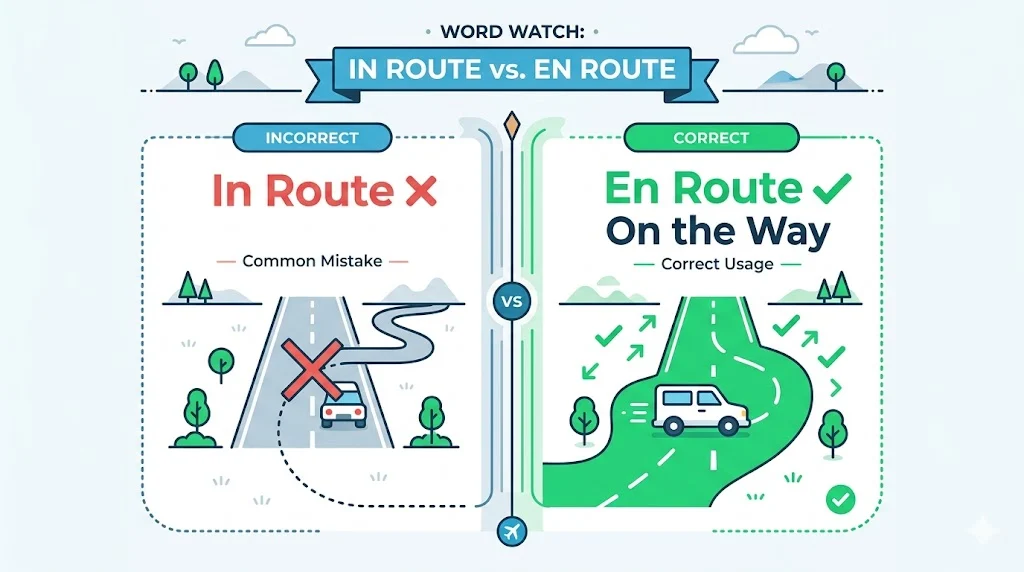
En route is correct and means on the way.
In route is incorrect in standard English.
Example: I am en route to the office right now.
I used to write in route in emails without thinking twice. It sounded right to me because it felt like normal English. One day, a client corrected it to en route, and I realized I had been using the wrong phrase in professional communication.
That pushed me to dig deeper into its meaning, origin, and correct usage. I learned that en route is a French phrase adopted into English, and using the correct form improves clarity and credibility.
Since then, I always double check such phrases before using them. If you have made the same mistake, this guide will help you understand and fix it completely.
Quick Answer
En route is the correct phrase. It means “on the way” or “in transit.”
In route is incorrect in standard English and should be avoided in formal writing.
Examples
Correct
I am en route to the airport.
Incorrect
I am in route to the airport.
In Route vs En Route Meaning
En Route
En route means “on the way to a destination.” It is commonly used in travel, communication, and professional writing.
Examples
- The package is en route to your address.
- We are en route to the meeting location.
- The ambulance is en route to the hospital.
In Route
In route is not considered standard English. It appears due to misunderstanding of the original phrase.
In Route vs En Route Difference
| Phrase | Meaning | Correct Usage | Example |
|---|---|---|---|
| En Route | On the way | Correct | She is en route home |
| In Route | Incorrect form | Not recommended | Incorrect usage |
Key Point
Always use en route in writing and speech.
Grammar Rule Depth
En Route as a Fixed Phrase
En route is a borrowed expression from French. It functions as an adverb in English.
Example
- We are en route to the office.
It does not change form and is always written as two words.
Why In Route Is Incorrect
English speakers often replace “en” with “in” because “in” feels more familiar. However, this breaks the original meaning and structure of the phrase.
The Origin of En Route
The phrase en route comes from French.
- En means “in” or “on”
- Route means “road” or “way”
Together, it literally means “on the way.”
The phrase entered English centuries ago and kept its original spelling and meaning. Many English expressions come from French, especially in formal and professional contexts.
Why People Write In Route Instead of En Route
1. Familiarity with English Words
People recognize “in” as a common English preposition, so they replace “en” with “in.”
2. Lack of Awareness
Many writers do not know that en route is a French phrase.
3. Pronunciation Confusion
Both phrases sound similar, which leads to spelling mistakes.
4. Informal Writing Habits
In casual texting or social media, people may use incorrect forms without checking.
Real World Usage of En Route
Travel
- We are en route to Paris.
- The flight is en route to London.
Business Communication
- The shipment is en route to the warehouse.
- I am en route to the meeting.
Emergency Services
- The ambulance is en route.
- Firefighters are en route to the scene.
Delivery Services
- Your package is en route.
- The driver is en route to your location.
En Route in Everyday Examples
Emails
I am en route to the office and will arrive in 20 minutes.
News
The rescue team is en route to the affected area.
Social Media
Running late but I am en route.
Formal Writing
The delegation is currently en route to the conference venue.
En Route in Different Contexts
Aviation
Pilots use “en route” to describe a flight in progress.
Example
The aircraft is en route to its destination.
Logistics
Companies use it to track shipments.
Example
Your order is en route and will arrive soon.
Daily Conversation
Example
I am en route, see you soon.
Common Mistakes with In Route vs En Route
Mistake 1 Using In Route
Incorrect
The package is in route.
Correct
The package is en route.
Mistake 2 Incorrect Spacing
Incorrect
Enroute
Correct
En route
Mistake 3 Overusing in Formal Writing
Some writers avoid the phrase completely due to confusion. Instead, they can confidently use en route correctly.
Related Words and Similar Expressions
Understanding alternatives improves vocabulary.
Similar Phrases
on the way
in transit
heading to
moving toward
Example
We are on the way to the office.
The shipment is in transit.
En Route vs Similar Phrases
| Phrase | Meaning | Usage |
|---|---|---|
| En Route | On the way | Formal and common |
| On the Way | Same meaning | Informal |
| In Transit | Moving between places | Logistics |
Usage Trends and Popularity
The phrase en route is widely used in:
- Aviation
- Logistics
- Business communication
- News reporting
The incorrect form in route appears mostly in informal writing and beginner level usage.
Search data and writing standards show that en route dominates in professional and global usage.
Grammar Insights and Advanced Usage
Placement in Sentences
En route usually appears after a verb.
Example
We are en route to the airport.
With “to”
It is often followed by “to.”
Example
She is en route to the office.
Without Object
Sometimes used alone.
Example
Help is en route.
Why Using En Route Improves Writing
Using the correct phrase shows:
- Strong grammar knowledge
- Professional writing skills
- Attention to detail
Incorrect usage can reduce credibility in professional communication.
Exercise 1 Choose the Correct Phrase
Fill in the blank with in route or en route.
The driver is ______ to your location.
Answer: en route
We are ______ to the airport.
Answer: en route
The package is ______ and will arrive soon.
Answer: en route
Exercise 2 Correct the Sentence
Rewrite the sentence correctly.
The shipment is in route to the warehouse.
Answer: The shipment is en route to the warehouse.
I am in route to the meeting.
Answer: I am en route to the meeting.
FAQs
What is the difference between in route and en route?
En route is correct and means on the way. In route is incorrect in standard English.
Is in route ever correct?
No, in route is not accepted in standard English writing.
What does en route mean?
It means on the way or in transit to a destination.
Where does en route come from?
It comes from French, meaning on the way.
Can I use en route in professional emails?
Yes, it is commonly used in business and formal communication.
Is en route one word or two words?
It is always written as two words.
What are alternatives to en route?
You can use on the way or in transit.
Conclusion
The difference between in route vs en route is simple but important. The correct phrase is en route, which means “on the way” and comes from French. The form in route is incorrect and should be avoided in professional and formal writing.
Understanding the origin of the phrase helps make it easier to remember. Since English borrows many expressions from other languages, keeping their original form is essential. Using the correct version not only improves clarity but also strengthens your writing credibility.
In everyday communication, business emails, logistics updates, and travel discussions, en route is widely accepted and understood. By practicing the correct usage and avoiding common mistakes, you can confidently use this phrase in any context.
A simple tip to remember is: if you mean “on the way,” always use en route.