
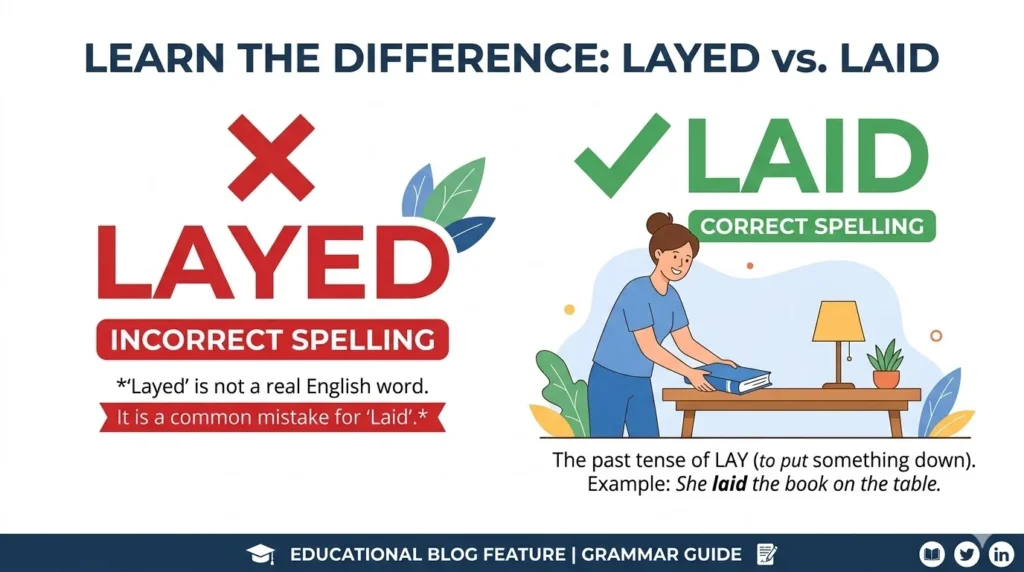
Laid is the correct past tense of the verb lay, which means to place something down. The spelling layed is incorrect in standard English and should not be used. For example, “She laid the book on the table” is correct, while “She layed the book on the table” is incorrect.
Many people get confused between layed and laid when writing in English. The words sound similar, and both appear related to the verb lay, which means to put or place something down. Because English verbs often change their form in the past tense, writers sometimes assume that layed is the correct past form of lay. However, this assumption leads to a common spelling mistake.
The correct past tense and past participle of lay is laid, not layed. Understanding this difference is important for clear communication, especially in professional writing, academic work, and everyday communication. Using the wrong form can make writing look careless and may confuse readers.
In this guide, you will learn the difference between layed and laid, the grammar rules behind the verb lay, common mistakes people make, and many real examples that show the correct usage. By the end of this article, you will clearly understand why laid is correct and how to use it confidently in your writing.
Quick Answer
The correct word is laid.
Laid is the past tense and past participle of the verb lay, which means to place something down.
The spelling layed is incorrect and should not be used in standard English.
Examples
Correct
She laid the phone on the desk.
Correct
The workers laid the bricks carefully.
Incorrect
She layed the phone on the desk.
Meaning Explained
To understand the difference, it helps to look at the verb lay.
Lay
The verb lay means to place something down in a specific position.
Examples
Please lay the book on the table.
They lay the tools carefully after work.
Past Tense
The past tense of lay is laid.
Examples
She laid the keys on the counter.
The hen laid three eggs.
The form layed does not follow the correct grammatical pattern and is considered an error.
Layed vs Laid Difference
| Word | Meaning | Correct Usage |
|---|---|---|
| Layed | Incorrect spelling | Should not be used |
| Laid | Past tense of lay | Correct form |
Key Idea
Whenever you want the past form of lay, the correct word is laid.
The Grammar Rule Behind Lay and Laid
The confusion often happens because English verbs have irregular forms.
Verb Forms of Lay
| Verb Form | Word |
|---|---|
| Base form | Lay |
| Past tense | Laid |
| Past participle | Laid |
Examples
Present
I lay the documents on the desk.
Past
I laid the documents on the desk.
Perfect tense
I have laid the documents on the desk.
Notice that layed never appears in the correct verb forms.
Why People Write Layed Instead of Laid
Several factors cause this mistake.
Regular Verb Pattern
Many English verbs form the past tense by adding ed.
Play → Played
Clean → Cleaned
Watch → Watched
Because of this pattern, writers sometimes assume lay → layed.
Similar Sound
The words layed and laid sound similar in casual speech, which makes the incorrect spelling easier to write.
Confusion With Other Words
People sometimes mix the verb lay with lie, which has different grammar rules.
Grammar Rule Depth
The verb lay is a transitive verb, which means it needs an object.
Example
She laid the blanket on the bed.
The object is blanket.
This rule helps distinguish lay from lie, which does not require an object.
Example
He lies on the couch.
Understanding this grammar rule makes it easier to use laid correctly.
Real World Usage of Laid
The word laid appears frequently in everyday communication.
Business Writing
The company laid the foundation for future growth.
Construction
Workers laid the concrete carefully.
Cooking
She laid the ingredients neatly on the counter.
Nature
The bird laid two eggs in the nest.
These examples show how commonly the word appears in different contexts.
Laid in Everyday Examples
Here are more examples showing how laid is used in sentences.
The teacher laid the papers on the desk.
The builder laid the bricks carefully.
She laid the baby in the crib.
They laid the carpet in the living room.
The farmer laid fresh hay in the barn.
Each example shows someone placing something down.
Laid in Professional Writing
Journalism
The government laid the groundwork for new policies.
Academic Writing
Researchers laid the theoretical foundation for the study.
Business Reports
The company laid plans for expansion next year.
Using the correct verb form ensures clarity and professionalism.
Laid in Social Media and Conversation
The word appears often in informal writing as well.
Example
I laid my phone on the table and forgot it.
Example
She laid the books neatly before starting the class.
Even in casual communication, the correct spelling should be used.
Common Mistakes with Layed vs Laid
Mistake 1
Incorrect
He layed the bag on the chair.
Correct
He laid the bag on the chair.
Mistake 2
Incorrect
The chicken layed three eggs.
Correct
The chicken laid three eggs.
Mistake 3
Incorrect
They layed the tiles yesterday.
Correct
They laid the tiles yesterday.
The incorrect form appears mainly because of misunderstanding verb rules.
Related Words and Similar Verb Confusions
Some verbs in English cause similar confusion.
Lay vs Lie
Lay requires an object.
Example
She laid the towel on the bed.
Lie does not require an object.
Example
He lay on the bed yesterday.
Other Confusing Verb Forms
set vs sat
raise vs rise
hang vs hung
Learning these pairs helps improve grammar accuracy.
Tips to Remember the Correct Word
A simple trick helps remember the correct form.
If you want the past tense of lay, always use laid.
Think of the phrase:
“Yesterday I laid something down.”
Another trick is remembering that laid contains the word aid, which can help you recall the correct spelling.
Layed vs Laid in Modern English Usage
In modern English, laid is the accepted past tense and past participle of lay.
The spelling layed sometimes appears in informal online writing, but dictionaries and grammar guides consider it incorrect.
Professional writing, education, journalism, and academic publications all use laid.
Usage Patterns and Language Trends
Language data shows that laid appears consistently in books, news articles, and academic writing.
The incorrect spelling layed appears mostly in informal online content where grammar rules are often ignored.
Because of this pattern, writers should always use laid to maintain clear and accurate language.
Exercise 1 Choose the Correct Word
Fill in the blanks using laid or layed.
She ______ the keys on the table.
Answer: laid
The bird ______ three eggs in the nest.
Answer: laid
The workers ______ the bricks carefully.
Answer: laid
Exercise 2 Correct the Sentence
Rewrite the sentence using the correct word.
She layed the book on the desk.
Answer: She laid the book on the desk.
The hen layed two eggs yesterday.
Answer: The hen laid two eggs yesterday.
They layed the carpet in the hallway.
Answer: They laid the carpet in the hallway.
FAQs
Is layed ever correct in English?
No. The spelling layed is not correct in standard English grammar. The correct past tense and past participle of the verb lay is laid.
What is the difference between layed and laid?
Laid is the correct past tense of lay, meaning to place something down. Layed is a common spelling mistake that should not be used.
Why do people write layed instead of laid?
Many people assume that verbs form the past tense by adding ed. Because of this pattern, writers sometimes incorrectly create the form layed.
Can laid be used in professional writing?
Yes. Laid appears frequently in professional communication, academic writing, journalism, and formal documents.
What does laid mean in a sentence?
Laid means placed something down. For example, “She laid the notebook on the table.”
Is laid the past tense of lay?
Yes. The verb forms are lay in present tense and laid in past tense and past participle.
How can I remember the correct word?
Remember that the past tense of lay is always laid. If you are describing something that happened yesterday, use laid instead of layed.
Conclusion
The difference between layed and laid is straightforward once you understand the grammar rule behind the verb lay. While both words may appear related, only one of them is correct in standard English.
The correct past tense and past participle of lay is laid. This form is used whenever you describe placing something down in the past. For example, a person can lay a book on a table today, and yesterday they laid it there. The spelling layed does not follow the correct verb pattern and is considered a common mistake.
This confusion happens because many English verbs form the past tense by adding ed, leading people to assume that layed must be correct. However, English contains many irregular verbs, and lay is one of them. Because of this rule, the correct form remains laid in both past tense and past participle forms.
Using laid correctly improves clarity, accuracy, and professionalism in writing. Whether you are writing emails, reports, academic papers, or social media posts, understanding this difference helps avoid a common grammar error.
Once you remember that the past tense of lay is always laid, choosing the correct word becomes simple.