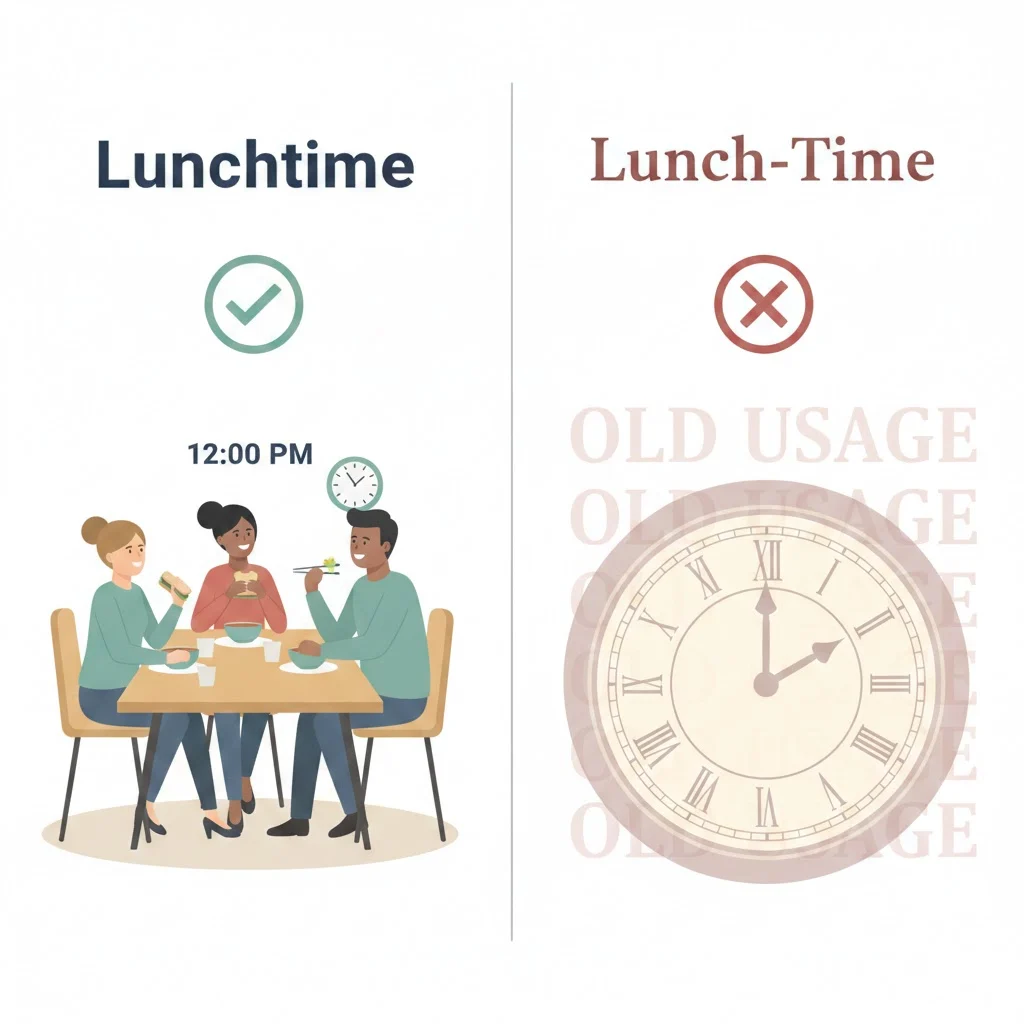
Lunchtime is the correct and standard spelling in modern English. Lunch-time with a hyphen is outdated and rarely used. In almost all formal, academic, and professional writing, lunchtime without a hyphen is correct.
Many people feel confused when writing lunchtime vs lunch-time because both versions appear online. Some websites use “lunchtime,” while others use “lunch-time.” This creates doubt about which form is correct. Since both look similar, writers often wonder whether the hyphen is necessary.
This confusion is common in emails, school essays, blog posts, office communication, and even printed materials. A small punctuation mark can affect clarity and professionalism. Many people search for “lunchtime vs lunch-time” to understand modern spelling rules and avoid mistakes.
In this complete guide, you will learn the correct spelling, grammar rules, historical background, real-world usage, common mistakes, comparison tables, related compound words, practice exercises with answers, and detailed FAQs. By the end of this article, you will clearly understand why lunchtime is correct and why lunch-time is rarely used today.
Quick Answer
Lunchtime is correct in modern English.
Lunch-time is outdated and rarely used.
Simple Examples
- I will call you at lunchtime.
- We usually eat at lunchtime.
What to Remember
In modern writing, compound time words like:
- lunchtime
- bedtime
- dinnertime
are written as one word.
The Origin of Lunchtime
To understand lunchtime vs lunch-time, we must look at the history of compound words in English.
How Compound Words Develop
English often forms new words by combining two separate words. Over time, these combinations go through three stages:
- Open form
- Hyphenated form
- Closed form
For example:
- Lunch time
- Lunch-time
- Lunchtime
This evolution is common in English. Many compound words started as two separate words, then became hyphenated, and finally merged into one word.
Why Lunchtime Became One Word
As usage increased, writers preferred a simpler form. Over time, dictionaries and style guides standardized lunchtime as one word. The hyphen gradually disappeared because it was no longer needed for clarity.
Language changes naturally. Today, major dictionaries list lunchtime as the correct spelling.
Grammar Rule Depth
Understanding compound noun rules removes confusion.
What Is Lunchtime?
Lunchtime is a compound noun.
It combines:
- Lunch
- Time
It refers to the period during the day when people eat lunch.
Why No Hyphen Is Needed
Hyphens are usually used when two words combine to form an adjective before a noun, such as:
- well-known author
- full-time job
But lunchtime functions as a noun, not a compound adjective. Therefore, it does not require a hyphen.
Similar Compound Nouns
- Bedtime
- Dinnertime
- Mealtime
- Playtime
All of these are written as single words in modern English.
British English vs American English Spelling
There is no difference between British and American English for this word.
Both use:
- Lunchtime
The hyphenated form lunch-time is considered outdated in both varieties.
Comparison Table
| Version | British English | American English | Modern Usage |
|---|---|---|---|
| Lunchtime | Correct | Correct | Standard |
| Lunch-time | Rare | Rare | Outdated |
Which Spelling Should You Use
Use lunchtime in:
- Academic writing
- Professional emails
- Business communication
- News articles
- Blog posts
- Social media
Avoid lunch-time, as it may look old-fashioned or incorrect.
If your goal is clear and modern English, always choose lunchtime.
Why People Make Mistakes With Lunchtime vs Lunch-Time
1. Seeing Old Books or Websites
Older publications sometimes used “lunch-time,” which creates confusion.
2. Overusing Hyphen Rules
Some writers believe compound words must always include a hyphen.
3. Influence of Other Hyphenated Words
Words like part-time or full-time may cause writers to assume lunch-time is correct.
4. Autocorrect Variations
Some outdated systems may not flag the hyphenated version.
Lunchtime in Everyday Examples
In Emails
- Let’s meet at lunchtime.
- I will respond after lunchtime.
In News
- Traffic increases during lunchtime hours.
- Restaurants are busy at lunchtime.
Social Media
- Best deals available at lunchtime.
- Lunchtime break vibes.
In Formal Writing
- Productivity often decreases during lunchtime.
- Schools provide meals at lunchtime.
Lunchtime vs Lunch-Time Google Trends and Usage Data
Search data shows that lunchtime is searched far more frequently than “lunch-time.” The hyphenated form has steadily declined in usage over the past decades.
Countries including:
- United States
- United Kingdom
- Canada
- Australia
primarily use lunchtime without a hyphen.
This shift reflects language modernization and dictionary standardization.
Comparison Table of Variations
| Word Form | Correct Today | Usage Level |
|---|---|---|
| Lunchtime | Yes | Very High |
| Lunch-time | No | Very Low |
| Lunch time | Rare | Informal Only |
Related Compound Words
Understanding similar words helps prevent mistakes.
Closed Compound Words
- Bedtime
- Dinnertime
- Mealtime
- Playtime
- Showtime
Hyphenated Compound Words
- Part-time
- Full-time
- Long-term
- Well-known
Notice that lunchtime belongs to the closed compound group.
Common Mistakes and Corrections
Wrong: We will meet at lunch-time.
Correct: We will meet at lunchtime.
Wrong: I prefer to walk during lunch-time.
Correct: I prefer to walk during lunchtime.
Wrong: Lunch-time is my favorite part of the day.
Correct: Lunchtime is my favorite part of the day.
Lunchtime in Extended Sentences
Simple Sentences
- Lunchtime is at noon.
- I eat at lunchtime.
Medium Sentences
- The cafeteria is crowded at lunchtime.
- Meetings are avoided during lunchtime.
Formal Sentences
- Employee engagement improves with structured lunchtime breaks.
- Lunchtime scheduling affects productivity metrics.
Practice Exercises
Fill in the Blank
- We will meet at ______.
Answer: lunchtime - The cafeteria opens before ______.
Answer: lunchtime - Traffic increases during ______ hours.
Answer: lunchtime
Choose the Correct Word
- (Lunchtime / Lunch-time) is my break.
Answer: Lunchtime - I eat at (lunchtime / lunch-time).
Answer: lunchtime - The office closes at (lunchtime / lunch-time).
Answer: lunchtime
FAQs
Is lunchtime one word or two?
Lunchtime is written as one word in modern English.
Is lunch-time correct?
Lunch-time is outdated and rarely used today.
Why was lunch-time used before?
Older English sometimes used hyphenated compound forms before standardization.
Do British and American English differ here?
No, both use lunchtime without a hyphen.
Is lunch time ever correct?
It may appear informally, but standard usage prefers lunchtime.
Why do compound words change over time?
Language evolves, and frequently used word combinations often merge into single words.
Should I ever use lunch-time in formal writing?
No, modern formal writing uses lunchtime.
Conclusion
The confusion between lunchtime vs lunch-time is understandable, but modern English is clear. Lunchtime is the correct and standard spelling. The hyphenated version is outdated and rarely used today.
English compound words often evolve from open to hyphenated to closed forms. Lunchtime has completed this evolution and is now firmly established as one word. Whether you are writing emails, academic papers, professional documents, or social media posts, always use lunchtime for clarity and correctness.
By understanding compound word development and modern usage patterns, you can avoid common mistakes and write confidently. Remember, language evolves, and standard usage matters.