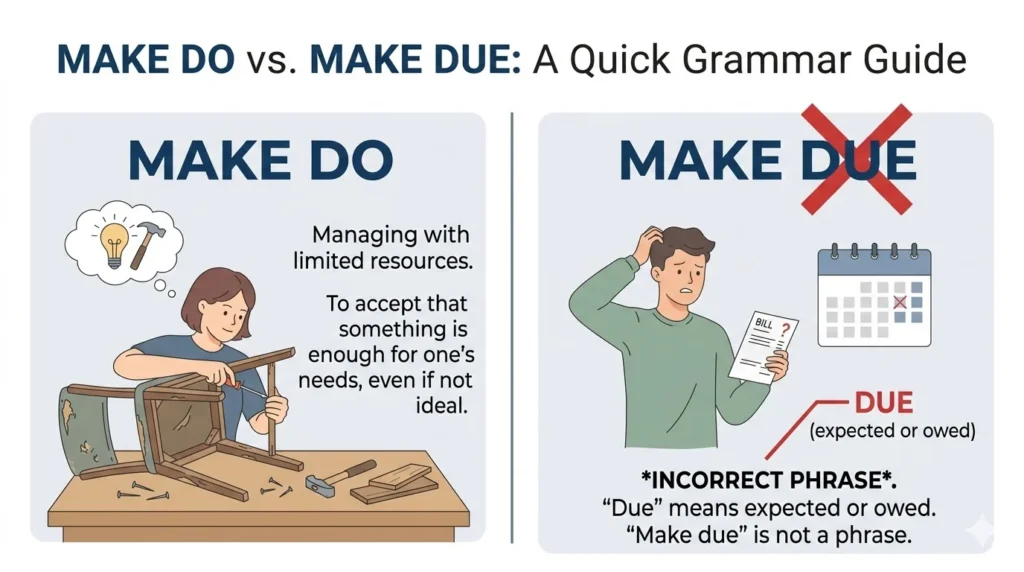
Make do is the correct phrase. It means to manage with what is available or to cope with limited resources. Make due is incorrect in standard English. Always use make do, never make due.
Many people search for make due vs make do because they see both spellings online and are unsure which one is correct. The confusion is common because the words do and due sound similar in pronunciation. When spoken quickly, they can sound almost the same, which leads to spelling mistakes in writing.
However, only one version is correct in standard English. Writing the wrong phrase can make your sentence look careless or unprofessional. This mistake appears often in emails, essays, blog posts, and even business communication.
Understanding the difference between make do and make due is important for clear and accurate writing. In this guide, you will learn the correct meaning, grammar rules, why people confuse the phrase, real life examples, common mistakes, related expressions, exercises with answers, and frequently asked questions. By the end of this article, you will confidently know which phrase to use and why.
Quick Answer
The correct phrase is make do.
Make due is incorrect and should not be used.
What Make Do Means
Make do means to manage, survive, or continue using what you already have, especially when something better is not available.
Simple Examples
- We did not have enough chairs, so we had to make do.
- I forgot my charger, so I will make do without it.
- They had little money, but they made do.
If you ever feel unsure between make due vs make do, always choose make do.
Meaning and Grammar Rule Explained
Understanding why make do is correct requires a look at its grammar and structure.
What Type of Phrase Is Make Do
Make do is a fixed idiomatic expression. It combines:
- Make, a verb
- Do, another verb
Together, they create a phrase meaning to manage or cope.
Why Make Due Is Incorrect
The word due is an adjective or noun. It means owed, expected, or scheduled.
Examples of due:
- The payment is due tomorrow.
- The train is due at noon.
Due does not fit grammatically in the phrase. It does not express coping or managing. Therefore, make due is grammatically incorrect.
Why People Confuse Make Do and Make Due
This mistake is very common. Here are the main reasons.
Similar Pronunciation
Do and due sound similar in many accents. When spoken quickly, the difference is almost invisible.
Influence of Other Phrases
People are used to hearing the word due in common expressions like:
- Due date
- Due process
- Payment due
Because due appears often in formal writing, writers mistakenly assume it fits here as well.
Autocorrect and Typing Errors
Some spellcheck tools fail to catch make due because due is a real word. This makes the mistake harder to detect.
Weak Understanding of Idioms
Make do is an idiomatic expression. Idioms do not always follow simple grammar rules. When learners do not recognize it as a fixed phrase, they guess the spelling.
Deep Grammar Explanation of Make Do
To fully understand make do, we must examine its grammatical function.
Make as a Causative Verb
The verb make can function in many ways. In this phrase, it is part of a verbal expression meaning to cause oneself to cope.
Do as an Action Verb
In this context, do does not mean perform a task. Instead, it refers to functioning or managing.
When combined, make do creates a meaning that cannot be understood by analyzing each word separately. This is typical of idiomatic expressions in English.
Verb Tense Variations
The phrase can change tense.
- Present: I make do
- Past: I made do
- Future: I will make do
- Continuous: We are making do
Examples:
- We are making do with what we have.
- She made do during difficult times.
- They will make do until help arrives.
Make due cannot be used in any tense correctly.
Real World Usage of Make Do
Seeing examples in different contexts helps fix the meaning in your mind.
Daily Conversation
- We ran out of milk, so we had to make do with water.
- The hotel was full, so we made do with a smaller room.
Family Life
- Growing up, we did not have much, but we made do.
- She forgot her notebook and had to make do with loose paper.
Work and Business
- The team had limited tools, but they made do.
- We will make do until the new equipment arrives.
Academic Writing
- In limited resource environments, communities must make do.
- Researchers often make do with available data.
News and Media
- Citizens were forced to make do during the crisis.
- Farmers had to make do with less water this season.
Make Do vs Make Due in Sentences
Let us compare correct and incorrect usage.
Correct: We had no backup plan, so we made do.
Incorrect: We had no backup plan, so we made due.
Correct: She will make do with her old laptop.
Incorrect: She will make due with her old laptop.
Correct: They made do during hard times.
Incorrect: They made due during hard times.
Every time, make due is grammatically wrong.
British and American English Usage
There is no difference between British and American English.
Both use make do.
Both consider make due incorrect.
Examples:
UK: We will make do until tomorrow.
US: We will make do until tomorrow.
Related Expressions Similar to Make Do
Learning related phrases improves understanding.
Get By
Means to survive or manage.
- We barely got by last year.
Cope With
Means to handle a difficult situation.
- She coped with stress well.
Do Without
Means to live without something.
- I can do without sugar.
Settle For
Means to accept something less than ideal.
- He settled for a smaller apartment.
These expressions share a similar meaning to make do.
Common Mistakes With Make Do
Writers often make these errors.
Using make due instead of make do
Adding unnecessary words
Confusing due with do in idiomatic phrases
Incorrect Examples
- We will make due with this.
- They made due during the shortage.
Correct Versions
- We will make do with this.
- They made do during the shortage.
Why Correct Usage Matters
Using the wrong phrase affects:
Clarity
Professional writing quality
Academic credibility
Reader trust
In formal writing, grammar errors reduce authority. Choosing make do correctly improves communication and confidence.
Make Do in Different Tenses
Present
- I make do with what I have.
Past
- She made do last year.
Future
- We will make do.
Continuous
- They are making do.
Make due does not work in any tense.
Practice Exercises
Fill in the Blanks
- We had no extra money, so we had to ______.
Answer: make do - She forgot her phone charger and had to ______ without it.
Answer: make do - During the storm, families had to ______.
Answer: make do - They will ______ until help arrives.
Answer: make do
Choose the Correct Phrase
- We will (make do / make due) with this solution.
Answer: make do - She had to (make do / make due) during hard times.
Answer: make do - They are (making do / making due) with limited supplies.
Answer: making do - He (made do / made due) with what he had.
Answer: made do
FAQs
Is make due ever correct?
No. Make due is incorrect in standard English.
What does make do mean?
Make do means to manage or cope with limited resources.
Why do people write make due?
Because do and due sound similar in speech.
Is make do formal or informal?
It can be used in both formal and informal writing.
Can I say made do?
Yes. Made do is the correct past tense form.
Is there a regional difference in usage?
No. Both British and American English use make do.
What part of speech is make do?
It is an idiomatic verb phrase.
Conclusion
The confusion between make due and make do is common but easy to fix. The correct phrase is always make do. It means to manage, cope, or survive using what is available. Make due is incorrect and should never be used in standard English.
Understanding that make do is an idiomatic expression helps prevent mistakes. Even though do and due sound similar, their meanings are completely different. Due relates to something owed or expected, while do in this phrase forms part of a fixed verbal expression.
By remembering the simple rule that only make do is correct, you can improve your writing clarity and professionalism. Whether you are writing an email, an essay, or a business report, choosing the correct phrase ensures accuracy and builds confidence.