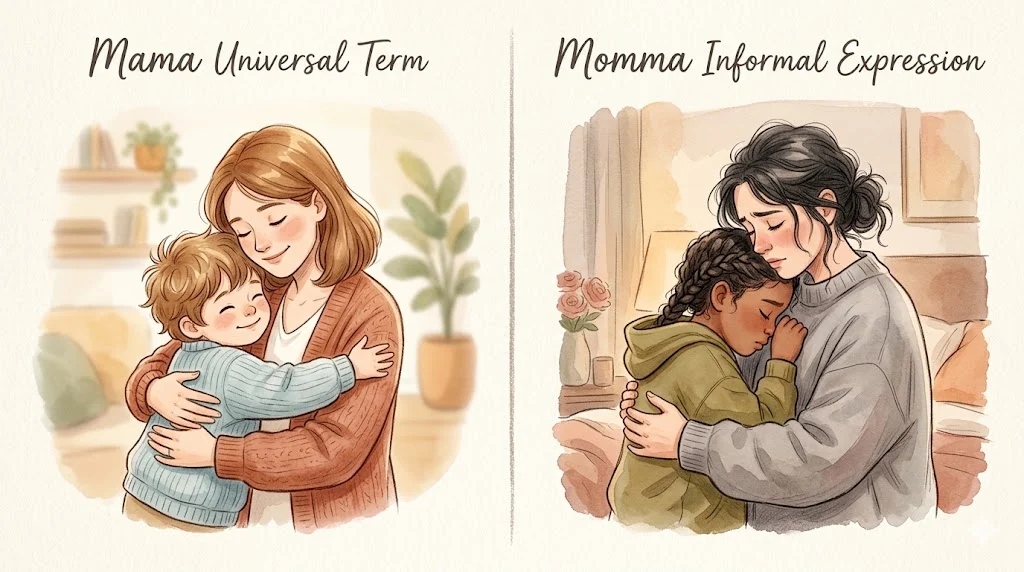
Momma and mama both mean mother. Mama is more common worldwide, while momma is informal and mainly used in American English for emotional or stylistic expression.
I used to think momma and mama were exactly the same and could be used anywhere. But when I started writing content and emails, I noticed different spellings in books, songs, and conversations.
Once, I used “momma” in a formal message, and it felt too casual. That made me research the difference. I learned that mama is more universal, while momma is more informal and expressive. After practicing their usage in different contexts, I became confident in choosing the right word.
If you have faced the same confusion, this guide will help you understand and use both words correctly.
Quick Answer
Both momma and mama mean mother.
Mama is more widely used and accepted globally.
Momma is informal and mostly used in American English, often to show emotion or affection.
Examples
I love you, mama.
My momma always supports me.
Momma vs Mama Meaning
Mama
Mama is a common and universal word for mother. It is used by children and adults in many cultures and languages.
Examples
The baby called her mama.
She missed her mama while traveling.
Momma
Momma is a variation of mama. It is more informal and often used to show warmth, love, or strong emotion.
Examples
My momma taught me everything.
Momma knows best.
Momma vs Mama Difference
| Word | Meaning | Tone | Usage |
|---|---|---|---|
| Mama | Mother | Neutral, universal | Global usage |
| Momma | Mother | Informal, emotional | Mostly American English |
Key Point
Both words mean the same, but tone and usage context are different.
Grammar Rule Depth
Both momma and mama are nouns used to refer to a mother.
They are not formal grammatical variations but spelling and stylistic choices.
Capitalization Rules
Use capital letters when used as a name.
Examples
I love you, Mama.
Momma is cooking dinner.
Lowercase when used generally.
Examples
She is a loving mama.
Every momma wants the best for her child.
Origin of Momma and Mama
Mama
The word mama comes from early human speech sounds like “ma” or “mam,” which babies naturally say.
It exists in many languages:
Spanish: mamá
French: maman
Urdu: mama or ammi
Momma
Momma developed later as a variation in English, especially in American dialects. It reflects pronunciation and emotional tone rather than a different meaning.
Why People Confuse Momma and Mama
Similar Sound
Both words sound very similar.
Same Meaning
They both refer to mother.
Cultural Influence
Different regions prefer different spellings.
Informal Usage
People often use them interchangeably in casual speech.
Real World Usage of Momma and Mama
Family Conversations
I love you, mama.
My momma made my favorite food.
Social Media
Missing my mama today.
My momma is my hero.
Music and Entertainment
Many songs use momma for emotional effect.
Example
Oh momma, I made it.
Daily Speech
Mama, can you help me?
Momma always knows.
Momma vs Mama in Different Contexts
Formal Writing
Use mother or sometimes mama carefully. Avoid momma.
Example
She thanked her mother for support.
Informal Writing
Both can be used.
Example
My momma is the best.
Emotional Expression
Momma is often used for stronger emotional tone.
Example
I miss you, momma.
Momma vs Mama in Everyday Examples
Emails
I will visit my mama this weekend.
News
She spoke about her mother, whom she calls mama.
Social Media
Love you mama.
My momma is my strength.
Formal Writing
The child referred to her as mama.
Common Mistakes with Momma vs Mama
Using Momma in Formal Writing
Incorrect
The report mentions her momma.
Correct
The report mentions her mother.
Confusing Tone
Momma sounds more emotional and informal.
Overuse in Professional Context
Use neutral terms like mother in formal writing.
Momma vs Mama in Emotional Expression
Momma often carries deeper emotional weight.
Examples
I miss my momma so much.
Momma always believed in me.
Mama is softer and more neutral.
Examples
Mama, I need your help.
She called out for her mama.
Cultural Usage Differences
United States
Momma is commonly used in informal speech.
Global Usage
Mama is widely used across cultures and languages.
South Asian Context
Mama can also mean uncle in some contexts, but usage depends on language.
Related Words for Mother
mother
mom
mommy
mum
mummy
ma
Each word varies by region and tone.
Usage Trends
Mama is more common globally and appears more in books and writing.
Momma is popular in:
Songs
Social media
Informal speech
Exercise 1 Choose the Correct Word
Fill in the blank with momma or mama.
I love you, ______.
Answer: mama
My ______ always supports me.
Answer: momma
The baby called her ______.
Answer: mama
Exercise 2 Correct the Sentence
Rewrite correctly.
She wrote about her momma in a formal essay.
Answer: She wrote about her mother in a formal essay.
I miss you mama so much momma.
Answer: I miss you, mama, so much.
Momma vs Mama in Idioms and Expressions
Common Expressions
Mama knows best
Yo mama jokes
Momma’s boy
Momma knows everything
These expressions show emotional or cultural tone.
Deeper Usage in Writing and Content
Writers often choose between momma and mama based on tone.
Emotional Storytelling
Momma adds warmth and realism.
Neutral Writing
Mama feels more universal and balanced.
Branding and Content
Content creators may use momma for relatability.
FAQs
What is the difference between momma and mama?
Both mean mother. Mama is more universal, while momma is informal and emotional, mainly used in American English.
Is momma a correct word?
Yes, momma is correct but informal. It is commonly used in speech, songs, and casual writing.
Which is more common mama or momma?
Mama is more common globally. Momma is popular in informal American usage.
Can I use momma in formal writing?
No, it is better to use mother in formal writing.
Why do people use momma instead of mama?
People use momma to express emotion, affection, or regional speech style.
Is mama used worldwide?
Yes, mama is used in many languages and cultures.
Are momma and mama interchangeable?
Yes in informal contexts, but tone may change.
Conclusion
The difference between momma vs mama is not about meaning but about tone, usage, and context. Both words refer to a mother, but they carry slightly different emotional and cultural meanings.
Mama is a universal and widely accepted term used across many languages and regions. It is simple, natural, and suitable for both casual and slightly neutral contexts. On the other hand, momma is more informal and expressive, often used in American English to show warmth, affection, or strong emotional connection.
Understanding this difference helps you choose the right word based on your audience and purpose. In professional or formal writing, it is best to use mother. In personal, emotional, or casual communication, both momma and mama can be used, depending on the tone you want to convey.
By learning these subtle differences and practicing their usage, you can improve your writing clarity and express emotions more effectively.