
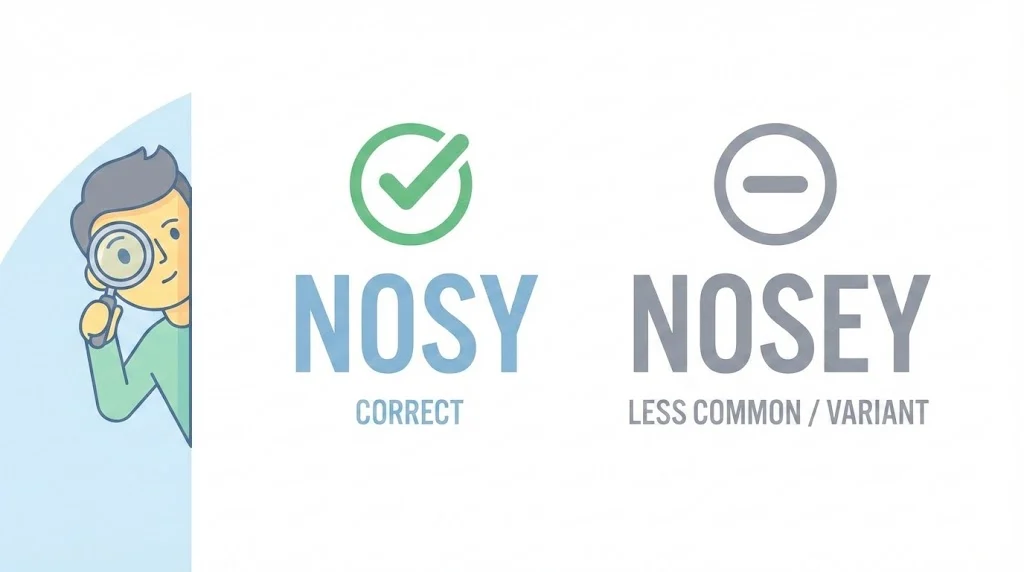
Nosy and nosey both describe someone who is overly curious or interested in other people’s private matters. Nosy is the more common and widely accepted spelling, while nosey is an alternative spelling used less often. In most modern writing, especially formal writing, nosy is preferred.
Many writers stop and wonder whether they should write nosy or nosey. Both spellings appear online, in books, and in everyday conversations, which makes the confusion understandable. Because the two words sound exactly the same and share the same meaning, people often assume they are equally correct in all situations.
The word is commonly used to describe someone who asks too many personal questions or gets involved in other people’s business. Since the word appears often in casual conversations, social media posts, and storytelling, choosing the correct spelling matters more than people think. Using the preferred form helps your writing look cleaner and more consistent.
This article explains everything you need to know about nosy or nosey. You will learn the grammar background, why two spellings exist, why people make mistakes, real world usage, examples, exercises, and clear answers to common questions. By the end, you will know exactly which spelling to use and when.
Quick Answer
Both nosy and nosey are accepted spellings, but nosy is the preferred and more common version in modern English.
Simple Examples
- She is very nosy about her neighbors.
- He asked too many nosy questions.
You may sometimes see nosey, but most dictionaries and modern writers prefer nosy.
Quick Tip
If you want the safest choice for writing, use nosy.
Grammar Rules Explained
Unlike many grammar confusions, this one is not about different meanings. It is mainly about spelling preference.
Meaning of Nosy and Nosey
Both words are adjectives. They describe a person who is too curious about other people’s private lives.
Examples
- A nosy neighbor watches everyone.
- A nosey coworker asks personal questions.
The meaning stays the same regardless of spelling.
Why Two Spellings Exist
The word comes from nose, referring to the idea of “sticking your nose into someone’s business.” Over time, writers shortened the spelling to nosy, while some kept the longer form nosey.
Language naturally evolves, and both spellings survived. However, one became more dominant.
Preferred Modern Usage
Today:
- Nosy is the standard and preferred spelling.
- Nosey is considered a variant or less common alternative.
If you are writing professionally or academically, choose nosy.
Why People Make Mistakes With Nosy or Nosey
This confusion happens for several simple reasons.
Same Pronunciation
Both words sound identical, so writers rely on guessing.
Visual Logic
Many people think “nosey” looks logical because it comes from the word nose.
Exposure to Both Spellings
Books, blogs, and social media use both forms, which increases uncertainty.
Lack of Clear Teaching
Unlike common grammar rules, this spelling difference is rarely explained in school.
Informal Writing Habits
Casual writing allows variation, making the distinction less obvious.
Nosy or Nosey in Real Life Usage
Understanding real-world usage helps you choose confidently.
Daily Conversation
- My aunt is a little nosy.
- Don’t be so nosy about their plans.
Emails
- Avoid asking nosy questions during interviews.
- The client thought the questions sounded nosy.
Social Media
- Stop being nosy and mind your own business.
- People online can be very nosy.
Books and Storytelling
- The nosy neighbor heard everything.
- A nosy reporter uncovered the story.
Professional Writing
Professional editors usually choose nosy because it looks more modern and standardized.
British and American English Usage
Both British and American English recognize nosy and nosey, but usage patterns differ slightly.
American English
- Strong preference for nosy.
British English
- Both spellings appear, but nosy remains more common today.
Conclusion
No matter where you write, nosy is the safest and most widely accepted spelling.
Which One Should You Use
The easiest rule is simple.
Use nosy in almost every situation.
Choose nosey only if:
- You are following a specific style guide that prefers it.
- You want a slightly old fashioned or stylistic tone.
For most writers:
- Blog writing → nosy
- School writing → nosy
- Professional writing → nosy
- Social media → either, but nosy is recommended.
Common Mistakes and Corrections
Wrong: She is very nosey in formal writing contexts.
Better: She is very nosy.
Wrong: My nosey neighbor watches everyone.
Preferred: My nosy neighbor watches everyone.
Wrong: He asked nosey questions in the interview.
Preferred: He asked nosy questions in the interview.
The issue is not meaning but consistency and modern preference.
Nosy or Nosey in More Sentences
Simple Sentences
- Stop being nosy.
- That sounds like a nosy question.
Medium Sentences
- The nosy neighbor always checks who visits our house.
- Her nosy attitude made others uncomfortable.
Formal Sentences
- Excessively nosy questioning may reduce trust.
- A nosy approach can damage professional relationships.
Related Words and Similar Confusions
Understanding related words improves confidence in spelling choices.
Related Words
- Curious
- Inquisitive
- Interfering
- Meddling
- Intrusive
Similar Spelling Confusions
- Grey or gray
- Cancelled or canceled
- Traveller or traveler
- Toward or towards
These variations show that English often allows multiple spellings, but one usually becomes dominant.
Why Nosy Became More Popular
Language usage changes over time based on simplicity and frequency.
Shorter Spellings Win
People naturally prefer shorter words when typing quickly.
Dictionary Preference
Major dictionaries list nosy first, influencing writers.
Publishing Standards
Editors and publishers gradually standardized nosy.
Digital Writing
Online content favors shorter spellings for readability.
Tone and Context Differences
While both spellings mean the same thing, readers may perceive small tone differences.
Nosy
- Modern
- Clean
- Standard
- Preferred for professional writing
Nosey
- Slightly old fashioned
- Informal or stylistic
- Less common
Most readers will not notice a meaning difference, but consistency matters.
Practice Exercises
Fill in the Blanks
- My ______ neighbor always asks personal questions.
Answer: nosy - Stop being so ______ about my plans.
Answer: nosy - The reporter seemed too ______ during the interview.
Answer: nosy - Her ______ behavior annoyed everyone.
Answer: nosy - He sounded ______ when asking about salaries.
Answer: nosy
Choose the Correct Word
- She is very (nosy / nosey) about other people’s lives.
Answer: nosy - The (nosy / nosey) coworker asked too many questions.
Answer: nosy - My grandmother calls herself a little (nosy / nosey).
Answer: nosy - Avoid sounding (nosy / nosey) during interviews.
Answer: nosy - The story included a (nosy / nosey) neighbor character.
Answer: nosy
FAQs
What is the difference between nosy and nosey?
Both words mean the same thing, but nosy is the preferred modern spelling, while nosey is a less common variation.
Is nosey incorrect?
No, nosey is not incorrect, but it is less common and not usually preferred in professional writing.
Which spelling should I use in formal writing?
Use nosy, as it is the standard form recognized by most editors and dictionaries.
Why are there two spellings?
The word comes from nose, and both spellings developed naturally over time before one became more popular.
Is nosy American or British spelling?
Both American and British English use nosy, though nosey appears occasionally in British writing.
Can I use nosey in fiction or casual writing?
Yes, you can if it matches your style or character voice, but consistency is important.
Does using nosey look wrong to readers?
Many readers recognize it, but some may view it as old fashioned or less standard.
Writing Tips to Remember the Correct Spelling
Use the Shorter Version
Most modern words become shorter over time. Think of nosy as the simplified spelling.
Think of Digital Writing
Most online articles use nosy, making it easier to remember.
Stay Consistent
Choose one spelling and use it throughout your article.
Follow Common Usage
When unsure, always choose nosy.
Extra Real Life Examples
Workplace
- Avoid asking nosy questions during onboarding.
- A nosy colleague can make meetings uncomfortable.
Family Situations
- Kids can be naturally nosy.
- Relatives may seem nosy during gatherings.
Online Communities
- Social media encourages nosy behavior.
- People become nosy about private lives online.
Conclusion
The confusion between nosy or nosey is common because both spellings exist and mean the same thing. However, modern English strongly prefers nosy, especially in professional, academic, and online writing. While nosey is still recognized, it is less common and can appear outdated or inconsistent.
Remember the simple rule: choose nosy for clear and modern writing. Understanding this small spelling difference helps you write more confidently and consistently. Whether you are writing a story, email, or article, using the preferred spelling improves readability and avoids unnecessary confusion.
Now that you understand the history, grammar background, real-world usage, and common mistakes, you can confidently choose the correct word every time.