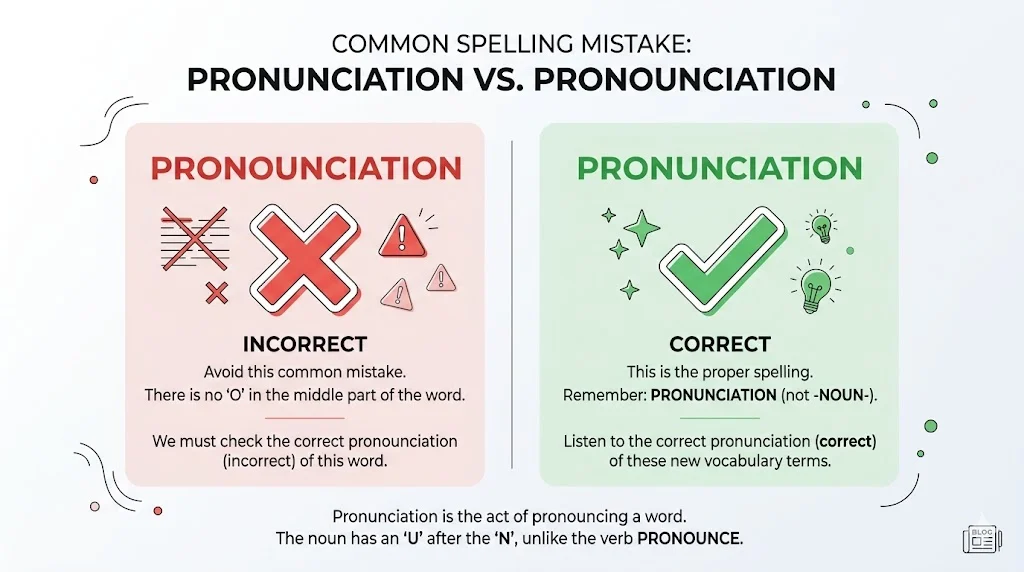
Pronunciation is the correct spelling of how words are spoken. Pronounciation is incorrect and a common mistake. Always use pronunciation in writing and speaking contexts.
I used to spell pronunciation incorrectly as pronounciation for a long time, especially while writing articles and emails. It looked right to me because the word pronounce contains “noun,” so I assumed the spelling followed the same pattern. One day, while editing content, I noticed the mistake repeated several times. That pushed me to research the correct form.
I learned that pronunciation drops the “o” from pronounce, which is why the spelling feels confusing. After understanding this rule and practicing it consistently, I fixed the mistake completely.
If you’ve struggled with pronounciation vs pronunciation, this guide will help you understand the difference clearly and avoid this common error.
Quick Answer
Pronunciation is the correct spelling.
Pronounciation is incorrect and should not be used.
Examples
Correct
Her pronunciation is very clear.
Incorrect
Her pronounciation is very clear.
Pronounciation vs Pronunciation Meaning
Pronunciation
Pronunciation refers to the way a word is spoken or sounded. It includes stress, intonation, and phonetic sound.
Examples
- His English pronunciation is improving.
- Good pronunciation helps clear communication.
Pronounciation
This is a misspelling of pronunciation and has no correct usage in English.
Pronounciation vs Pronunciation Difference
| Word | Meaning | Correct Usage |
|---|---|---|
| Pronunciation | Way of speaking words | Correct |
| Pronounciation | Misspelling | Incorrect |
Key Point
The correct word removes the extra “o” found in pronounce.
Grammar Rule Depth
Why Pronunciation Drops the “O”
The confusion comes from the base word pronounce.
Pronounce → Pronunciation
Notice that the “ou” sound changes to “u”.
This happens because of word formation rules in English, where suffixes like -ation can change the spelling of the root word.
Similar Patterns
- Announce → Announcement
- Denounce → Denunciation
In some cases, spelling changes when forming nouns.
Word Formation Explained
English often modifies root words when adding suffixes.
Base Word
Pronounce
Noun Form
Pronunciation
This is an example of morphological change, where spelling adjusts to fit pronunciation patterns.
The Origin of Pronunciation
The word comes from Latin roots.
- Pronuntiare meaning “to speak out”
- Old French influence shaped the modern form
Over time, English simplified the spelling, leading to pronunciation, not pronounciation.
Why People Write Pronounciation
1. Influence of Pronounce
People assume the spelling stays the same.
2. Visual Pattern
The word looks like it should include “noun”.
3. Lack of Awareness
Many learners are not taught spelling transformations.
Real World Usage of Pronunciation
Education
Teachers focus on pronunciation in language learning.
Example
Students practice English pronunciation daily.
Business
Clear pronunciation improves communication.
Example
Good pronunciation is important in presentations.
Media
Broadcasters require correct pronunciation.
Example
News anchors train for perfect pronunciation.
Pronunciation in Everyday Examples
Emails
Your pronunciation has improved a lot.
News
Clear pronunciation helps in broadcasting.
Social Media
I am working on my pronunciation.
Formal Writing
Accurate pronunciation enhances communication clarity.
Pronunciation in Language Learning
Pronunciation is one of the most important skills in learning any language.
It includes
- Sounds
- Stress
- Rhythm
- Intonation
Without correct pronunciation, communication becomes unclear.
Common Mistakes with Pronounciation vs Pronunciation
Mistake 1 Adding Extra “O”
Incorrect
Pronounciation
Correct
Pronunciation
Mistake 2 Mixing Forms
Incorrect
Pronounce → Pronounciation
Correct
Pronounce → Pronunciation
Mistake 3 Ignoring Spell Check
Many people ignore spelling tools and repeat this mistake.
Pronunciation Tips for Learners
Break the Word
Pro-nun-ci-a-tion
Practice Speaking
Repeat words slowly and clearly.
Use Dictionaries
Check phonetic symbols for correct pronunciation.
Related Words and Forms
Verb
Pronounce
Noun
Pronunciation
Adjective
Pronounced
Pronunciation in Different Contexts
Academic
Proper pronunciation is essential in language exams.
Professional
Clear pronunciation builds confidence in meetings.
Casual
People often discuss pronunciation when learning English.
Usage Trends
The correct spelling pronunciation dominates in:
- Books
- Academic writing
- Online content
- Professional communication
The incorrect spelling appears mostly in informal writing.
Exercise 1 Choose the Correct Word
Fill in the blank.
Her ______ is very clear.
Answer: pronunciation
Good ______ improves communication.
Answer: pronunciation
Exercise 2 Correct the Sentence
Rewrite correctly.
His pronounciation is perfect.
Answer: His pronunciation is perfect.
I need to improve my pronounciation.
Answer: I need to improve my pronunciation.
FAQs
What is the correct spelling pronunciation or pronounciation?
The correct spelling is pronunciation. Pronounciation is incorrect and should not be used.
Why is pronunciation spelled without the extra o?
Because English changes the root word pronounce when forming the noun pronunciation.
Is pronounciation ever correct?
No, it is always considered a spelling mistake.
What does pronunciation mean?
It means the way a word is spoken or sounded.
Why do people make this mistake?
Because they relate it to the word pronounce and assume the spelling stays the same.
How can I remember the correct spelling?
Break it into parts: pro-nun-ci-a-tion and avoid adding an extra o.
Is pronunciation important in English?
Yes, it is essential for clear communication and understanding.
Conclusion
The confusion between pronounciation vs pronunciation is very common, especially among English learners and writers. The correct form is pronunciation, while pronounciation is simply a spelling mistake that should be avoided.
The confusion comes mainly from the base word pronounce, which contains an extra “o.” However, when the noun form is created, the spelling changes, and the extra vowel is removed. This type of spelling shift is common in English and is part of its natural evolution.
Understanding this difference improves both writing accuracy and professional communication. Whether you are writing emails, academic content, or social media posts, using the correct spelling builds credibility and clarity.
A simple way to remember is to focus on the sound pattern: pro-nun-ci-a-tion, not pro-noun-ci-a-tion. With regular practice and awareness, you can eliminate this mistake completely and strengthen your English skills.