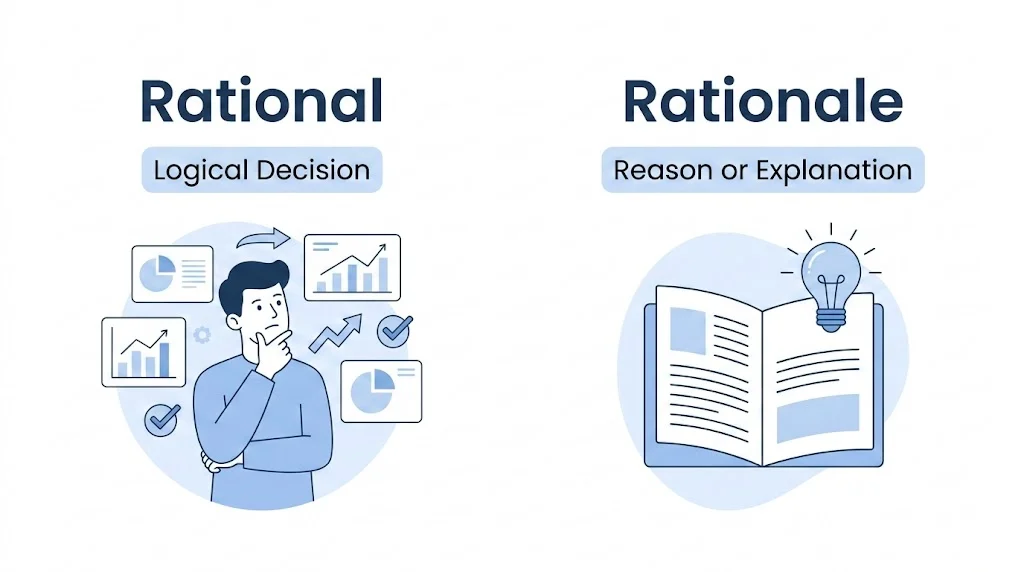
Rational is an adjective that describes something logical, reasonable, or based on clear thinking. Rationale is a noun that means the underlying reason, explanation, or justification for something. Use rational to describe decisions or behavior, and use rationale when referring to the explanation behind those decisions.
Many English learners and even fluent writers feel confused about rational vs rationale. These two words look almost identical and share a similar origin, but they have completely different grammatical roles and meanings. A small difference in spelling changes how the word functions in a sentence. Because of this similarity, people often misuse one in place of the other.
If you have ever wondered whether to write “a rational decision” or “the rationale decision,” you are not alone. This confusion appears frequently in academic writing, professional communication, business reports, and exam essays. Understanding the distinction between rational and rationale is important for clarity, credibility, and strong writing.
In this complete guide, you will learn the exact difference between rational and rationale, grammar rules, pronunciation, real-world examples, common mistakes, memory tricks, practice exercises with answers, and frequently asked questions. By the end, you will confidently know when to use each word correctly.
Quick Answer
Rational is an adjective that describes something logical or based on reason.
Rationale is a noun that refers to the explanation or reason behind an action or decision.
Simple Examples
- She made a rational choice.
- The manager explained the rationale for the new policy.
Easy Tip
If you are describing something as logical, use rational.
If you are explaining the reason behind something, use rationale.
Understanding the Meaning of Rational
Definition of Rational
Rational means based on logic, reason, or clear thinking. It describes actions, decisions, beliefs, or behavior that are sensible and not emotional or impulsive.
It answers the question: Is this logical?
Rational Is an Adjective
Since rational is an adjective, it describes a noun.
Examples:
- A rational argument
- A rational explanation
- A rational person
- A rational decision
Example Sentences
- It was a rational decision to save money instead of spending it.
- He gave a rational response during the debate.
- Investors made rational choices during the market change.
- Staying calm was the rational thing to do.
Opposite of Rational
The opposite of rational is irrational, which means not logical or unreasonable.
Example:
- His fear of harmless insects was irrational.
Understanding this contrast helps reinforce the meaning of rational.
Understanding the Meaning of Rationale
Definition of Rationale
Rationale means the underlying reason, explanation, or justification for something. It refers to the reasoning behind an action or decision.
It answers the question: Why was this done?
Rationale Is a Noun
Because rationale is a noun, it names a thing. Specifically, it names the explanation behind something.
Examples:
- The rationale for the rule
- The rationale behind the decision
- A clear rationale
- The project rationale
Example Sentences
- The teacher explained the rationale for changing the syllabus.
- The company shared the rationale behind the price increase.
- Understanding the rationale helps employees accept change.
- The report provides the rationale for the new strategy.
Common Word Pairings
Rationale often appears with words like:
- Behind
- For
- Explain
- Provide
- Justify
- Support
Example:
- What is the rationale behind this decision?
Grammar Rules Explained Clearly
Understanding grammar roles removes confusion.
Rational Is an Adjective
Adjectives describe nouns.
Correct:
- A rational plan
- Rational thinking
Incorrect:
- The rational for this policy is unclear.
Here, rational is incorrectly used as a noun.
Rationale Is a Noun
Nouns name things.
Correct:
- The rationale for this policy is clear.
Incorrect:
- She made a rationale decision.
Here, rationale incorrectly modifies decision, which requires an adjective.
Pronunciation Differences
Although similar, they are pronounced slightly differently.
- Rational: ra shuh nul
- Rationale: ra shuh nal
The ending sound of rationale is slightly longer.
Even though pronunciation differs slightly, confusion still occurs in writing because the spellings look similar.
Why People Confuse Rational vs Rationale
Similar Spelling
Both words share the same root and look almost identical.
Same Root Origin
Both come from the Latin word meaning reason. Because of shared origins, their meanings are related.
Lack of Grammar Awareness
Writers often forget that one is an adjective and the other is a noun.
Academic Usage
Both words frequently appear in essays and research papers, increasing the chances of misuse.
Rational vs Rationale in Real-Life Usage
In Academic Writing
- The researcher provided a clear rationale for the study.
- The hypothesis was based on rational analysis.
Business Communication
- The CEO explained the rationale behind restructuring.
- A rational strategy reduces financial risk.
In Daily Conversation
- That was a rational decision.
- What is the rationale for this rule?
In Professional Reports
- The report outlines the rationale for expansion.
- Rational budgeting prevents overspending.
Which One Should You Use
Ask yourself a simple question.
Are you describing something logical? Use rational.
Are you explaining the reason behind something? Use rationale.
Quick Test
If the word describes a noun, use rational.
If the word names the reason, use rationale.
Example:
- A rational explanation
- The rationale for the explanation
Common Mistakes and Corrections
Wrong: She made a rationale decision.
Correct: She made a rational decision.
Wrong: The rational behind the policy is unclear.
Correct: The rationale behind the policy is unclear.
Wrong: He explained the rational for the project.
Correct: He explained the rationale for the project.
Wrong: We need a rationale approach.
Correct: We need a rational approach.
Rational vs Rationale in Extended Examples
Simple Sentences
- He gave a rational answer.
- The rationale for the answer was explained later.
Medium Sentences
- Choosing a safer option was rational under the circumstances.
- The manager shared the rationale for reducing costs.
Advanced Sentences
- A rational investor evaluates risk before making decisions.
- The committee presented a detailed rationale for policy reform.
Synonyms of Rational
- Logical
- Reasonable
- Sensible
- Practical
- Sound
Example:
- It was a sensible and rational decision.
Synonyms of Rationale
- Reason
- Explanation
- Justification
- Basis
- Argument
Example:
- The explanation behind the plan was convincing.
Practice Exercises
Fill in the Blanks
- She made a ______ choice.
Answer: rational - The manager explained the ______ for the change.
Answer: rationale - Investors prefer ______ strategies.
Answer: rational - The report includes the ______ behind the decision.
Answer: rationale - It was a calm and ______ reaction.
Answer: rational
Choose the Correct Word
- The company provided a clear (rational / rationale).
Answer: rationale - It was a (rational / rationale) response.
Answer: rational - The teacher explained the (rational / rationale) for homework.
Answer: rationale - Making a budget is a (rational / rationale) action.
Answer: rational
Advanced Usage in Academic Writing
In academic contexts, both words appear frequently but serve different functions.
Example in research paper:
- The rationale for this study is to examine behavioral patterns.
- The research design follows a rational structure.
Notice that rationale introduces purpose, while rational describes structure.
Rational vs Rationale in Business Strategy
Business professionals often use both words.
Example:
- A rational investment minimizes risk.
- The rationale for expansion includes market growth.
Using them correctly improves clarity and professionalism.
Memory Trick to Remember the Difference
Look at the endings.
Rational ends in al and describes something.
Rationale ends in ale and names the explanation.
Think of rationale as containing the word tale. A tale is a story or explanation. That reminds you that rationale is the explanation.
FAQs
What is the main difference between rational and rationale?
Rational is an adjective meaning logical, while rationale is a noun meaning the explanation or reason behind something.
Can rational and rationale be used interchangeably?
No, they cannot be used interchangeably because they have different grammatical roles.
Is rationale formal English?
Yes, rationale is commonly used in academic, business, and professional writing.
What part of speech is rational?
Rational is an adjective that describes nouns.
What part of speech is rationale?
Rationale is a noun that names a reason or explanation.
Why do people confuse rational vs rationale?
Because they look similar, share the same root origin, and both relate to reasoning.
Can I say rationale decision?
No, you should say rational decision because decision needs an adjective.
How do I remember the difference easily?
Remember that rationale refers to the reason, and rational describes something logical.
Conclusion
The difference between rational vs rationale becomes clear once you understand their grammar roles. Rational is an adjective that describes something logical or sensible. Rationale is a noun that refers to the explanation or justification behind an action.
Most confusion happens because both words look similar and share the same root related to reason. However, remembering that rational describes and rationale explains makes the distinction simple.
Using these words correctly improves clarity in academic writing, business communication, and professional reports. With practice and awareness, choosing between rational and rationale becomes easy and natural.