
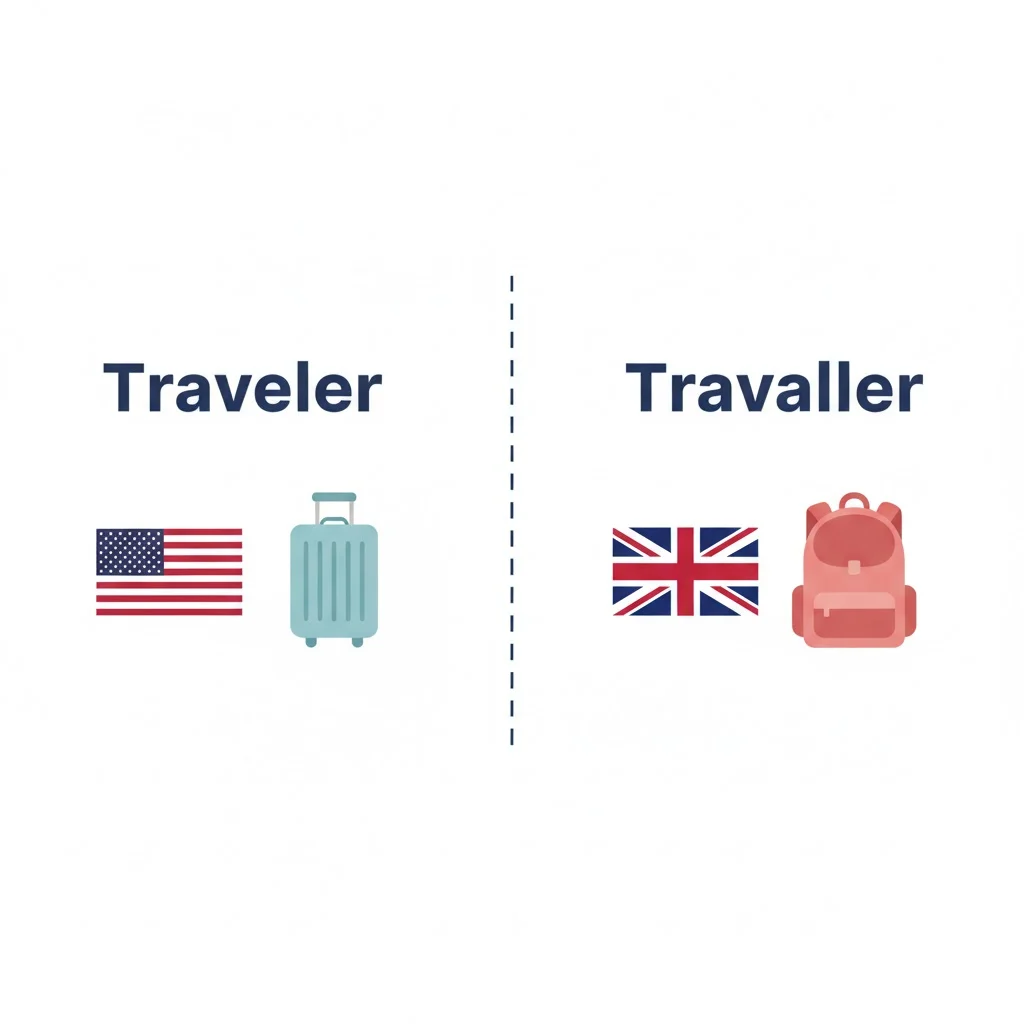
Traveler and traveller mean the same thing. The difference is spelling. Traveler is used in American English. Traveller is used in British English and most Commonwealth countries. Choose the spelling based on your audience and region.
Many writers pause when typing traveler vs traveller. Both spellings look correct. Both are seen in books, blogs, and news. So which one should you use?
This confusion happens because English has two main spelling systems: American and British. Some words differ by one letter. In this case, the difference is a single extra l. People search for “traveler vs traveller” to avoid mistakes in essays, resumes, websites, and professional writing. Using the wrong regional spelling can make content look inconsistent or careless.
The good news is simple. Both words are correct. The right choice depends on your audience. In this complete guide, you will learn the grammar rule behind the spelling difference, the history of both forms, real world examples, common mistakes, related words, exercises with answers, and clear advice on which spelling to use.
Quick Answer
Both traveler and traveller are correct.
- Traveler is the American English spelling.
- Traveller is the British English spelling.
Simple Examples
- American English: She is a frequent traveler.
- British English: She is a frequent traveller.
The meaning does not change. Only the spelling changes.
Grammar Rule Depth
To understand traveler vs traveller, we need to understand how English handles doubled consonants.
The Base Word
The base word is travel.
When adding the suffix er, the spelling changes depending on the version of English used.
American English Rule
In American English, many words ending in a vowel plus consonant do not double the final consonant when adding a suffix, unless the stress falls on the last syllable.
Since the stress in travel is on the first syllable, American English keeps one l:
- travel + er = traveler
- travel + ing = traveling
British English Rule
British English often doubles the final l when adding suffixes like er, ing, or ed, even if the stress is not on the last syllable.
So in British English:
- travel + er = traveller
- travel + ing = travelling
- travel + ed = travelled
This is why the difference exists.
The Origin of Traveler and Traveller
The word travel comes from Old French and Latin roots. Over time, English adopted and adapted it.
In the 18th and 19th centuries, spelling systems were not fully standardized. American English began to simplify spellings. One major influence was Noah Webster, who preferred simpler forms.
American English removed extra letters in many words:
- colour → color
- centre → center
- traveller → traveler
British English kept traditional spellings, including doubled consonants.
That is why today we see both traveler and traveller.
British English vs American English Spelling
This is a regional spelling difference.
American English
- traveler
- traveling
- traveled
British English
- traveller
- travelling
- travelled
Comparison Table
| American English | British English |
|---|---|
| traveler | traveller |
| traveling | travelling |
| traveled | travelled |
| counselor | counsellor |
| jeweler | jeweller |
Both forms are correct within their spelling systems.
Which Spelling Should You Use
The answer depends on your audience.
If Your Audience Is in the United States
Use traveler.
American schools, businesses, and publishers expect American spelling.
If Your Audience Is in the United Kingdom
Use traveller.
British publishers and institutions follow British spelling rules.
If Your Audience Is Global
Choose one system and stay consistent.
Consistency is more important than the specific spelling. Do not mix traveler and traveller in the same document.
Why People Confuse Traveler vs Traveller
Both Appear Online
Search engines show both spellings, which increases confusion.
Spell Check Settings
If your computer is set to US English, it will flag traveller as incorrect. If set to UK English, it will flag traveler.
Copy and Paste Writing
Writers sometimes copy text from different sources and mix spelling systems.
Weak Awareness of Regional Differences
Many learners do not realize that American and British English differ in spelling rules.
Traveler vs Traveller in Real World Usage
In News
American news websites use traveler.
British newspapers use traveller.
In Books
American publishers print traveler.
British publishers print traveller.
In Government Documents
US government uses traveler.
UK government uses traveller.
In Tourism Industry
American travel blogs use traveler.
British travel blogs use traveller.
Traveler vs Traveller in Sentences
American Style
- The solo traveler explored Europe.
- She is a frequent business traveler.
British Style
- The solo traveller explored Europe.
- She is a frequent business traveller.
The meaning remains exactly the same.
Common Mistakes and Corrections
Wrong: She is a world traveller. (In US document)
Correct: She is a world traveler.
Wrong: He is an experienced traveler. (In UK essay)
Correct: He is an experienced traveller.
Wrong: The company helps travellers and travelers book flights.
Correct: Choose one spelling and stay consistent.
Related Words With Similar Differences
Many words follow the same American vs British pattern.
| American | British |
|---|---|
| traveler | traveller |
| counselor | counsellor |
| modeler | modeller |
| jeweler | jeweller |
| marveled | marvelled |
| fueling | fuelling |
Understanding this pattern helps avoid future confusion.
Google Trends and Usage by Region
Search behavior shows clear regional preference.
- United States searches more for traveler.
- United Kingdom, Canada, and Australia search more for traveller.
Both keywords have strong search volume because people want to confirm correct spelling.
Practice Exercises
Fill in the Blanks
- She is an experienced world ______.
Answer: traveler or traveller depending on region - The ______ packed his suitcase.
Answer: traveler or traveller - A solo ______ must plan carefully.
Answer: traveler or traveller - The frequent ______ earned reward points.
Answer: traveler or traveller
Choose the Correct Spelling for US English
- business traveller / business traveler
Answer: business traveler - frequent traveller / frequent traveler
Answer: frequent traveler
Choose the Correct Spelling for UK English
- world traveler / world traveller
Answer: world traveller - solo traveler / solo traveller
Answer: solo traveller
FAQs
What is the difference between traveler and traveller?
The difference is spelling. Traveler is American English. Traveller is British English.
Is traveler correct spelling?
Yes. Traveler is correct in American English.
Is traveller wrong?
No. Traveller is correct in British English.
Which spelling is more common worldwide?
Traveler is more common in the United States. Traveller is common in the UK and Commonwealth countries.
Can I use both in the same article?
No. Choose one spelling system and stay consistent.
Why does British English double the l?
British spelling often doubles the final consonant when adding suffixes.
Does the meaning change between traveler and traveller?
No. Both words have the same meaning.
Conclusion
The confusion between traveler vs traveller is not about right or wrong. It is about regional spelling differences. American English uses traveler with one l. British English uses traveller with two l letters. The meaning stays the same in both versions.
Understanding this difference helps you write with confidence. The key is consistency. If you write for an American audience, use traveler. If you write for a British or Commonwealth audience, use traveller. Do not mix both spellings in one document.
Now that you understand the grammar rule, origin, real world usage, and regional differences, you can choose the correct spelling easily. Clear and consistent writing builds trust and professionalism.