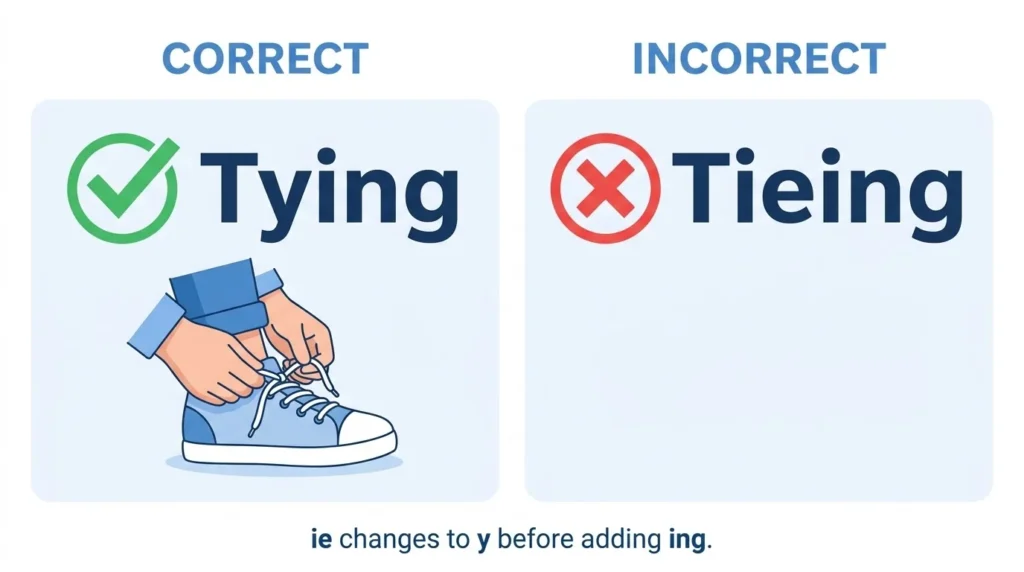
Tying is the correct present participle and gerund form of the verb tie. Tieing is incorrect in modern English. When a verb ends in ie, the ie changes to y before adding ing, which is why tie becomes tying, not tieing.
Many writers pause when typing the word tying and wonder if it should be spelled tieing instead. This confusion is very common because the base word is tie, and naturally people think adding ing should make it tieing. However, English spelling rules change the word before adding ing.
People search for “tying vs tieing” because they want to know which spelling is correct and why the spelling changes. This confusion appears in school writing, professional emails, blog posts, and even published content. A small spelling error can make writing look careless.
In this complete guide, you will learn the correct spelling, grammar rules, word formation patterns, why people make this mistake, real-world usage, detailed examples, exercises with answers, and expert tips to remember the rule forever.
Tying vs Tieing Quick Answer
Tying is correct.
Tieing is incorrect.
Simple Examples
- She is tying her shoes.
- He is tying a knot.
- The sailor is tying the rope securely.
You should never use tieing in standard English.
Grammar Rule Explained Clearly
To understand why tying is correct, we must understand how verbs ending in ie behave when adding ing.
Core Rule
When a verb ends in ie, change ie to y, then add ing.
Formula
ie → y + ing
Example
tie → tying
die → dying
lie → lying
This is a consistent spelling rule in English.
Why Does English Change ie to y
English spelling tries to make words easier to pronounce and read. If we kept the original spelling and simply added ing, we would get:
tieing
dieing
lieing
These forms look awkward and are harder to read. Changing ie to y makes the word smoother and easier to pronounce.
This rule applies only when adding ing, not when adding s or d.
Understanding Present Participles and Gerunds
To fully understand tying vs tieing, we need to understand what tying actually is grammatically.
Present Participle
A present participle is formed by adding ing to a verb. It is used in continuous tenses.
Example
She is tying her shoes.
Gerund
A gerund is a verb ending in ing that functions as a noun.
Example
Tying knots takes practice.
In both cases, the correct form is tying.
Why People Write Tieing
Despite the rule being clear, many writers still use tieing. Here are the main reasons.
Logical Assumption
People think the word is tie, so adding ing should create tieing. This seems logical but ignores spelling rules.
Lack of Awareness of ie Rule
Many learners are unaware that verbs ending in ie follow a special transformation rule.
Autocorrect Confusion
Some basic writing tools do not always flag tieing as incorrect, especially in informal contexts.
Rare Exposure to the Rule
Many grammar lessons focus on common patterns like adding ing, but not on special transformations like ie to y.
Tying vs Tieing in Real World Usage
Seeing the correct spelling in different contexts builds confidence.
Daily Life
- She is tying her shoelaces.
- He is tying the ribbon around the gift.
- The climber is tying the safety rope.
Academic Writing
- The report discusses tying theory to practice.
- Tying historical events together improves understanding.
Professional Emails
- I am tying up the final details of the project.
- She is tying the documents for submission.
Sports
- The athlete is tying his shoes before the race.
- Tying the match at the last minute changed the result.
Tying as Part of Phrasal Verbs
The word tying appears in many phrasal verbs.
Tying Up
- She is tying up loose ends.
- The meeting is tying up resources.
Tying In
- The theme is tying in with the main message.
- This idea is tying in perfectly with our goals.
These common phrases always use tying, never tieing.
British and American English Usage
There is no difference between British and American English.
Both use:
tie → tying
die → dying
lie → lying
The spelling rule is universal in modern English.
Words That Follow the Same Rule
Learning similar words strengthens understanding.
die → dying
lie → lying
vie → vying
All follow the same pattern: change ie to y before adding ing.
Words That Do Not Follow This Rule
This rule applies only when adding ing. Other endings behave differently.
tie → tied
tie → ties
Here, the spelling of tie does not change.
Common Mistakes and Corrections
Wrong
She is tieing her shoes.
Correct
She is tying her shoes.
Wrong
He is tieing a knot.
Correct
He is tying a knot.
Wrong
The sailor is tieing the rope.
Correct
The sailor is tying the rope.
Wrong
Tieing takes patience.
Correct
Tying takes patience.
Tying vs Tieing in Sentences
Simple Sentences
- She is tying her hair.
- He is tying the rope.
Medium Sentences
- The child is tying his shoelaces carefully.
- The sailor is tying the boat to the dock.
Formal Sentences
- The researcher is tying theoretical concepts to practical applications.
- Tying together multiple perspectives strengthens the argument.
Deep Grammar Breakdown
Let us examine the spelling transformation carefully.
The verb tie ends in ie. English avoids stacking vowels awkwardly before adding ing. Therefore:
tie + ing would visually create tieing.
To prevent awkward vowel clusters and pronunciation confusion, the ie transforms into y.
This is not optional. It is a standard orthographic rule in English morphology.
The same logic applies to:
die → dying
lie → lying
If we wrote dieing or lieing, pronunciation and readability would become inconsistent.
Historical Perspective
Older English sometimes showed alternative spellings in informal contexts, but modern standardized English dictionaries recognize only tying as correct.
Modern grammar authorities consistently reject tieing.
Why Tying Looks Unusual at First
Some writers think tying looks strange because:
- The base word is tie.
- The y appears suddenly.
- It looks like the base word changes too much.
However, once you see dying and lying, the pattern becomes clear.
Memory Trick
Remember this simple sentence:
If a verb ends in ie, change ie to y before adding ing.
Think of:
Die becomes dying
Lie becomes lying
Tie becomes tying
If you remember dying and lying, you will never forget tying.
Practice Exercises
Fill in the Blanks
- She is ______ her shoes.
Answer: tying - He is ______ the rope tightly.
Answer: tying - The child is ______ a ribbon.
Answer: tying - The sailor is ______ the boat.
Answer: tying - ______ knots requires patience.
Answer: Tying
Choose the Correct Word
- She is (tying / tieing) her hair.
Answer: tying - He is (tying / tieing) a knot.
Answer: tying - The athlete is (tying / tieing) his shoes.
Answer: tying - (Tying / Tieing) takes practice.
Answer: Tying
Advanced Usage Examples
Academic Context
- Tying evidence to theory strengthens research validity.
- Scholars are tying historical records to modern interpretations.
Business Context
- We are tying up the final contract details.
- The team is tying marketing strategy to consumer behavior.
Creative Writing
- She stood quietly, tying a ribbon in her hair.
- He focused on tying the final knot before sunset.
FAQs
Is tieing ever correct in English?
No, tieing is not correct in modern standard English. The correct spelling is tying.
Why does tie change to tying?
When a verb ends in ie, English changes ie to y before adding ing.
Is tying used in both American and British English?
Yes, both American and British English use tying as the correct spelling.
Does this rule apply to all verbs ending in ie?
Yes, when adding ing, verbs ending in ie change ie to y.
What is the gerund form of tie?
The gerund form of tie is tying.
What is the present participle of tie?
The present participle of tie is tying.
Why do people write tieing?
Because they assume adding ing does not change the original spelling, but English spelling rules require the change.
Conclusion
The confusion between tying and tieing is common but easy to fix. The correct spelling is always tying. English spelling rules require that verbs ending in ie change ie to y before adding ing. This transformation prevents awkward spelling and improves pronunciation.
Understanding this rule helps with other words like dying and lying. Once you recognize the pattern, you will never hesitate again. Clear spelling improves clarity, professionalism, and writing quality. Whether in school essays, professional emails, or creative writing, using tying correctly shows strong command of English grammar.
Now you can confidently choose tying every time.