
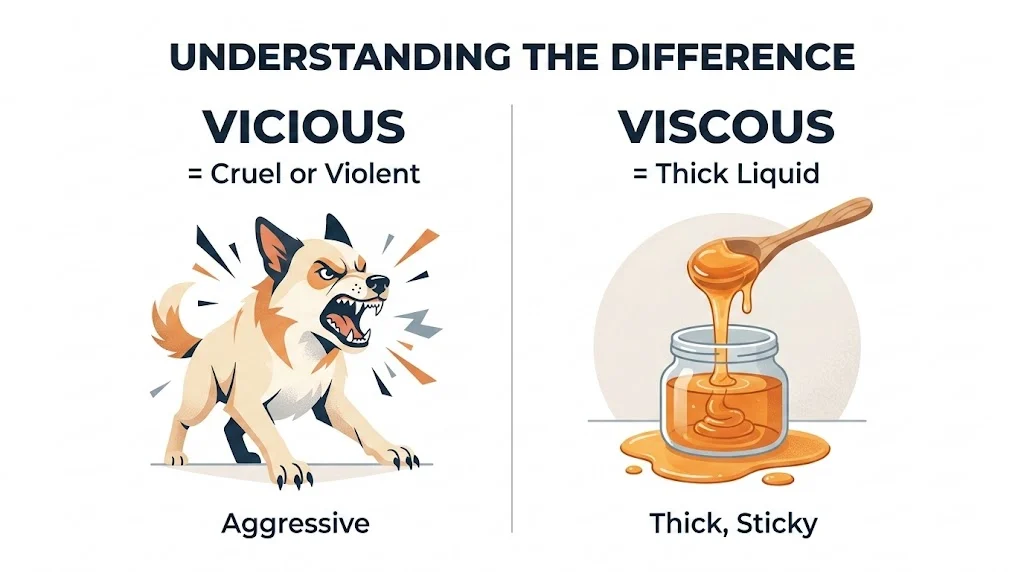
Vicious means cruel, violent, or aggressive behavior. Viscous describes a thick, sticky liquid that flows slowly. Use vicious for harmful actions or harsh words, and use viscous for substances like oil, syrup, or lava.
Many writers get confused between vicious vs viscous because the words look similar and sound almost the same. The spelling difference is small, but the meanings are completely different. Using the wrong word can change your sentence and make your writing unclear.
People search for “vicious vs viscous” because both words appear in news articles, science discussions, school essays, and daily conversation. A single letter can turn a sentence about violence into one about thick liquids. This mistake happens often in exams, blog posts, and professional writing.
Understanding the difference between vicious and viscous improves clarity and confidence. In this complete guide, you will learn detailed grammar explanations, real-world examples, common mistakes, related confusing words, practical exercises with answers, and easy memory tips to help you choose the correct word every time.
Quick Answer
Vicious describes cruelty, aggression, or harmful behavior.
Viscous describes a thick liquid that moves slowly.
Simple Examples
- The dog became vicious when provoked.
- The oil is very viscous in cold weather.
- He made a vicious comment.
- Honey is thick and viscous.
Quick Memory Trick
- Vicious contains the word “vice,” which relates to bad behavior.
- Viscous sounds like “sticky,” which relates to thick liquids.
Grammar Rules and Word Meaning Explained
What Does Vicious Mean
Vicious is an adjective. It describes a person, action, or behavior that is cruel, violent, aggressive, or deliberately harmful.
It can also describe something severe or intense.
Examples
- The criminal committed a vicious attack.
- She faced vicious criticism online.
- A vicious storm destroyed homes.
What Does Viscous Mean
Viscous is also an adjective. It describes liquids that are thick and resist flow.
Scientists often use this word when discussing fluids.
Examples
- The engine oil became more viscous in winter.
- Lava is extremely viscous.
- The syrup is thick and viscous.
Deep Meaning of Vicious
The word vicious refers to harmful intent or extreme severity. It can describe people, animals, actions, criticism, or cycles.
Vicious Behavior
- A vicious dog may bite without warning.
- A vicious criminal shows no mercy.
Vicious Language
- Online users posted vicious comments.
- The debate turned vicious quickly.
The Vicious Cycle
A vicious cycle describes a negative situation that repeats and worsens over time.
- Poverty can create a vicious cycle of debt.
- Stress may lead to a vicious cycle of poor health.
Deep Meaning of Viscous
The word viscous is scientific and physical. It describes resistance to movement in liquids.
Viscous Liquids
- Honey is more viscous than water.
- Molten glass is highly viscous.
Scientific Usage
In physics and chemistry, viscosity measures how thick a liquid is.
- Oil has higher viscosity than water.
- Blood becomes more viscous in cold temperatures.
Everyday Usage
- The sauce is too viscous to pour easily.
- The shampoo feels thick and viscous.
Why People Confuse Vicious vs Viscous
Similar Spelling
Only one letter differs between the two words.
Similar Pronunciation
They sound almost identical when spoken quickly.
Rare Usage of Viscous
Many people use “vicious” more often than “viscous,” so they default to the familiar word.
Spellcheck Limitations
Spellcheck tools may not catch the error because both words are correctly spelled English words.
Vicious vs Viscous in Real World Usage
News and Media
- The suspect carried out a vicious assault.
- The oil spill created a thick, viscous layer on the water.
Academic Writing
- The research analyzed viscous fluid dynamics.
- The article described a vicious cycle of violence.
Business and Economy
- Inflation can create a vicious economic cycle.
- Industrial lubricants are often highly viscous.
Social Media
- The celebrity received vicious online criticism.
- The product feels thick and viscous.
Which Word Should You Use
Ask yourself this question:
Are you describing behavior or cruelty? Use vicious.
Are you describing a thick liquid? Use viscous.
Quick Test
If you can replace it with “cruel” or “violent,” use vicious.
If you can replace it with “thick” or “sticky,” use viscous.
Common Mistakes and Corrections
Wrong: The syrup tasted vicious.
Correct: The syrup tasted viscous.
Wrong: The criminal poured viscous insults online.
Correct: The criminal poured vicious insults online.
Wrong: The vicious liquid moved slowly.
Correct: The viscous liquid moved slowly.
Wrong: He faced viscous criticism.
Correct: He faced vicious criticism.
Related Confusing Word Pairs
Learning similar word pairs improves vocabulary accuracy.
- Affect vs Effect
- Compliment vs Complement
- Principal vs Principle
- Stationary vs Stationery
- Eminent vs Imminent
These words, like vicious vs viscous, have similar spelling but different meanings.
Practice Exercises
Fill in the Blanks
- The dog became ______ after being mistreated.
Answer: vicious - The oil is too ______ to pour quickly.
Answer: viscous - She faced ______ criticism online.
Answer: vicious - Honey is thick and ______.
Answer: viscous - Poverty can create a ______ cycle.
Answer: vicious
Choose the Correct Word
- The lava is extremely (vicious / viscous).
Answer: viscous - He launched a (vicious / viscous) attack.
Answer: vicious - The shampoo feels thick and (vicious / viscous).
Answer: viscous - She made a (vicious / viscous) comment.
Answer: vicious
FAQs
What is the main difference between vicious and viscous?
Vicious means cruel or aggressive behavior, while viscous describes a thick liquid that flows slowly.
Can vicious describe a liquid?
No, vicious describes harmful behavior or actions, not physical substances.
Can viscous describe a person?
No, viscous is used for liquids, not people or behavior.
Why are vicious and viscous commonly confused?
They look similar and sound almost the same when spoken.
Is vicious always negative?
Yes, vicious carries a negative meaning related to harm or aggression.
Is viscous a scientific word?
Yes, viscous is often used in science to describe fluid thickness.
What is a vicious cycle?
A vicious cycle is a negative situation that repeats and worsens over time.
Conclusion
The confusion between vicious vs viscous is understandable because the words look and sound similar. However, their meanings are completely different. Vicious refers to cruelty, aggression, or harmful behavior. Viscous refers to thick liquids that move slowly.
Remember the simple memory trick: vicious relates to vice or bad behavior, and viscous relates to sticky substances. By understanding their meanings, usage, and examples, you can avoid this common mistake and write with clarity and confidence.
Choosing the correct word improves communication and prevents misunderstanding. With practice and awareness, mastering vicious vs viscous becomes easy and natural.