
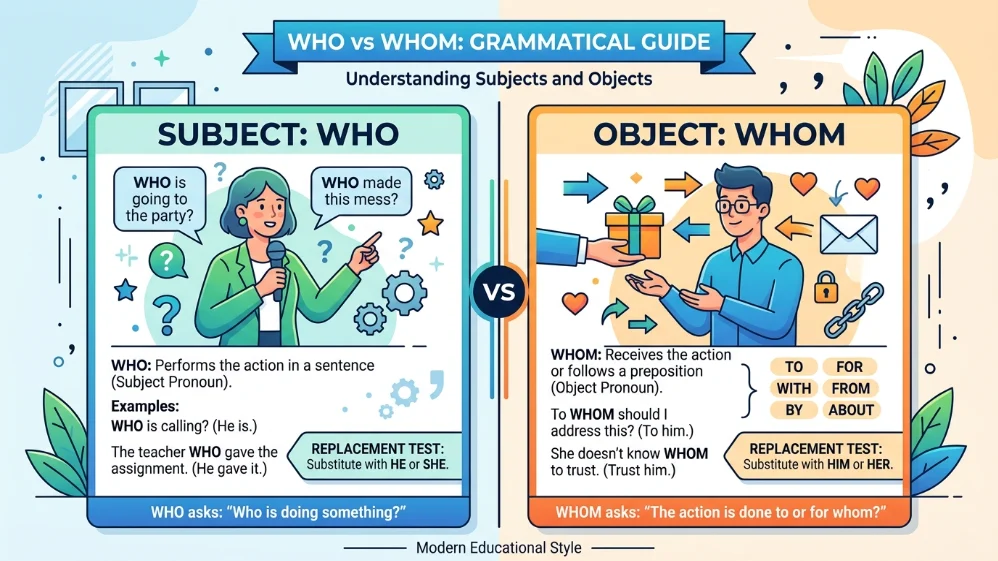

Use who when referring to the subject of a sentence and whom when referring to the object. Example: Who called you? Whom did you call?
I used to avoid using whom completely because I never felt confident about where it belonged. During writing emails and articles, I often replaced it with who because it felt easier. Later, while editing professional content, I realized that understanding one simple grammar rule solved almost everything. The trick was learning whether the word acts as the subject or the object.
After practicing this rule in everyday writing, I stopped second guessing myself. If you also hesitate before typing who or whom, this guide will help you understand the difference with simple explanations, examples, grammar rules, exercises, and real world usage.
Quick Answer
Who is used for the subject of a sentence.
Whom is used for the object of a sentence.
Examples
Who called you?
Whom did you invite?
Easy Rule
If you can replace the word with he / she, use who.
If you can replace it with him or her, use whom.
Who Meaning
Who refers to the person performing an action.
Think of who as the subject.
Examples
- Who wrote this article?
- Who wants pizza?
- Who is speaking?
In all these examples, the person is doing the action.
Whom Meaning
Whom refers to the person receiving an action.
Think of whom as the object.
Examples
- Whom did you call?
- Whom should I contact?
- Whom were they helping?
The person receives the action instead of performing it.
Who vs Whom Difference
| Word | Function | Grammar Role | Example |
|---|---|---|---|
| Who | Subject | Performs action | Who called? |
| Whom | Object | Receives action | Whom did you call? |
Key Rule
Who performs.
Whom receives.
Grammar Rule Depth
Understanding grammar rules makes this topic much easier.
Who Is a Subject Pronoun
Subject pronouns perform actions.
Examples:
He runs.
She speaks.
They work.
Since who acts like these words, use who when talking about subjects.
Example:
Who opened the door?
Whom Is an Object Pronoun
Object pronouns receive actions.
Examples:
Call him.
Invite her.
Help them.
Since whom behaves similarly, use it when the word receives an action.
Example:
Whom did you invite?
The He and Him Trick
This is the easiest method.
Replace the word with he or him.
If he works, use who.
If him works, use whom.
Example:
Who called?
He called.
Correct.
Example:
Whom did you call?
You called him.
Correct.
Why People Confuse Who and Whom
Several reasons create confusion.
Formal Grammar Rules
Many people learn the rule but rarely practice it.
Spoken English Simplification
Modern speech often replaces whom with who.
Fear of Sounding Wrong
People avoid whom because they worry about mistakes.
The Origin of Who and Whom
Both words come from Old English.
Who developed from early Germanic words for subjects.
Whom evolved as an object form.
Historically, English used many object forms.
Over time, some disappeared while whom remained.
Today, whom survives mostly in formal English.
British English vs American English Usage
Both regions understand both words.
However, usage differs slightly.
| Region | Who Usage | Whom Usage |
|---|---|---|
| American English | Very common | Less common |
| British English | Common | Slightly more common formally |
American English often replaces whom with who.
British formal writing still preserves whom more often.
Which Spelling Should You Use
Casual Writing
Use who most of the time.
Example:
Who are you texting?
Formal Writing
Use whom when grammar requires it.
Example:
To whom should I address this letter?
Professional Communication
Use correct grammar when possible.
Formal writing still values proper usage.
Who and Whom in Questions
Questions create most confusion.
Subject Questions Use Who
Who broke the window?
Who called earlier?
Object Questions Use Whom
Whom did you call?
Whom should I ask?
Who and Whom After Prepositions
Prepositions often require whom.
Examples:
To whom are you speaking?
For whom was this gift purchased?
With whom did you travel?
This rule helps identify whom quickly.
Real World Usage
Emails
Who sent this document?
To whom should I forward this?
Meetings
Who approved the proposal?
Whom should we contact?
Customer Service
Who helped you today?
Whom did you speak with?
Who and Whom in Everyday Examples
Social Media
Who wants coffee?
Who watched this movie?
News Writing
Who won the election?
Whom authorities questioned remains unknown.
Academic Writing
Researchers interviewed students whom teachers recommended.
Common Mistakes With Who and Whom
Mistake 1 Using Who After Prepositions
Incorrect:
To who should I send this?
Correct:
To whom should I send this?
Mistake 2 Overusing Whom
Incorrect:
Whom is calling?
Correct:
Who is calling?
Mistake 3 Avoiding Whom Completely
Formal writing sometimes requires whom.
Ignoring it completely creates errors.
Modern English Usage
Modern English uses who more frequently.
Many native speakers rarely say whom.
However, formal writing still uses it.
Professional communication may expect it.
Understanding both remains valuable.
Usage Trends
Who appears far more frequently than whom.
Why?
Because spoken English prefers simplicity.
Whom survives mainly in:
Formal writing
Academic writing
Legal documents
Professional communication
Related Words
whoever
whomever
whose
who’s
These words create similar confusion.
Learning them improves grammar accuracy.
Tips to Remember Who vs Whom
Remember:
Who equals he
Whom equals him
Also remember:
Subjects perform actions.
Objects receive actions.
This rule solves most problems.
Exercise 1 Choose the Correct Word
______ called yesterday?
Answer: Who
To ______ should I send this email?
Answer: whom
______ wants dessert?
Answer: Who
Exercise 2 Correct the Sentence
To who are you talking?
Answer:
To whom are you talking?
Whom is calling me?
Answer:
Who is calling me?
Exercise 3 He or Him Test
Replace with he or him.
Who should I invite?
Answer:
I should invite him.
Correct word: whom
Who finished the project?
Answer:
He finished the project.
Correct word: who
FAQs
What is the difference between who and whom?
Who is used for subjects while whom is used for objects.
Is whom still used today?
Yes. It remains common in formal writing.
Can I always use who?
In casual speech, often yes. In formal writing, not always.
How do I know whether to use who or whom?
Use the he and him test.
Why is whom disappearing?
Modern English prefers simpler grammar patterns.
Do native speakers still use whom?
Yes, especially in formal contexts.
Is whom necessary in business writing?
Formal business communication may still expect correct usage.
Conclusion
Understanding who and whom becomes much easier when you stop memorizing complicated rules and focus on one simple idea: subjects perform actions while objects receive them.
Who works as a subject pronoun, while whom functions as an object pronoun. Although modern English increasingly prefers who, formal writing still uses whom in many situations.
The easiest way to avoid mistakes is using the he and him test. If he fits, choose who. If him fits, choose whom.
With practice, this difference becomes natural and improves both professional and everyday writing.