
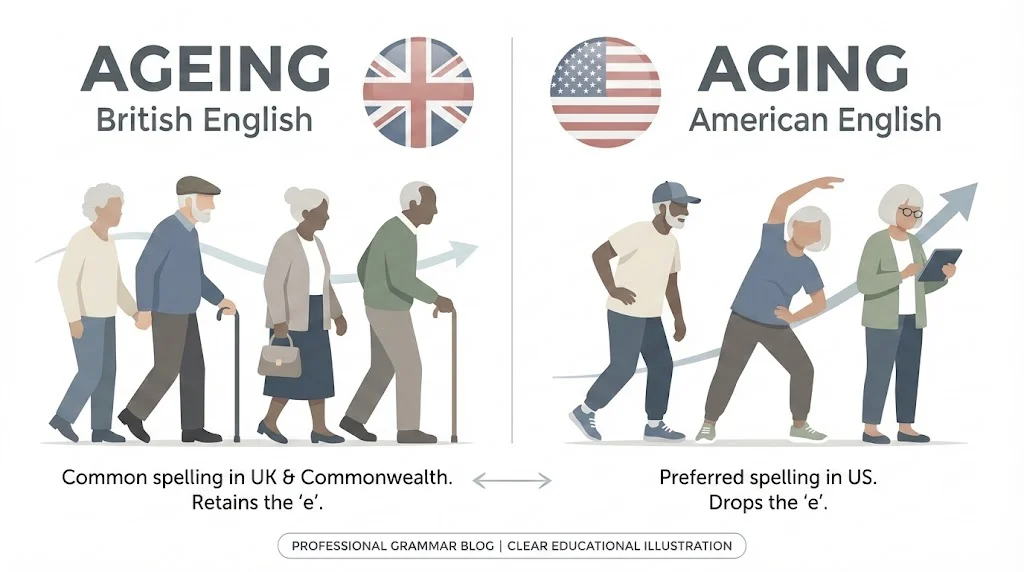
Ageing and aging both mean growing older. Ageing is the preferred spelling in British English, while aging is the standard spelling in American English. The meaning is the same, but the spelling depends on regional language rules.
Many writers feel unsure when choosing between ageing or aging. Both spellings look correct, both appear in books and articles, and both mean the same thing. This creates confusion, especially for students, bloggers, and professionals who want to write correctly.
People search for “ageing or aging” because English spelling rules change based on region. British English often keeps extra letters, while American English prefers simplified spelling. Without knowing this rule, writers may think one spelling is wrong.
This article explains the difference between ageing and aging in a clear and simple way. You will learn grammar rules, spelling logic, regional usage, real life examples, common mistakes, related words, exercises with answers, and helpful tips to choose the correct form every time.
Quick Answer
Both spellings are correct.
Ageing is used in British English.
Aging is used in American English.
Simple Examples
- The population is ageing rapidly.
- The population is aging rapidly.
The meaning does not change. Only the spelling changes based on location.
Grammar Rules Explained Clearly
To understand ageing or aging, we must look at verb formation rules.
Base Word Age
The root word is age.
It can be a noun or a verb.
- Noun: Age affects health.
- Verb: People age over time.
Adding ING to Age
When forming the present participle, English follows spelling rules.
British English Rule
British English keeps the letter e before adding ing.
- Age → Ageing
- Queue → Queueing
- Dye → Dyeing
This rule preserves pronunciation clarity.
American English Rule
American English removes the silent e before adding ing.
- Age → Aging
- Queue → Queuing
- Dye → Dying
This simplifies spelling and reflects pronunciation.
Why Ageing and Aging Both Exist
English evolved differently in different regions.
British English History
British English tends to preserve older spellings. It keeps extra letters to reflect word origins and pronunciation.
That is why ageing remains common in the UK, Australia, and other Commonwealth countries.
American English Simplification
American English favors shorter and simpler spelling. Many words lost silent letters over time.
That is why aging became the standard spelling in the United States.
Both systems are correct within their regions.
Why People Confuse Ageing or Aging
This confusion happens for several reasons.
Both Spellings Look Correct
Unlike spelling mistakes, both ageing and aging appear in dictionaries.
Global English Exposure
People read content from the US and UK online, mixing spelling styles.
Spellcheck Differences
Some spellcheck tools accept both spellings, while others flag one as incorrect.
Academic and Medical Usage
Scientific writing often uses both spellings depending on publication standards.
Unclear Regional Awareness
Many writers do not know which spelling belongs to which region.
Ageing or Aging in Real World Usage
Daily Conversation
- Ageing affects energy levels.
- Aging affects energy levels.
Health and Medical Writing
- Healthy ageing requires balanced nutrition.
- Healthy aging requires balanced nutrition.
News and Media
- The country faces an ageing population.
- The country faces an aging population.
Academic Writing
- Research focuses on cognitive ageing.
- Research focuses on cognitive aging.
Meaning stays the same in all cases.
British and American English Usage
This is where the main difference exists.
British English
Uses ageing consistently.
- Ageing population
- Healthy ageing
- Ageing process
Common in:
- United Kingdom
- Australia
- New Zealand
- South Africa
American English
Uses aging consistently.
- Aging population
- Healthy aging
- Aging process
Common in:
- United States
- American publications
- US academic journals
Which Spelling Should You Use
Choose based on your audience.
Use Ageing If
- Your audience is British or Commonwealth
- You follow UK spelling rules
- You write for UK based institutions
Use Aging If
- Your audience is American
- You follow US spelling rules
- You write for US publications
Important Tip
Do not mix both spellings in the same article. Consistency matters more than choice.
Ageing or Aging in Sentences
Simple Sentences
- Ageing is natural.
- Aging is unavoidable.
Medium Level Sentences
- Healthy ageing improves quality of life.
- Healthy aging improves quality of life.
Formal Writing
- The study examines the biological effects of ageing.
- The study examines the biological effects of aging.
Common Mistakes and Corrections
Wrong: The aging population in the UK is growing.
Correct: The ageing population in the UK is growing.
Wrong: The ageing population in the US needs support.
Correct: The aging population in the US needs support.
Wrong: Mixing spellings in one article.
Correct: Use one spelling consistently.
Related Words With Similar Spelling Rules
Understanding similar words helps remember the rule.
British vs American Spelling Examples
- Ageing vs Aging
- Colour vs Color
- Behaviour vs Behavior
- Labour vs Labor
- Centre vs Center
These differences follow the same regional logic.
Ageing or Aging in Professional Fields
Healthcare
- Focus on healthy ageing strategies.
- Focus on healthy aging strategies.
Psychology
- Cognitive ageing affects memory.
- Cognitive aging affects memory.
Technology
- Technology supports ageing populations.
- Technology supports aging populations.
Economics
- Ageing demographics impact pensions.
- Aging demographics impact pensions.
Style Consistency in Writing
Consistency improves clarity and professionalism.
Good Practice
- Choose one spelling style
- Apply it throughout the article
- Match regional standards
Poor Practice
- Switching between ageing and aging
- Ignoring audience location
- Relying only on spellcheck
Practice Exercises
Fill in the Blanks
- The population is ______ rapidly in the UK.
Answer: ageing - Healthy ______ requires exercise.
Answer: aging or ageing depending on region - Cognitive ______ affects memory.
Answer: aging or ageing - The report studies ______ societies.
Answer: ageing or aging
Choose the Correct Word
- British journals prefer (ageing / aging).
Answer: ageing - American spelling uses (ageing / aging).
Answer: aging - Do not mix (ageing / aging) styles.
Answer: both - The process of growing older is called (ageing / aging).
Answer: both
FAQs
What is the difference between ageing and aging?
Ageing is British English spelling, while aging is American English spelling.
Are ageing and aging both correct?
Yes, both are correct depending on regional language rules.
Which spelling should I use in academic writing?
Use the spelling that matches the journal or institution style guide.
Is ageing wrong in American English?
It is not wrong, but aging is preferred in American English.
Is aging wrong in British English?
It is understood, but ageing is the standard spelling.
Can I use both spellings in one article?
No, always stay consistent with one spelling style.
Do ageing and aging have different meanings?
No, both mean the process of growing older.
Conclusion
The difference between ageing and aging is not about meaning but about spelling tradition. Both words describe the same natural process of growing older. The only difference lies in regional language rules.
British English keeps the letter e and uses ageing, while American English removes it and uses aging. Neither spelling is wrong. What matters most is choosing the correct one for your audience and staying consistent throughout your writing.
Once you understand this rule, the confusion disappears. By applying the correct spelling based on region, your writing becomes clearer, more professional, and easier to read. Ageing or aging, the meaning stays the same. Only the spelling changes.