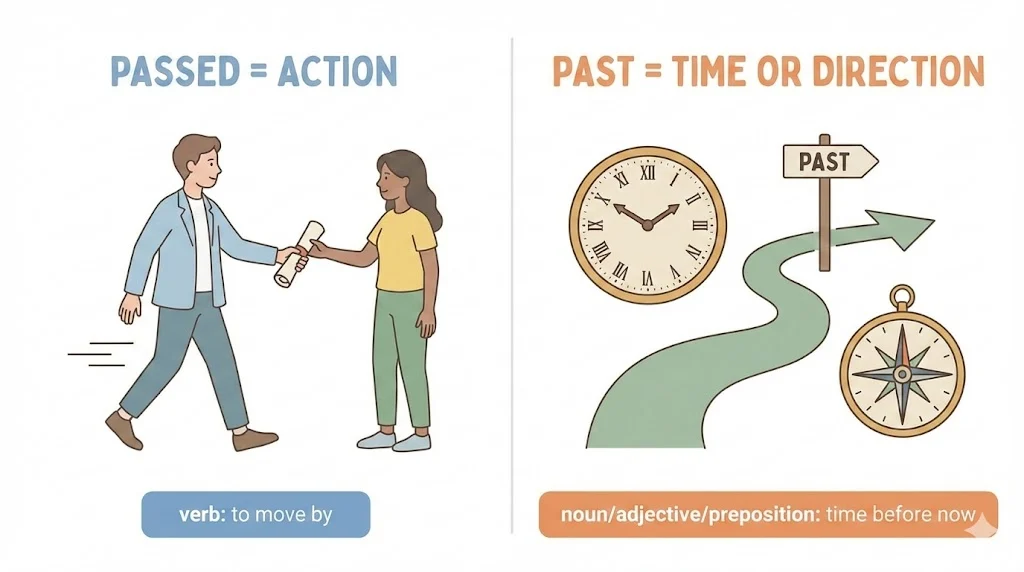

Passed is the past tense of the verb pass, meaning to move by, succeed, or give something. Past is usually a noun, adjective, adverb, or preposition that refers to time gone by or movement beyond something. Use passed when describing an action, and use past when referring to time, position, or direction.
Many writers feel confused about passed or past because the two words sound almost the same but have different meanings and grammar roles. This mistake appears often in school assignments, emails, blog posts, and everyday writing. Choosing the wrong word can change the meaning of a sentence and make writing unclear.
People search for “passed or past” because both words are common in English and are used in many situations. Since pronunciation is similar, writers often guess without knowing the rule. The good news is that the difference becomes simple once you understand how each word works in a sentence.
This article explains everything clearly. You will learn grammar rules, why people make mistakes, real life examples, common errors, related word patterns, practice exercises with answers, and clear FAQs to help you use passed and past confidently every time.
Passed or Past Quick Answer
Passed is a verb. It shows an action that already happened.
Past usually refers to time, direction, or position and is not a verb in most cases.
Simple Examples
- She passed the exam.
- We walked past the park.
- Time has passed quickly.
- Learn from the past.
Easy Tip
If the word shows an action, use passed.
If it refers to time or location, use past.
Grammar Rules Explained
Passed Meaning and Rule
Passed is the past tense of the verb pass. It describes an action that happened earlier.
It can mean:
- Moving by something
- Completing or succeeding
- Giving something to someone
- Time moving forward
Examples
- He passed the ball to his friend.
- She passed her driving test.
- Days passed quickly.
- The car passed us on the highway.
Because it is a verb, it usually appears with a subject performing an action.
Past Meaning and Rule
Past is not usually a verb. It works as:
- A noun
- An adjective
- An adverb
- A preposition
It refers to earlier time or movement beyond something.
Examples
- The past cannot be changed. (noun)
- Past experiences teach us lessons. (adjective)
- Walk past the store. (preposition)
- The runner moved past quickly. (adverb)
Key Grammar Difference
- Passed = action happened
- Past = time, place, or direction
A simple way to test:
If you can replace it with went by or completed, use passed.
Why People Make Mistakes With Passed or Past
Similar Pronunciation
Both words sound very similar, especially in fast speech, making spelling choices difficult.
Both Appear in Similar Contexts
Sentences about movement or time often contain both words.
Example:
- Time passed in the past.
Weak Grammar Awareness
Many people learn English through conversation first and do not focus on parts of speech.
Fast Typing and Editing
Writers often choose the wrong spelling while typing quickly.
Autocorrect Limitations
Spellcheck tools may not catch the mistake because both words are valid English words.
Passed or Past in Real Life Usage
Daily Conversation
- I passed your house yesterday.
- Let us forget the past.
- The bus passed us quickly.
- Walk past the bank and turn left.
Emails
- I passed your message to the manager.
- Please look at our past records.
- The deadline has passed.
Social Media
- Time has passed so fast this year.
- Leave the past behind and move forward.
Formal Writing
- The bill passed in parliament.
- Past performance does not guarantee future results.
British and American English Usage
There is no difference between British and American English.
Both use:
- Passed as the verb
- Past for time or position
Examples
- UK: She passed the interview.
- US: She passed the interview.
- UK: We must learn from the past.
- US: We must learn from the past.
Which One Should You Use
Ask yourself a simple question.
Is this word showing an action?
If yes, use passed.
If no, and it refers to time or direction, use past.
Quick Check
- He went by the house → He passed the house.
- Earlier time → the past
Common Mistakes and Corrections
Wrong: She past the exam.
Correct: She passed the exam.
Wrong: We walked passed the store.
Correct: We walked past the store.
Wrong: The passed is gone.
Correct: The past is gone.
Wrong: Time past quickly.
Correct: Time passed quickly.
Wrong: Drive passed the traffic light.
Correct: Drive past the traffic light.
Passed or Past in More Sentences
Simple Sentences
- He passed the note to me.
- The past is behind us.
Medium Sentences
- She passed the finish line first.
- We walked past the school before lunch.
Formal Sentences
- The proposal passed after discussion.
- Past experiences influence decision making.
Detailed Usage Situations
Passed as Success
- She passed her exam with high marks.
- They passed the final inspection.
Passed as Movement
- The train passed the station.
- A bird passed overhead.
Past as Time Reference
- In the past, people wrote letters by hand.
- The past year was challenging.
Past as Direction
- Walk past the library and turn right.
- The runner moved past the finish line.
Related Grammar Patterns
Understanding similar confusing pairs helps strengthen grammar skills.
- then or than
- your or you’re
- its or it’s
- affect or effect
- their or there
These pairs, like passed or past, confuse writers because pronunciation is similar.
Passed vs Past in Common Expressions
Expressions with Passed
- Time has passed.
- Passed away
- Passed the test
- Passed on information
Expressions with Past
- In the past
- Past tense
- Past experience
- Past midnight
Learning common expressions helps memorization.
Memory Tricks to Remember
Action Rule
If someone is doing something, use passed.
Example:
- She passed the ball.
Time Rule
If it relates to history or earlier time, use past.
Example:
- Forget the past.
Direction Rule
If movement goes beyond something, use past.
Example:
- Walk past the door.
Advanced Examples for Better Understanding
Academic Context
- The student passed all required courses.
- Past research supports this theory.
Business Context
- The project deadline has passed.
- Past performance reviews show improvement.
Travel Context
- We passed three towns on the way.
- The hotel is just past the bridge.
Emotional Context
- She moved past her fears.
- Difficult moments passed with time.
Practice Exercises
Fill in the Blanks
- She ______ the final exam.
Answer: passed - We walked ______ the restaurant.
Answer: past - Time has ______ quickly.
Answer: passed - Learn from the ______.
Answer: past - The car ______ us on the road.
Answer: passed - It is already ______ midnight.
Answer: past
Choose the Correct Word
- He (passed / past) the ball to me.
Answer: passed - We drove (passed / past) the park.
Answer: past - The opportunity has (passed / past).
Answer: passed - She spoke about her (passed / past) experiences.
Answer: past - The train (passed / past) the station quickly.
Answer: passed
Passed or Past in Writing Styles
Informal Writing
- I just walked past your house.
- The weekend passed too fast.
Professional Writing
- The proposal passed committee review.
- Past data shows steady growth.
Academic Writing
- The experiment passed all tests.
- Past literature supports the hypothesis.
Frequently Confused Sentence Patterns
Some sentence structures commonly cause mistakes.
Movement Example
Wrong: Walk passed the gate.
Correct: Walk past the gate.
Time Example
Wrong: The passed cannot be changed.
Correct: The past cannot be changed.
Action Example
Wrong: He past the exam.
Correct: He passed the exam.
Common Writing Tips
- Identify if the word is an action.
- Check whether time or direction is mentioned.
- Read the sentence aloud for meaning, not sound.
- Remember that only passed is a verb.
FAQs
What is the difference between passed and past?
Passed is a verb showing an action that happened, while past refers to time, position, or direction.
When should I use passed in a sentence?
Use passed when describing an action such as moving by, succeeding, or giving something.
When should I use past in a sentence?
Use past when referring to earlier time or movement beyond something.
Is past ever a verb?
No, in modern standard English, past is usually a noun, adjective, adverb, or preposition.
Why do people confuse passed and past?
Because they sound very similar and often appear in similar contexts.
Can passed and past be used together in one sentence?
Yes. Example: Time passed, but memories of the past remained.
Does spelling really matter here?
Yes, using the wrong word changes meaning and can confuse readers.
Conclusion
The difference between passed and past becomes simple once you understand their grammar roles. Passed is always a verb and describes an action that happened. Past refers to time, direction, or position and usually functions as a noun, adjective, adverb, or preposition.
Many writers confuse these words because they sound similar, but using the right one improves clarity and professionalism. Always check whether the sentence describes an action or a reference to time or place. If it is an action, choose passed. If it refers to earlier time or moving beyond something, choose past.
With practice, examples, and the rules in this guide, you can confidently use passed or past correctly in everyday writing, academic work, and professional communication.