
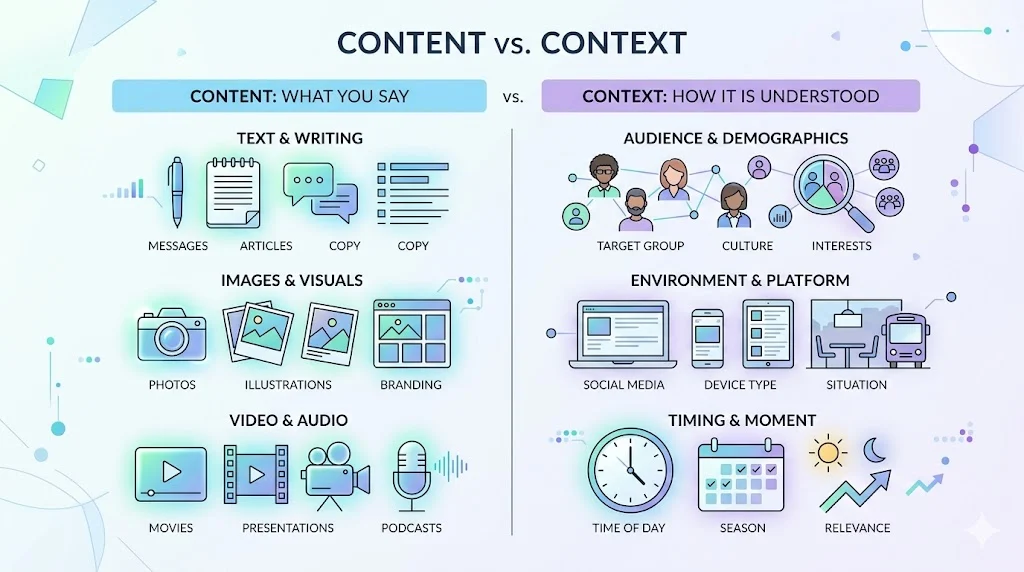
Content is the information or material itself, while context is the situation or background that gives meaning to that content. Content is what you say; context explains what it means.
I used to confuse content and context while writing articles and social media posts. I focused only on what I was saying, not how it would be understood. Once, I shared a message that sounded correct to me, but people misunderstood it completely.
That is when I realized the importance of context. Content delivers the message, but context shapes its meaning. After learning this, I started writing more clearly and thinking about audience, situation, and tone.
If you have ever faced confusion between content and context, this guide will help you understand both deeply and use them correctly in writing, communication, and real life.
Quick Answer
Content is the actual information, words, images, or message.
Context is the situation, background, or setting that explains the meaning of that content.
Examples
The sentence “It is cold here” is content.
Saying it inside a freezer is the context.
Content vs Context Meaning
Content
Content refers to the information, message, or material being communicated.
It can include:
Text
Images
Videos
Audio
Data
Examples:
- This article is content.
- A blog post is content.
- A video tutorial is content.
Context
Context refers to the circumstances, background, or situation that helps explain meaning.
It answers questions like:
Where is it said
Why is it said
Who is saying it
When is it said
Examples:
- The location of a conversation
- The tone of voice
- Cultural background
- Time and situation
Content vs Context Difference
| Aspect | Content | Context |
|---|---|---|
| Definition | Information or message | Situation or background |
| Purpose | Deliver message | Give meaning |
| Focus | What is said | Why and how it is said |
| Example | A sentence | Situation of the sentence |
Key Point: Content without context can be misunderstood.
Grammar Rule Depth
Both content and context are nouns, but they function differently in language.
Content as a Noun
Content refers to material or information.
Example
The website has useful content.
Context as a Noun
Context refers to the environment or situation.
Example
You must understand the context before judging the statement.
Usage Tip
Content answers “what”
Context answers “why” and “how”
The Origin of Content and Context
Content
Comes from Latin contentum, meaning “contained” or “held together.”
It later evolved to mean information or material inside something.
Context
Comes from Latin contextus, meaning “connection” or “woven together.”
It refers to how different elements connect to create meaning.
Why People Confuse Content and Context
- Similar Words – Both start with “cont.”
- Used Together – Often appear in communication discussions.
- Overlapping Roles – Both are important for meaning.
- Lack of Awareness – Many people focus only on content, ignoring context.
Real World Usage of Content and Context
In Communication
Content is the message.
Context is how the message is understood.
Example
Content: “Nice job.”
Context: Could be praise or sarcasm.
In Education
Content is what students learn.
Context helps them understand it.
In Business
Content is marketing material.
Context is audience, timing, and platform.
Content vs Context in Everyday Examples
Emails
Content: Meeting is canceled.
Context: Emergency vs routine change affects tone.
News
Content: A headline
Context: Political or social background
Social Media
Content: A post
Context: Audience reaction, culture, timing
Formal Writing
Content: Research findings
Context: Academic field and purpose
Content vs Context in Digital Marketing
In modern communication, this topic is very important.
Content
Blog posts
Videos
Ads
Social media posts
Context
Target audience
Platform
Timing
User intent
Example
Same content posted on different platforms may perform differently because of context.
Content Without Context Problem
Content alone can cause confusion.
Example
“She is great.”
Without context: unclear meaning
With context: could mean skill, personality, or sarcasm
Context Changes Meaning
Context can completely change how content is understood.
Example
Content: “That was smart.”
Context 1: Genuine praise
Context 2: Sarcasm after a mistake
Types of Context
Linguistic Context
Words around a sentence
Situational Context
Environment or setting
Cultural Context
Beliefs and traditions
Historical Context
Time period
Importance of Content and Context Together
Good communication needs both.
Content delivers information
Context ensures correct understanding
Without context, content may be misinterpreted.
Content vs Context in Writing
Writers must balance both.
Content Focus
Clear message
Strong information
Context Focus
Audience
Tone
Purpose
Content vs Context in Conversation
Example
Content: “You are late.”
Context: Friendly joke vs serious complaint
Common Mistakes with Content vs Context
Mistake 1 Ignoring Context
Focusing only on content leads to misunderstanding.
Mistake 2 Mixing Meanings
Using content when context is needed
Incorrect
Understand the content of the situation
Correct
Understand the context of the situation
Content vs Context in Professional Writing
Professionals must consider both.
Content ensures clarity
Context ensures relevance
Related Words
Content Related
information
material
data
Context Related
background
situation
environment
Usage Trends
In modern communication, especially online, both content and context are equally important.
Content drives communication
Context drives understanding
Exercise 1 Choose the Correct Word
- The article has useful ______.
Answer: content - You must understand the ______ before reacting.
Answer: context - Social media ______ depends on audience.
Answer: content
Exercise 2 Correct the Sentence
- Understand the content of the situation.
Answer: Understand the context of the situation. - The context of the blog is very informative.
Answer: The content of the blog is very informative.
FAQs
What is the difference between content and context?
Content is the message, while context is the situation that explains its meaning.
Why is context important?
Context helps people understand the true meaning of content and prevents misunderstanding.
Can content exist without context?
Yes, but it may be misunderstood without proper context.
What is an example of content and context?
Content is a sentence, while context is the situation in which it is used.
Which is more important content or context?
Both are equally important for effective communication.
How does context affect meaning?
Context changes interpretation based on situation, tone, and background.
Is content used in digital marketing?
Yes, content includes blogs, videos, and ads, while context defines audience and platform.
Conclusion
Understanding the difference between content and context is essential for effective communication. Content is the message you deliver, while context is the environment that gives that message meaning. Without context, content can easily be misunderstood, no matter how clear it seems.
In today’s world, especially in digital communication, both content and context play a critical role. Whether you are writing an email, creating a blog, or posting on social media, focusing on both ensures your message is not only delivered but also understood correctly.
By remembering that content is “what you say” and context is “how and why it is understood,” you can improve clarity, avoid confusion, and communicate more effectively in every situation.