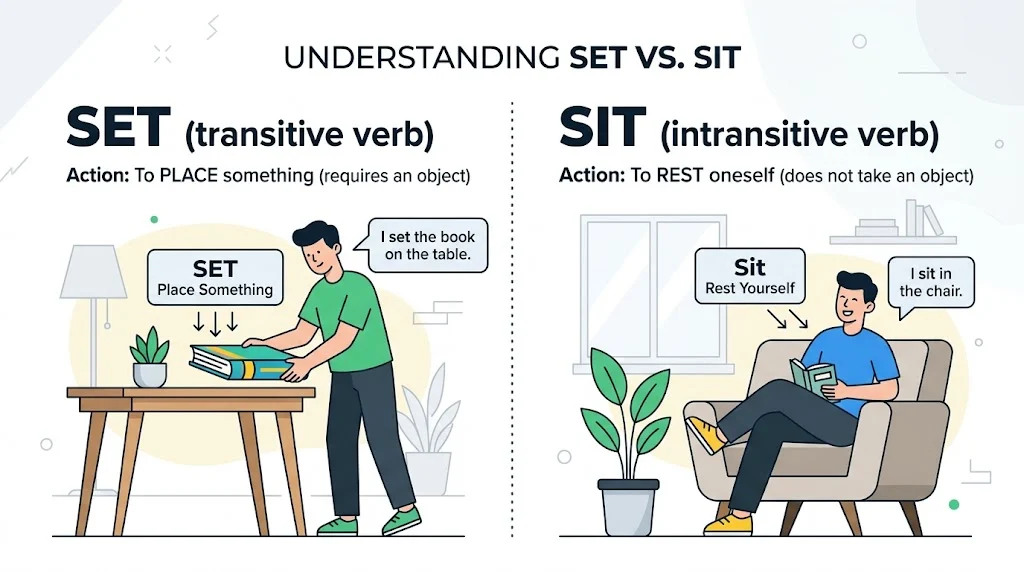

Set means to place something; sit means to rest yourself. Set always needs an object; sit does not. Example: Set the glass on the table. Sit on the chair.
I used to confuse set and sit in my writing, especially in professional emails and instructions. I once wrote, “sit the files on the desk,” and a colleague corrected me. That experience made me realize the importance of understanding grammar patterns: set requires an object, while sit does not.
By practicing this simple distinction daily, I quickly stopped making mistakes. Now I use both verbs correctly in emails, reports, social media, and casual writing. If you’ve faced the same confusion, this guide will give you a complete roadmap to master set vs sit, including meanings, grammar rules, examples, idioms, and common mistakes.
Quick Answer
Set means to place or put something somewhere. It is always followed by an object.
Sit means to rest your body in a seated position. It never takes an object.
Rule of Thumb:
- Set something → Object required
- Sit yourself → No object needed
Quick Examples
- Set the book on the table.
- Sit on the chair.
- She set the alarm for 7 am.
- Please sit quietly while the class begins.
Set vs Sit Meaning
Set
To place, arrange, or put something in a particular position or state.
Expanded Examples:
- She set the table for dinner.
- The teacher set the rules for the project.
- He set his phone on the nightstand before sleeping.
- The company set strict deadlines for the project.
Sit
To rest or position yourself in a seated posture, sometimes temporarily, sometimes permanently.
Expanded Examples:
- He sat by the window to enjoy the sunset.
- Sit down while I explain the instructions.
- The cat sat on the sofa quietly.
- During the ceremony, the audience sat patiently.
Key Point:
Set acts on an object. Sit acts on the subject (you or someone else).
Set vs Sit Difference
| Word | Meaning | Verb Type | Needs Object | Example |
|---|---|---|---|---|
| Set | To place or put | Transitive | Yes | Set the cup on the table |
| Sit | To rest or be seated | Intransitive | No | Sit on the chair |
Tip: Always ask yourself: “Am I moving something or positioning myself?”
Grammar Rule Depth
1. Set Is a Transitive Verb
Transitive verbs always need an object. Without an object, the sentence is incorrect.
Examples:
- Correct: Set the keys on the counter.
- Incorrect: Set on the counter.
Additional Usage:
- Set + object + preposition:
Set the glass on the table.
Set the deadline for next Monday.
2. Sit Is an Intransitive Verb
Intransitive verbs never take an object. They describe the subject’s action.
Examples:
- Correct: Sit on the sofa.
- Incorrect: Sit the sofa.
Additional Usage:
- Sit + preposition/adverb:
Sit quietly.
Sit beside me.
3. Past and Past Participle Forms
| Verb | Present | Past | Past Participle |
|---|---|---|---|
| Set | set | set | set |
| Sit | sit | sat | sat |
Examples:
- Set: Yesterday, she set the documents on the desk.
- Sit: He sat by the fire all evening.
Common Mistakes:
- Incorrect: He set on the chair.
- Correct: He sat on the chair.
Origin of Set and Sit
Both verbs come from Old English roots:
- Set → settan, meaning “to put, place, or cause to sit.”
- Sit → sittan, meaning “to rest in a seated position.”
Over centuries, English developed different grammar rules for these verbs:
- Set became transitive (needs an object)
- Sit became intransitive (no object needed)
Understanding this historical context explains why native speakers rarely confuse these verbs, while learners often do.
Why People Confuse Set and Sit
- Similar Meaning: Both relate to “position” or “placement.”
- Similar Sound: They sound alike in speech.
- Grammar Misunderstanding: Learners often do not recognize transitive vs intransitive usage.
- Past Tense Confusion: Set is always set; sit becomes sat, leading to errors.
Real World Usage of Set and Sit
At Home
- Set the table for dinner.
- Sit down and relax.
- Set the alarm for 7 am.
- Sit in the living room until dinner is ready.
At Work
- Set the files on the desk.
- Sit in the meeting room until the presentation begins.
- Set the schedule for the week.
- Sit quietly during the conference call.
In School
- Set your books neatly on the desk.
- Sit quietly during the lecture.
- The teacher set rules for the science experiment.
- Sit in your assigned seat.
Set vs Sit in Different Contexts
Instructions
- Set the printer paper correctly.
- Sit still while I demonstrate.
Commands
- Set it down immediately.
- Sit here until called.
Descriptions
- The sun sets in the west every evening.
- He sat on the porch enjoying the view.
Set vs Sit Idioms and Expressions
Learning idioms helps with fluency.
Set Expressions
- Set in stone → Permanent or unchangeable
Example: The rules are set in stone. - Set the stage → Prepare for something
Example: The announcement set the stage for change. - Set apart → Make different or special
Example: Her skills set her apart from the others.
Sit Expressions
- Sit tight → Wait patiently
Example: Sit tight while I make the call. - Sit on the fence → Avoid taking a side
Example: He decided to sit on the fence during the debate. - Sit pretty → Be in a comfortable or advantageous position
Example: With that promotion, she sits pretty now.
Common Mistakes Expanded
- Using Sit with an Object
- Incorrect: Sit the bag on the chair.
- Correct: Set the bag on the chair.
- Using Set Without an Object
- Incorrect: Set here.
- Correct: Sit here.
- Mixing Verb Forms
- Incorrect: Yesterday I sit the book down.
- Correct: Yesterday I set the book down.
- Past Tense Misuse
- Incorrect: He set in the living room.
- Correct: He sat in the living room.
Related Words and Expressions
Set Related
- set up → arrange or prepare
- set aside → reserve or save
- set in motion → start a process
- set forth → explain or present
Sit Related
- sit down → rest in a seated position
- sit back → relax
- sit still → remain seated quietly
- sit out → not participate
Usage Trends
Set and sit are among the most commonly used English verbs. Mistakes occur mainly among learners due to:
- Confusion between transitive vs intransitive forms
- Past tense differences
- Idiomatic usage
Consistent practice and examples reduce these errors and improve writing and speaking skills.
Exercises
Exercise 1: Choose the Correct Word
- Please ______ the bag on the chair.
Answer: set - You can ______ here.
Answer: sit - She ______ the plate on the table.
Answer: set - He ______ on the bench near the river.
Answer: sat - The teacher ______ the rules before starting.
Answer: set
Exercise 2: Correct the Sentences
- Sit the book on the table.
Answer: Set the book on the table. - He set on the chair.
Answer: He sat on the chair. - Yesterday, she sit the documents down.
Answer: Yesterday, she set the documents down.
FAQs
What is the difference between set and sit?
Set means to place something (needs an object). Sit means to rest yourself (no object).
When should I use set?
Use set when placing or arranging something. Example: Set the glass on the table.
When should I use sit?
Use sit when positioning yourself. Example: Sit on the chair.
Is set a transitive verb?
Yes, it always needs an object.
Is sit an intransitive verb?
Yes, it does not require an object.
What is the past tense of sit?
The past tense of sit is sat.
Why do people confuse set and sit?
Because both relate to position and sound similar, but their grammar rules differ.
Can set and sit be used in idioms?
Yes. Examples: set in stone, sit tight, set the stage, sit on the fence.
Conclusion
Mastering set vs sit is essential for clear English writing and speaking. Set means to place something and requires an object, while sit means to rest yourself and does not. The simple rule, “set something, sit yourself,” prevents most common mistakes. Expanding your understanding with verb forms, examples, idioms, and exercises ensures accuracy in professional writing, daily communication, and academic work. With practice, you’ll gain confidence and write these verbs correctly every time.