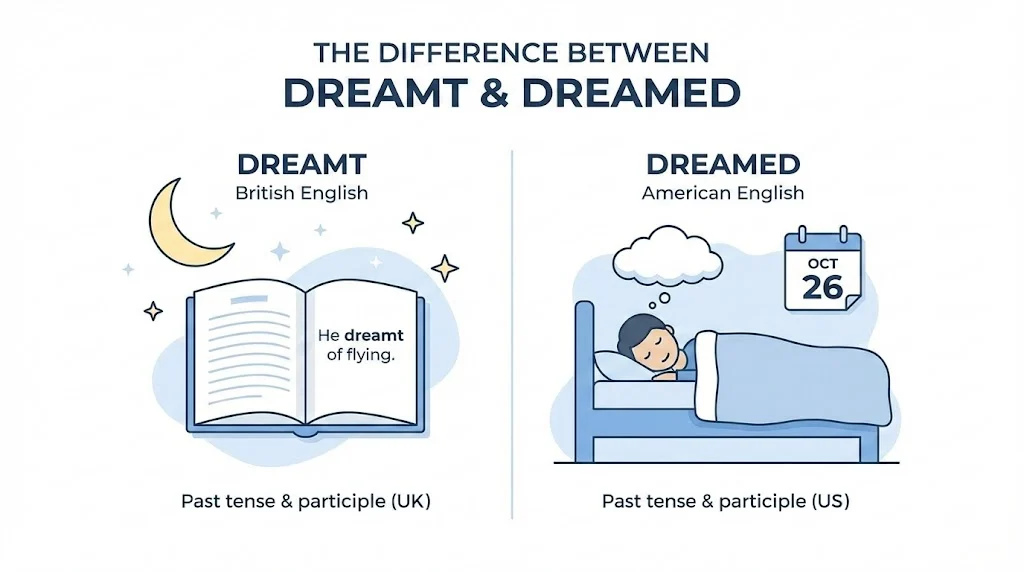
Dreamed and dreamt are both correct past tense forms of the verb dream. Dreamed is more common in American English, while dreamt is more common in British English. The meaning is the same in both cases and depends mainly on writing style and audience.
Many people feel unsure when writing dreamt or dreamed because both forms appear correct. This confusion often happens when writing stories, personal experiences, school essays, or professional content. Since both words are accepted in English, writers wonder which one is better and when to use each form.
People search for “dreamt or dreamed” to understand grammar rules, regional differences, and proper usage. The confusion increases because English allows both regular and irregular past tense forms for some verbs, and dream is one of them.
Using the wrong form does not usually make a sentence incorrect, but it can feel inconsistent or unnatural depending on your audience. This article explains everything clearly. You will learn grammar rules, why both forms exist, British and American preferences, real-world examples, common mistakes, exercises with answers, and helpful tips to choose the right word confidently every time.
Dreamt or Dreamed Quick Answer
Both dreamt and dreamed are correct.
- Dreamed is more common in American English
- Dreamt is more common in British English
Simple Examples
- I dreamed about traveling the world.
- I dreamt about traveling the world.
Both sentences are grammatically correct.
Grammar Rules Explained Clearly
To understand this properly, we must look at how English forms past tense verbs.
Dream as a Verb
The verb dream means to experience images or thoughts during sleep. It can also mean to imagine or hope for something.
Examples
- I dream about success.
- She dreams of becoming a doctor.
Past Tense Forms of Dream
Dream has two acceptable past tense forms.
- Dreamed
- Dreamt
Both forms have the same meaning and function the same way in sentences.
Why English Allows Two Forms
English has two main types of past tense verbs.
- Regular verbs add ED
- Irregular verbs change form
Dream is a special case. It follows both patterns depending on regional usage and writing style.
Dreamed Meaning and Usage
Dreamed follows the regular verb rule by adding ED.
When Dreamed Is Commonly Used
- American English
- Modern writing
- Academic and professional writing
- Simple and clear language preference
Examples With Dreamed
- I dreamed about my childhood home.
- She dreamed of becoming an artist.
- He dreamed that he was flying.
- They dreamed of a better future.
Dreamed sounds natural to American readers and is widely used in textbooks and formal writing.
Dreamt Meaning and Usage
Dreamt follows an irregular verb pattern.
When Dreamt Is Commonly Used
- British English
- Commonwealth countries
- Literature and storytelling
- Poetic or traditional tone
Examples With Dreamt
- I dreamt of walking through the forest.
- She dreamt about her future career.
- He dreamt that he was late for work.
- They dreamt of peace.
Dreamt often feels more expressive or literary.
Why Both Dreamt and Dreamed Exist
The reason lies in the history of the English language.
Language Evolution
Older forms of English favored irregular verbs. Over time, English began simplifying verb patterns. This led to the rise of regular forms like dreamed.
Regional Preferences
Different regions adopted different forms.
- British English preserved dreamt
- American English favored dreamed
Both remained correct and accepted.
British and American English Usage
This difference is important for writers who target specific audiences.
British English Preference
British English tends to prefer dreamt.
Examples
- I dreamt about my school days.
- She dreamt of becoming famous.
American English Preference
American English prefers dreamed.
Examples
- I dreamed about my school days.
- She dreamed of becoming famous.
Global English Tip
If your audience is international, dreamed is usually safer because it is more widely understood.
Which One Should You Use
The choice depends on your audience and tone.
Use Dreamed When
- Writing for American readers
- Writing professionally or academically
- Wanting simple and modern language
Use Dreamt When
- Writing for British readers
- Writing fiction or stories
- Wanting a traditional or literary tone
Consistency Matters
Choose one form and use it consistently in your writing.
Why People Get Confused With Dreamt or Dreamed
This confusion is very common.
Both Forms Are Correct
When both options are correct, people hesitate.
Regional Exposure
People read content from different regions and see both forms.
Education Differences
Some schools teach dreamed first, others teach dreamt.
Influence of Literature
Books often use dreamt, while modern media uses dreamed.
Dreamt or Dreamed in Real Life Usage
Daily Conversation
- I dreamed about you last night.
- I dreamt about my exam results.
Emails
- I dreamed about the project deadline.
- I dreamt about missing the meeting.
Storytelling
- He dreamt of a hidden treasure.
- She dreamed of flying across the sky.
Academic Writing
- Participants reported that they dreamed about the event.
- Subjects dreamed of familiar places.
Common Mistakes and Corrections
Wrong: I have dream last night.
Correct: I dreamed last night.
Wrong: I dream yesterday about school.
Correct: I dreamed yesterday about school.
Wrong: I have dreamt of it yesterday.
Correct: I dreamed of it yesterday.
Tense consistency is more important than choosing dreamt or dreamed.
Dreamt or Dreamed With Helping Verbs
Both forms work with auxiliary verbs.
Present Perfect
- I have dreamed about this moment.
- I have dreamt about this moment.
Past Perfect
- I had dreamed of success.
- I had dreamt of success.
Both are grammatically correct.
Related Verbs With Similar Patterns
Dream is not the only verb with two accepted past forms.
Common Examples
- Learn learned or learnt
- Burn burned or burnt
- Spell spelled or spelt
- Leap leaped or leapt
British English often prefers the shorter form.
Dreamt or Dreamed in Sentences
Simple Sentences
- I dreamed last night.
- I dreamt last night.
Medium Sentences
- I dreamed about my childhood memories.
- I dreamt about meeting old friends.
Formal Sentences
- The patient dreamed of recurring images.
- The author dreamt of distant lands.
Practice Exercises
Fill in the Blanks
- I ______ about my future last night.
Answer: dreamed or dreamt - She ______ of becoming a writer.
Answer: dreamed or dreamt - He has ______ about this moment for years.
Answer: dreamed or dreamt - They ______ of traveling the world.
Answer: dreamed or dreamt
Choose the Correct Word for American English
- I ______ about winning the prize.
Answer: dreamed - She has ______ about this opportunity.
Answer: dreamed
Choose the Correct Word for British English
- I ______ of walking alone at night.
Answer: dreamt - He has ______ of success since childhood.
Answer: dreamt
FAQs
Is dreamt correct English?
Yes, dreamt is correct and commonly used in British English.
Is dreamed American English?
Yes, dreamed is preferred in American English.
Do dreamt and dreamed mean the same thing?
Yes, both have the same meaning.
Which form should I use in exams?
Use the form preferred by your region or follow your teacher’s guidance.
Is dreamt outdated?
No, it is still widely used in British English.
Can I mix dreamt and dreamed in one article?
It is better to stay consistent and use one form.
Is dreamed more common globally?
Yes, dreamed is more common worldwide due to American English influence.
Conclusion
The difference between dreamt and dreamed is not about correctness but preference. Both are grammatically correct and mean the same thing. Dreamed follows the regular verb pattern and is common in American English and modern writing. Dreamt follows an older irregular pattern and is favored in British English and literature.
The most important rule is consistency. Choose the form that matches your audience and writing style and stick with it throughout your content. Understanding this distinction helps you write with confidence and clarity.
Once you know this rule, you will never hesitate again when choosing between dreamt or dreamed.