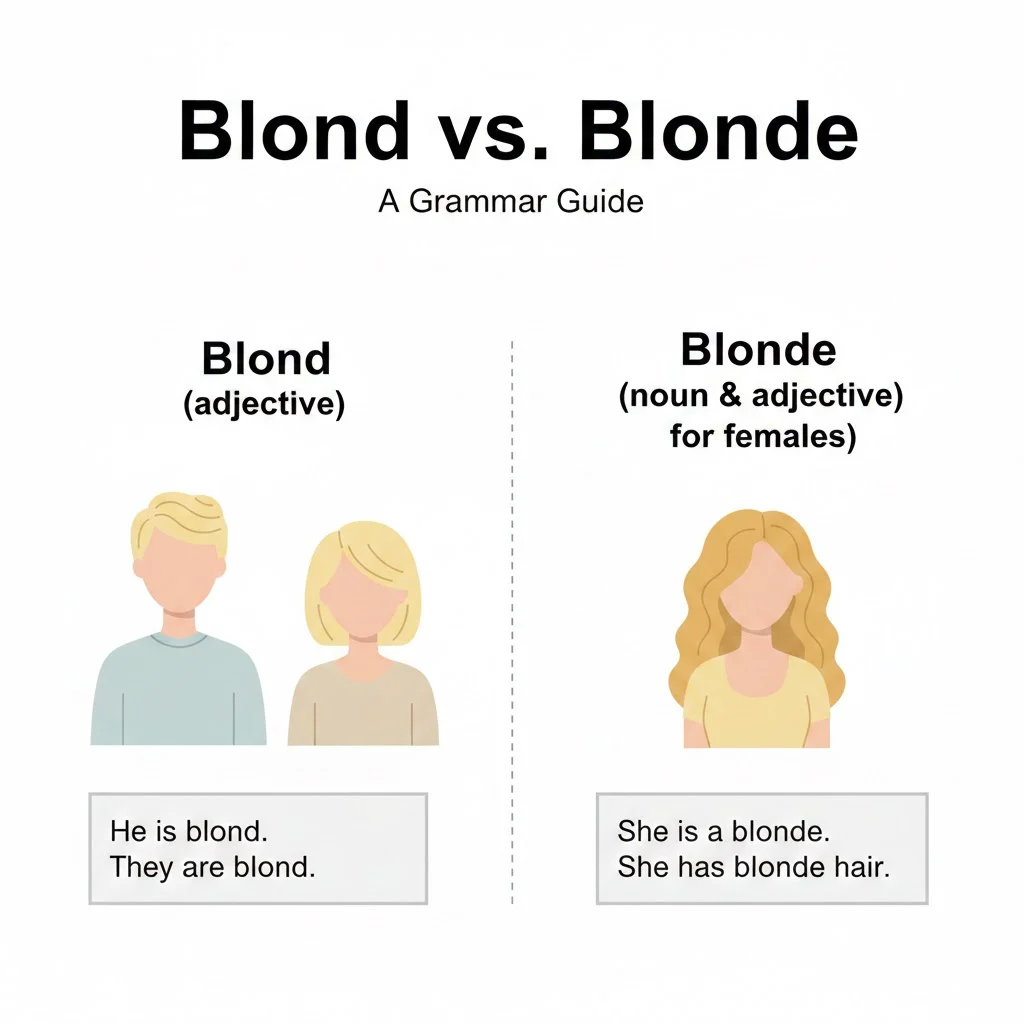

Blond and blonde both describe fair or light hair color. Blond is commonly used for men and as an adjective in American English, while blonde is often used for women and as a noun. In modern usage, blond is acceptable for all genders in most contexts, especially in American English.
Many people hesitate when writing blond or blonde because both spellings look correct and mean the same thing. The confusion increases because usage changes depending on gender, grammar role, and regional English. Some people believe blond is for men and blonde is for women. Others think one spelling is British and the other is American.
This uncertainty appears in blogs, school writing, novels, captions, and professional content. A single wrong choice can distract readers or make writing feel inconsistent.
This article removes all confusion. You will learn the difference between blond and blonde, grammar rules in depth, historical background, real world usage, regional differences, common mistakes, related words, practice exercises with answers, and clear guidance on which spelling you should use.
Quick Answer
Both blond and blonde describe light colored hair.
Blond is commonly used as an adjective and for men.
Blonde is often used as a noun and for women.
Simple Examples
- He has blond hair.
- She is a blonde.
- A blond child played outside.
- The blonde smiled at the camera.
Easy Tip
If you are unsure, blond is always safe in modern American English.
Grammar Rules Explained Clearly
Understanding grammar roles removes most confusion.
Blond as an Adjective
Blond is most often used as an adjective.
Adjectives describe nouns.
Examples
- He has blond hair.
- A blond actor starred in the film.
- The boy’s blond curls shone in the sun.
In American English, blond is commonly used for both men & women when acting as an adjective.
Blonde as a Noun
Blonde is often used as a noun.
A noun names a person or thing.
Examples
- She is a blonde.
- The movie featured a mysterious blonde.
- The blonde walked into the room.
Traditionally, blonde refers to a woman with light hair.
Gender Based Grammar Rule
Historically:
- Blond referred to men
- Blonde referred to women
This rule came from French grammar, where gender affects spelling. Modern English does not strictly require this distinction, but it still appears in formal or traditional writing.
Origin and History of Blond and Blonde
The words blond and blonde come from French.
In French:
- Masculine form was blond
- Feminine form was blonde
English borrowed both forms and partially kept the gender distinction. Over time, English simplified usage, especially in American English, where blond became more common for all genders.
British English tends to preserve the traditional distinction more often than American English.
Why People Confuse Blond or Blonde
Same Meaning
Both words describe the same hair color, which makes the difference seem unnecessary.
French Influence
English speakers are not used to gendered spelling, unlike French.
Regional Differences
Different regions follow different conventions, increasing confusion.
Informal Writing
Blogs and social media mix both spellings without consistency.
Autocorrect Variations
Some spellcheck tools suggest one spelling over the other without explanation.
Blond or Blonde in Real World Usage
In Daily Conversation
- He is blond with blue eyes.
- She is a natural blonde.
- A blond child ran past us.
News and Media
- The suspect was described as blond.
- The actress is a famous blonde.
Fashion and Beauty
- Blond hair trends are changing.
- Platinum blonde remains popular.
Literature and Fiction
- A blond hero entered the scene.
- The mysterious blonde caught his attention.
British English vs American English Usage
American English
- Blond is commonly used for everyone
- Blonde is mostly used as a noun for women
Examples:
- She has blond hair.
- She is a blonde.
British English
- Blond is usually used for men
- Blonde is usually used for women
Examples:
- A blond man
- A blonde woman
Both systems are correct within their regions.
Which Spelling Should You Use
Use Blond When
- Writing American English
- Using the word as an adjective
- Writing gender neutral content
- You want a safe choice
Use Blonde When
- Referring to a woman as a noun
- Writing British or traditional English
- Writing fiction that follows classic style
Simple Rule
If you are unsure, choose blond. It will never be considered wrong in modern usage.
Common Mistakes and Corrections
Wrong: She is a blond.
Correct: She is a blonde.
Wrong: He has blonde hair.
Correct: He has blond hair.
Wrong: The blond woman smiled.
Correct: The blonde woman smiled.
Wrong: A blonde boy stood there.
Correct: A blond boy stood there.
Blond or Blonde in More Sentences
Simple Sentences
- He is blond.
- She is a blonde.
Medium Sentences
- The blond athlete won the race.
- A famous blonde starred in the movie.
Formal Writing
- The witness described a blond individual.
- The novel portrays the blonde as mysterious.
Related Words and Variations
Understanding related words improves accuracy.
- Brunette
- Redhead
- Fair haired
- Light haired
Unlike blond and blonde, brunette keeps the feminine form in English more consistently.
Cultural Usage and Stereotypes
The word blonde is often linked with cultural stereotypes, especially in jokes or media. Modern writing avoids stereotypes and focuses on neutral descriptions. Using blond as an adjective helps maintain professionalism and neutrality.
Blond or Blonde in Professional Writing
In journalism and formal writing:
- Adjectives are preferred over nouns
- Blond is favored for clarity
- Gendered spelling is often avoided
This reduces bias and keeps writing neutral.
Practice Exercises
Fill in the Blanks
- He has ______ hair.
Answer: blond - She is a natural ______.
Answer: blonde - A ______ actor appeared on stage.
Answer: blond - The famous ______ smiled at reporters.
Answer: blonde - The child was ______ with green eyes.
Answer: blond
Choose the Correct Word
- The (blond / blonde) man waved.
Answer: blond - She is a (blond / blonde).
Answer: blonde - A (blond / blonde) hairstyle became popular.
Answer: blond - The movie featured a mysterious (blond / blonde).
Answer: blonde
FAQs
What is the difference between blond and blonde?
Blond is commonly used as an adjective and for men, while blonde is often used as a noun and for women.
Is blond or blonde correct for females?
Both are correct, but blonde is traditionally used as a noun for women.
Is blond American and blonde British?
Not exactly. American English prefers blond for most uses, while British English keeps the gender distinction more often.
Can blond be used for women?
Yes. In modern American English, blond is acceptable for all genders.
Is blonde becoming outdated?
No, but it is used more selectively, mostly as a noun.
Which spelling is safer in professional writing?
Blond is the safest and most neutral choice.
Does pronunciation change between blond and blonde?
No. Both are pronounced the same.
Conclusion
The confusion between blond and blonde comes from history, gender rules, and regional differences. Both words describe the same hair color, but their usage depends on grammar role and style. Blond is commonly used as an adjective and works for everyone, especially in American English. Blonde is often used as a noun and traditionally refers to women.
If you want a simple rule, use blond when describing hair and blonde when referring to a woman as a noun. When in doubt, blond is always acceptable and professional.
Understanding this difference improves clarity, consistency, and confidence in writing. With practice, choosing between blond and blonde becomes effortless.