
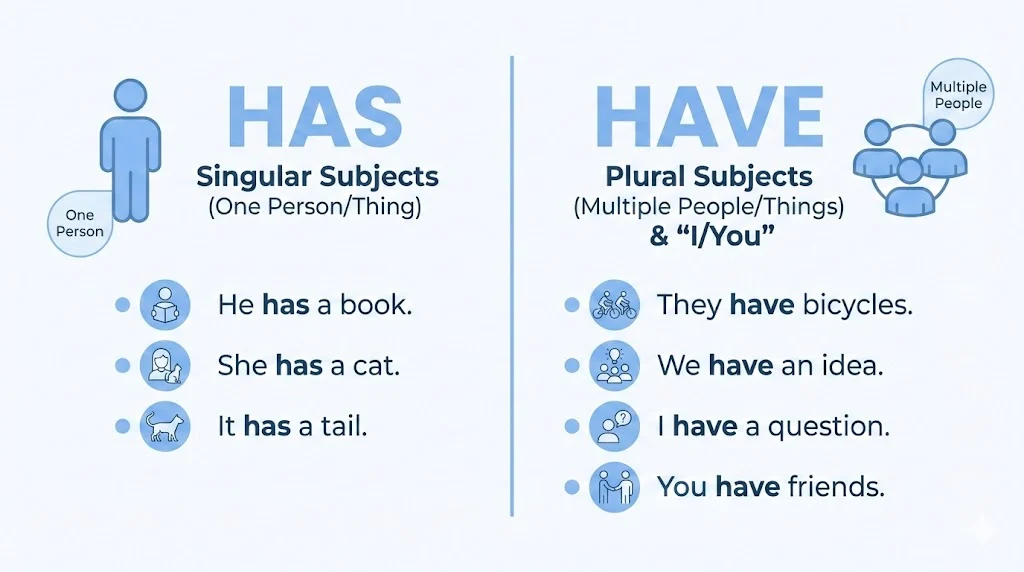
Has and have are forms of the verb to have. Use has with singular subjects such as he, she, it, or one person or thing. Use have with plural subjects and with I, you, we, and they. Choosing the correct word depends on the subject of the sentence.
Many writers feel confused about has or have because both words come from the same verb but are used with different subjects. This confusion appears in daily conversation, emails, school writing, and professional communication. A small mistake with has or have can make a sentence sound incorrect and reduce clarity.
People often search for “has or have” because they want simple rules that are easy to remember. English grammar can feel complicated when verb forms change based on subjects. The good news is that once you understand the basic rule, choosing between has and have becomes simple.
This guide explains everything clearly. You will learn grammar rules, real life examples, common mistakes, special cases, practice exercises with answers, and tips to remember the correct usage every time.
Has or Have Quick Answer
Has is used with singular subjects like he, she, it, or one person or thing.
Have is used with plural subjects and with I, you, we, and they.
Examples
- She has a new book.
- They have two cars.
- He has a meeting today.
- We have dinner at eight.
Easy Tip
If the subject is singular, use has.
If the subject is plural or I, you, we, they, use have.
Grammar Rules Explained
Understanding the Verb To Have
The verb to have shows possession, experience, relationships, or actions.
- Possession: I have a phone.
- Experience: She has a headache.
- Actions: They have lunch together.
The verb changes form depending on the subject.
When to Use Has
Use has with:
- He
- She
- It
- Singular nouns
Examples:
- He has a new job.
- The dog has a collar.
- My friend has a bicycle.
- The company has many customers.
When to Use Have
Use have with:
- I
- You
- We
- They
- Plural nouns
Examples:
- I have a question.
- You have great ideas.
- We have enough time.
- They have finished the project.
Why People Make Mistakes With Has or Have
Similar Meaning
Both words share the same meaning, which makes them easy to mix up.
Speaking vs Writing
In fast speech, people often do not notice subject agreement errors.
Long Sentences
When the subject is far from the verb, writers forget which form to use.
Learning English Rules
Many learners memorize vocabulary before mastering subject verb agreement.
Informal Writing Habits
Text messages and social media often ignore grammar accuracy.
Has or Have in Real Life Usage
Daily Conversation
- He has a busy schedule.
- We have plans tonight.
- She has a new phone.
- They have many responsibilities.
Emails
- The manager has approved your request.
- We have attached the document.
- She has responded to your message.
School Writing
- The student has completed the assignment.
- Students have different learning styles.
Workplace Writing
- The company has new policies.
- Employees have access to training.
Social Media
- She has amazing talent.
- We have reached 10,000 followers.
British and American English Usage
There is no difference between British and American English when using has or have.
Both follow the same rules:
- Singular subjects use has.
- Plural subjects and I, you, we, they use have.
Examples:
- UK: The team has won the match.
- US: The team has won the match.
- UK: The players have trained hard.
- US: The players have trained hard.
Which One Should You Use
Ask yourself one question:
Is the subject singular or plural?
- Singular subject → has
- Plural subject → have
Quick Check Examples
- The child → has
- The children → have
- My teacher → has
- My teachers → have
Common Mistakes and Corrections
Wrong: He have a car.
Correct: He has a car.
Wrong: They has a meeting.
Correct: They have a meeting.
Wrong: She have a dog.
Correct: She has a dog.
Wrong: We has enough time.
Correct: We have enough time.
Has or Have in Questions
Questions follow the same subject rules.
Examples
- Has she finished her work?
- Have they arrived yet?
- Has the teacher called you?
- Have we missed the train?
Has or Have in Negative Sentences
Negative forms use has not or have not.
Examples
- He has not finished.
- They have not arrived.
- She has not called.
- We have not started.
Short forms:
- hasn’t
- haven’t
Has or Have in Present Perfect Tense
Has and have are used as helping verbs in present perfect tense.
Structure
Subject + has/have + past participle
Examples
- She has finished her homework.
- They have completed the project.
- He has traveled abroad.
- We have learned a lot.
Has or Have With Collective Nouns
Collective nouns can confuse writers.
Examples
- The team has won today.
- The family has moved to a new house.
If the group acts as one unit, use has.
In some contexts, especially informal speech, people may use have when emphasizing individuals.
Has or Have With Everyone and Everybody
Words like everyone and everybody are singular.
Examples:
- Everyone has a ticket.
- Everybody has an opinion.
Has or Have With None and Some
The choice depends on meaning.
- None has arrived. (singular idea)
- None have arrived. (plural idea)
Both may appear in modern English depending on emphasis.
Has or Have in Everyday Examples
Simple Sentences
- He has a bike.
- They have two dogs.
Medium Sentences
- She has a lot of work today.
- We have several ideas to discuss.
Formal Sentences
- The organization has achieved its goals.
- Researchers have collected the data.
Common Patterns to Remember
Pronoun Rule
He, she, it → has
I, you, we, they → have
Noun Rule
One person or thing → has
More than one → have
Related Grammar Confusions
Learning similar grammar topics helps avoid mistakes.
- Is or are
- Was or were
- Do or does
- Has been or have been
- There is or there are
Practice Exercises
Fill in the Blanks
- She ______ a new laptop.
Answer: has - They ______ many books.
Answer: have - The dog ______ a collar.
Answer: has - We ______ enough food.
Answer: have - He ______ an important meeting.
Answer: has - I ______ a question.
Answer: have - The students ______ homework today.
Answer: have - My brother ______ a bicycle.
Answer: has
Choose the Correct Word
- She (has / have) a new car.
Answer: has - They (has / have) finished dinner.
Answer: have - The teacher (has / have) a plan.
Answer: has - We (has / have) time to talk.
Answer: have - He (has / have) an exam tomorrow.
Answer: has
Sentence Correction Practice
- He have a new phone.
Answer: He has a new phone. - They has completed the task.
Answer: They have completed the task. - She have many friends.
Answer: She has many friends.
Has or Have in Professional Communication
Correct verb agreement improves clarity.
Examples:
- The company has announced new policies.
- Employees have received training.
Incorrect grammar can reduce professionalism in emails and reports.
Has or Have in Academic Writing
Academic writing requires correct subject verb agreement.
Examples:
- The study has shown clear results.
- Researchers have analyzed the data.
Has or Have in Spoken English
Native speakers sometimes shorten sentences, but standard grammar remains important in writing.
Example:
- She’s got a book. (informal)
- She has a book. (standard)
Memory Tricks
Trick One
He, she, it has.
Trick Two
I, you, we, they have.
Trick Three
If you can replace the subject with he / she, use has.
FAQs
What is the difference between has and have?
Has is used with singular subjects like he, she, or it. Have is used with plural subjects and with I, you, we, and they.
When should I use has in a sentence?
Use has when the subject is singular, such as one person, one animal, or one thing.
When should I use have in a sentence?
Use have with plural subjects and pronouns like I, you, we, and they.
Can has and have be used in the same sentence?
Yes, if different subjects are used. For example, she has a car and they have bikes.
Why do people confuse has and have?
Because both come from the same verb and sound similar in conversation.
Is there a difference between British and American English?
No, both use the same rules for has and have.
How can I remember has or have easily?
Remember he, she, it takes has. I, you, we, they take have.
Conclusion
The difference between has and have is simple once you understand subject agreement. Use has with singular subjects and have with plural subjects and the pronouns I, you, we, and they. Although mistakes are common, a quick check of the subject makes the correct choice clear.
By learning the grammar rules, seeing real examples, and practicing exercises, you can easily avoid confusion. Correct use of has or have improves clarity, professionalism, and confidence in writing. With practice, choosing the right word becomes natural and automatic.