
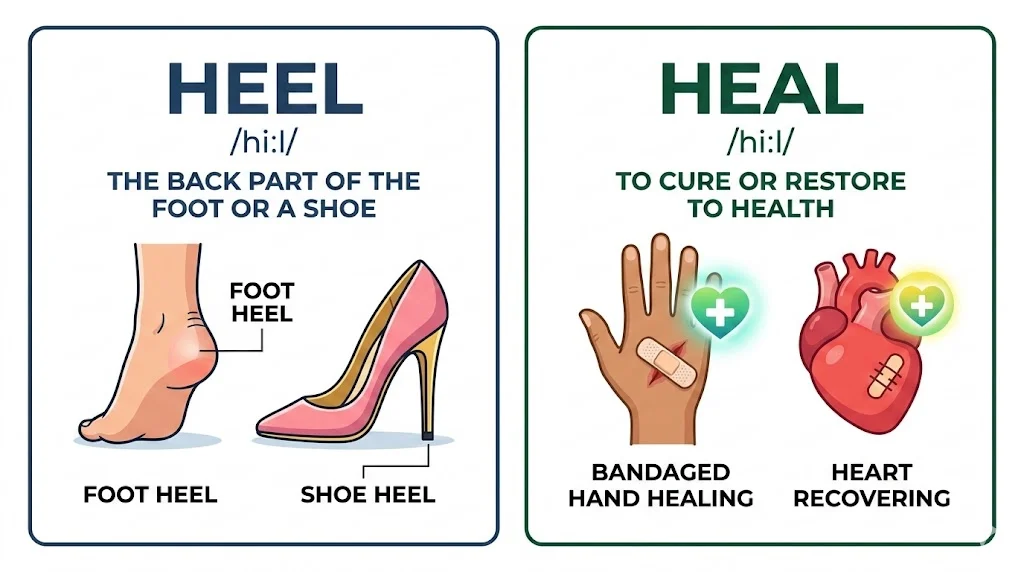
Heel usually refers to the back part of the foot or the bottom part of a shoe. It can also mean to tilt to one side or to follow closely.
Heal means to recover, repair, or become healthy again. It is commonly used for wounds, emotions, and relationships.
Use heel for body parts, shoes, or tilting. Use heal for recovery and improvement.
Many writers pause when choosing between heel vs heal because both words sound the same. They are homophones, which means they share pronunciation but have different meanings and spellings. This small spelling difference changes the meaning completely. Using the wrong word can confuse readers and make writing look careless.
People search for “heel vs heal” because these words appear in daily life. We talk about high heels, sore heels, and a dog heeling beside its owner. We also talk about wounds healing, hearts healing, and communities healing after loss. Since the pronunciation is identical, mistakes happen easily in emails, essays, blog posts, and social media captions.
This complete guide explains the difference in simple language. You will learn grammar rules, word origins, real world usage, common mistakes, detailed examples, practice exercises with answers, and helpful memory tricks. By the end, you will confidently use heel and heal correctly every time.
Quick Answer
Heel is usually a noun referring to the back part of the foot or the raised part of a shoe. It can also be a verb meaning to tilt or to follow closely.
Heal is a verb meaning to recover, repair, or make healthy again.
Simple Examples
- My heel hurts after walking all day.
- She wore high heels to the party.
- The cut will heal in a few days.
- Time can heal emotional pain.
Quick Memory Tip
Think of heal as related to health. Both words begin with “hea.”
Think of heel as related to shoe or foot.
Grammar Rule Depth
Understanding the grammatical function of each word helps prevent confusion.
Heel as a Noun
Most commonly, heel is a noun.
It refers to:
- The back part of the human foot
- The raised back part of a shoe
- The back end of an object like a loaf of bread
Examples:
- He injured his heel while running.
- The heel of the shoe broke.
- She stood on her heels.
Heel as a Verb
Heel can also function as a verb in specific contexts.
It can mean:
- To tilt or lean to one side
- For a dog to walk closely beside its owner
Examples:
- The boat began to heel in strong wind.
- The dog was trained to heel.
Heal as a Verb
Heal is almost always used as a verb.
It means:
- To recover from injury
- To repair damage
- To become healthy again
Examples:
- The wound will heal soon.
- Doctors helped him heal.
- Communities need time to heal after tragedy.
Key Grammar Difference
Heel can be a noun or verb.
Heal is primarily a verb.
Why People Confuse Heel vs Heal
Same Pronunciation
Both words sound identical in spoken English. This causes confusion when writing.
Autocorrect Problems
Spell check tools do not always catch homophone errors because both spellings are correct words.
Fast Typing
When typing quickly, people choose the wrong spelling without noticing.
Emotional Writing
In emotional or storytelling writing, writers may focus on ideas rather than spelling accuracy.
Weak Vocabulary Awareness
Some learners are unfamiliar with nautical or shoe related meanings of heel, increasing confusion.
The Origin of Heel and Heal
Understanding word history makes the difference clearer.
Origin of Heel
The word heel comes from Old English “hēla,” meaning the back of the foot. Over time, it expanded to include the raised part of shoes and the idea of leaning or tilting.
Origin of Heal
The word heal comes from Old English “hǣlan,” meaning to make whole. This root is connected to the idea of wholeness and health.
Notice the connection between heal and whole. Healing restores wholeness.
British and American English Usage
There is no spelling difference between British and American English for heel or heal.
Both use:
- Heel for foot, shoe, tilt, or dog command
- Heal for recovery and repair
Examples:
- UK: Her heel slipped on the stairs.
- US: Her heel slipped on the stairs.
- UK: The injury will heal quickly.
- US: The injury will heal quickly.
Which Word Should You Use
Ask yourself one simple question:
Are you talking about a body part, shoe, tilting, or a dog command?
Use heel.
Are you talking about recovery, repair, or improvement?
Use heal.
Heel vs Heal in Real World Usage
In Health and Medicine
- The skin will heal naturally.
- The doctor said it will take time to heal.
Never use heel when talking about recovery.
In Fashion
- She loves wearing high heels.
- The heel of the shoe snapped.
Never use heal when talking about shoes.
In Sports
- He felt pain in his heel during practice.
- The sprained ankle needs time to heal.
In Sailing
- The ship began to heel due to wind pressure.
Dog Training
- The trainer taught the dog to heel properly.
Common Mistakes and Corrections
Wrong: My injury will heel soon.
Correct: My injury will heal soon.
Wrong: She wore high heals to the wedding.
Correct: She wore high heels to the wedding.
Wrong: The boat started to heal in the storm.
Correct: The boat started to heel in the storm.
Wrong: Emotional pain takes time to heel.
Correct: Emotional pain takes time to heal.
Heel vs Heal in Everyday Examples
Emails
- Please allow the wound to heal before returning to work.
- My shoe heel broke during the meeting.
Social Media
- Time helps hearts heal.
- Loving these new high heels.
News Writing
- The community continues to heal after the disaster.
- The yacht began to heel sharply in the storm.
Formal Writing
- Psychological therapy helps patients heal from trauma.
- Structural imbalance caused the vessel to heel dangerously.
Extended Examples for Clarity
Emotional Context
Heal:
- Forgiveness can help people heal.
- Grief takes time to heal.
Heel:
- She twisted her heel while walking.
Physical Injury Context
Heal:
- The fracture will heal with proper care.
Heel:
- He stepped on a sharp object and hurt his heel.
Mechanical or Object Context
Heel:
- The chair leaned back on its heel.
Heal:
- This machine cannot heal itself.
Related Homophones and Common Confusions
Learning similar pairs improves writing skills.
- Break vs Brake
- Plain vs Plane
- Right vs Write
- Meet vs Meat
- Sale vs Sail
Like heel vs heal, these words sound alike but differ in meaning.
Practice Exercises
Fill in the Blanks
- The cut will ______ soon.
Answer: heal - She wore high ______ to the event.
Answer: heels - My dog knows how to ______.
Answer: heel - Emotional wounds take time to ______.
Answer: heal - The boat began to ______ in strong wind.
Answer: heel
Choose the Correct Word
- The injury will (heel / heal).
Answer: heal - She injured her (heel / heal).
Answer: heel - Time helps people (heel / heal).
Answer: heal - The ship started to (heel / heal).
Answer: heel
Advanced Usage and Deeper Explanation
Heel in Figurative Language
Heel can also describe weakness.
- The company revealed its financial heel.
Heal in Figurative Language
Heal often appears in emotional and spiritual contexts.
- The nation must heal together.
- Dialogue can heal divisions.
Common Writing Tips
- Always check context.
- Read your sentence aloud.
- Replace heal with recover.
- Replace heel with foot or shoe to test meaning.
FAQs
What is the difference between heel and heal?
Heel refers to the back part of the foot, the bottom of a shoe, or tilting. Heal means to recover or repair.
Is heel ever used for recovery?
No, heel does not mean recovery. Heal is used for healing and repair.
Can heal be used as a noun?
Heal is mainly a verb. It describes the action of recovery.
Why do people confuse heel and heal?
Because they are homophones and sound exactly the same.
How can I remember heel vs heal?
Heal starts with hea like health. Heel relates to shoes and feet.
Is there a spelling difference in British English?
No, both British and American English use the same spelling.
Can heel be used as a command?
Yes, heel is used as a command in dog training.
Conclusion
The difference between heel vs heal is simple once you understand the context. Heel relates to feet, shoes, tilting, or dog commands. Heal relates to recovery, repair, and becoming whole again. Although they sound the same, their meanings are completely different.
Mistakes happen because English has many homophones. Paying attention to context solves the problem. If you are talking about health or recovery, choose heal. If you are talking about a shoe, foot, or leaning motion, choose heel.
With practice, examples, and careful reading, you can confidently use heel and heal correctly in any situation.