
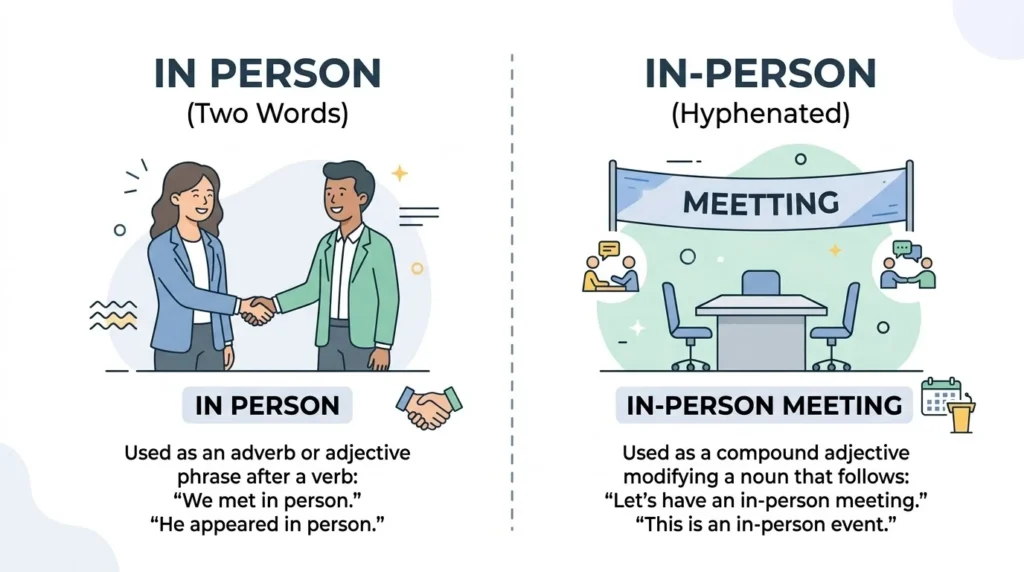
In-person is a hyphenated adjective used before a noun to describe something that happens face to face. In person is a phrase used after a verb or at the end of a sentence. Both forms are correct, but they are used in different grammatical situations.
Example
We held an in-person meeting yesterday.
The manager spoke to the team in person.
Many writers are unsure whether they should write in person or in-person. The difference may seem small, but the correct form depends on how the phrase is used in a sentence. Some people always write it without a hyphen, while others always include the hyphen. This confusion often appears in emails, business communication, event announcements, and online content.
Understanding when to use in person and when to use in-person helps improve clarity and professionalism in writing. The phrase is very common today, especially after the rise of remote work, online meetings, and virtual events. Companies, schools, and organizations frequently distinguish between virtual participation and face-to-face interaction.
This guide explains the difference between in person and in-person, their grammar rules, real world usage, examples in sentences, and common mistakes. By the end, you will know exactly when to use each form correctly.
Quick Answer
Both forms are correct but used differently.
In-person is used as an adjective before a noun.
Example
We scheduled an in-person interview.
In person is used as a phrase after a verb or at the end of a sentence.
Example
She attended the meeting in person.
In Person vs In-Person Meaning Explained
The phrase in person means meeting or interacting physically rather than through phone calls, video calls, or online communication.
It describes face-to-face interaction.
The hyphenated version in-person functions as a compound adjective. It describes a noun and gives more information about the type of event, meeting, or activity.
In Person vs In-Person Difference
| Form | Grammar Role | Example |
|---|---|---|
| In person | Phrase used after verbs | The manager spoke to us in person |
| In-person | Hyphenated adjective before noun | The company held an in-person meeting |
Key Rule
Use in-person before a noun.
Use in person after a verb.
The Origin of the Phrase In Person
The phrase in person has been used in English for many centuries. It comes from legal and formal language where people were required to appear physically rather than sending a representative.
Historically, courts and official meetings required individuals to appear in person to give testimony or confirm agreements.
Over time, the phrase became part of everyday English and expanded beyond legal use. It began to describe any situation where people meet physically rather than communicating remotely.
The hyphenated adjective in-person developed later as writing styles evolved. Writers began hyphenating compound modifiers placed before nouns to make sentences easier to read.
Grammar Rule Depth
Understanding compound modifiers helps explain the difference.
A compound modifier occurs when two or more words work together to describe a noun.
Example
high-quality product
long-term plan
well-known author
Similarly, in-person meeting uses a compound modifier.
Without the hyphen, the sentence can be confusing when placed before a noun.
Example
in person meeting
This looks unclear.
Adding the hyphen clarifies that both words describe the noun together.
Example
in-person meeting
When the phrase comes after a verb, no hyphen is needed.
Example
The team met in person.
Why People Get Confused About In Person vs In-Person
Several factors cause confusion.
Hyphen Rules Are Not Always Obvious
Many writers are unsure when English requires hyphenated compound modifiers.
Spoken Language Sounds the Same
When spoken, there is no visible hyphen, so people often guess the spelling when writing.
Increased Digital Communication
Since remote meetings and online work became common, the phrase appears much more frequently. Increased usage naturally increases spelling mistakes.
Real World Usage of In Person
The phrase appears frequently in professional communication.
Business Communication
Companies often distinguish between remote and physical meetings.
Example
The company plans an in-person conference next month.
Example
The CEO will address employees in person.
Education
Schools use the phrase to differentiate classroom learning from online learning.
Example
Students returned for in-person classes this semester.
Example
The teacher met parents in person during conferences.
Healthcare
Medical providers often schedule physical appointments.
Example
The doctor recommended an in-person consultation.
Example
Patients should visit the clinic in person if symptoms worsen.
In Person Examples in Sentences
Here are examples showing how the phrase appears in everyday writing.
The manager spoke to the employees in person.
The company scheduled an in-person training session.
The director prefers discussing important issues in person.
The school organized an in-person graduation ceremony.
The professor met students in person after class.
Each example shows the phrase describing physical presence.
In Person in Professional Writing
Professional writers frequently use the phrase when describing meetings and interactions.
Corporate Communication
Organizations often clarify whether meetings occur physically or online.
Example
The board approved an in-person meeting for next week.
Journalism
News articles often describe public appearances.
Example
The president addressed supporters in person.
Academic Writing
Researchers may describe interviews conducted physically.
Example
Participants were interviewed in person.
In Person in Social Media and Conversation
The phrase also appears frequently in casual communication.
Example
I finally met my online friend in person.
Example
The workshop will be an in-person event this year.
Even in informal writing, using the correct form improves clarity.
Common Mistakes with In Person
One common mistake is forgetting the hyphen when the phrase acts as an adjective.
Incorrect
The company held an in person meeting.
Correct
The company held an in-person meeting.
Another mistake is adding a hyphen when the phrase appears after a verb.
Incorrect
We met in-person yesterday.
Correct
We met in person yesterday.
Related Words and Similar Expressions
Understanding related phrases can strengthen writing.
Similar Expressions
face to face
physically present
on site
in attendance
These expressions communicate a similar idea of physical presence.
In Person in Modern English
The phrase became even more common after the growth of remote work and virtual communication.
Organizations now regularly differentiate between:
virtual meetings
remote work
in-person meetings
This shift has made the phrase a key part of modern professional vocabulary.
Usage Patterns in Different Countries
English speakers around the world use both forms.
However, the grammar rule remains the same internationally.
When used before a noun, the phrase is hyphenated.
When used after a verb, the phrase remains open without a hyphen.
Exercise 1 Choose the Correct Form
Fill in the blank with in person or in-person.
The company scheduled an ______ interview.
Answer: in-person
The manager spoke to the team ______.
Answer: in person
The school organized an ______ orientation session.
Answer: in-person
Exercise 2 Correct the Sentence
Rewrite each sentence using the correct form.
The company held an in person conference last week.
Answer: The company held an in-person conference last week.
We met the new client in-person yesterday.
Answer: We met the new client in person yesterday.
FAQs
What is the difference between in person and in-person?
In person is a phrase used after verbs to describe physical presence. In-person is a hyphenated adjective used before a noun to describe events or activities that happen face to face.
When should I use in-person with a hyphen?
Use in-person when the phrase appears before a noun and acts as a compound modifier. For example, an in-person meeting or an in-person interview.
When should I write in person without a hyphen?
Use in person when the phrase comes after a verb or at the end of a sentence. For example, the manager spoke to the employees in person.
Is in-person a formal word?
Yes. Both forms are acceptable in formal and informal writing. The phrase commonly appears in business communication, education, healthcare, and journalism.
Can in person start a sentence?
Yes. The phrase can appear at the beginning of a sentence if the structure allows it. For example, In person meetings often improve communication between team members.
Why does the phrase sometimes use a hyphen?
The hyphen appears when the phrase works as a compound adjective describing a noun. Hyphens help readers understand that the two words work together to describe the noun.
Is the phrase common in modern English?
Yes. The phrase is widely used today, especially when distinguishing between virtual and face to face communication.
Conclusion
Understanding the difference between in person and in-person helps writers communicate clearly and professionally. Although the two forms look very similar, their usage depends on grammar and sentence structure.
The phrase in person describes physical presence and usually appears after verbs. It emphasizes that someone attended an event or met another person face to face rather than communicating remotely.
The hyphenated form in-person functions as a compound adjective placed before a noun. It describes meetings, interviews, classes, events, and other activities that take place physically rather than online.
Because modern workplaces rely heavily on both virtual and physical interaction, the phrase appears frequently in business writing, education, healthcare communication, and journalism. Using the correct form ensures clarity and prevents misunderstandings.
By remembering the simple rule of using in-person before nouns and in person after verbs, writers can easily choose the correct form every time.