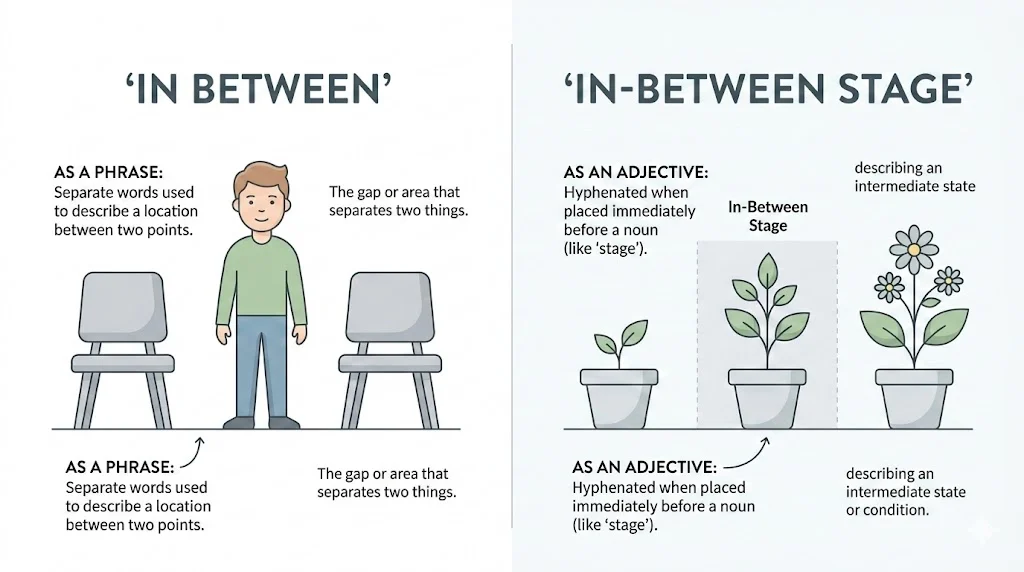
In-between is the correct standard spelling when used as an adjective or noun. In between as two separate words is also correct when used as a prepositional phrase. Inbetween written as one word is not standard in formal English and should be avoided in academic and professional writing.
Many writers feel confused when deciding between inbetween or in-between. The words look almost identical, yet the correct choice depends on grammar structure and usage. Some people write it as one word, others use a hyphen, and many separate it into two words. Because of this variation, uncertainty is common in emails, essays, blogs, and even professional documents.
The confusion usually happens because English sometimes allows both hyphenated and open compound forms. However, not every variation is correct. Using the wrong form can make writing appear careless or informal.
In this complete guide, you will learn the difference between inbetween, in-between, and in between, understand grammar rules in depth, explore real-world examples, see common mistakes, practice with exercises, and gain confidence in choosing the correct form every time.
Inbetween or In-Between Quick Answer
- In-between is correct when used as an adjective or noun.
- In between is correct when used as a phrase.
- Inbetween as one word is generally incorrect in standard English.
Simple Examples
- She felt stuck in between two choices.
- The house is located in-between the two buildings.
- Incorrect: She felt stuck inbetween two choices.
Easy Tip
If you are using it as a descriptive word before a noun, use in-between with a hyphen.
If you are using it as a phrase after a verb, use in between as two words.
Grammar Rules Explained Clearly
Understanding compound words is the key to mastering inbetween or in-between.
What Is a Compound Word
A compound word is formed by combining two words. English has three types:
- Open compounds: two separate words
- Hyphenated compounds: connected with a hyphen
- Closed compounds: written as one word
The confusion comes from not knowing which category applies.
In Between as Two Words
In between functions as a prepositional phrase. It usually appears after a verb and before a noun.
Examples
- The ball landed in between the chairs.
- She stood in between her parents.
- There was silence in between the two speeches.
Here, “in” is a preposition and “between” is also a preposition. Together they act as a phrase describing position.
This form is grammatically correct and very common.
In-Between With a Hyphen
In-between with a hyphen is often used as an adjective or noun.
As an Adjective
- The in-between stage can feel uncomfortable.
- He is in that in-between age between childhood and adulthood.
- They are in an in-between situation.
When the word directly describes a noun, the hyphen helps clarify that both words work together as one modifier.
As a Noun
- She lives in the in-between of two cultures.
- The in-between can feel uncertain.
In this case, it acts as a single conceptual noun.
Is Inbetween One Word Ever Correct
In formal writing, inbetween written as one word is not standard. Some informal online posts use it, but dictionaries and style guides prefer either in between or in-between.
In academic, professional, and formal contexts, avoid writing it as one word.
Why People Confuse Inbetween or In-Between
Visual Similarity
All three versions look nearly identical. Small differences create confusion.
Evolution of English
Some compound words start as two words and later become one word. This change over time makes writers uncertain.
Informal Internet Usage
Online writing often ignores hyphen rules, spreading incorrect forms like inbetween.
Hyphen Uncertainty
Many writers are unsure when to use hyphens in compound adjectives.
Inbetween or In-Between in Real-Life Usage
In Daily Conversation
- I felt caught in between two arguments.
- He is in that in-between phase of life.
In Academic Writing
- The study focuses on individuals in between adolescence and adulthood.
- The in-between period is psychologically complex.
Professional Writing
- The project is currently in an in-between stage.
- There was confusion in between departments.
British and American English Usage
Both British and American English follow the same rules:
- Use in between as a phrase.
- Use in-between as a modifier.
- Avoid inbetween as one word in formal contexts.
There is no regional difference in standard usage.
Which Form Should You Use
Ask yourself how the word functions in your sentence.
If it describes a noun directly, use in-between.
If it describes position or location after a verb, use in between.
Quick Test
- She stood between them → She stood in between them.
- It is an awkward phase → It is an in-between phase.
Common Mistakes and Corrections
Wrong: She stood inbetween her friends.
Correct: She stood in between her friends.
Wrong: It is an inbetween stage.
Correct: It is an in-between stage.
Wrong: The space in-between the buildings was narrow.
Correct: The space in between the buildings was narrow.
Notice how the function of the word determines the correct form.
Deeper Grammar Insight
Why Hyphens Matter
Hyphens clarify meaning. Without them, readers may misinterpret the structure.
Example:
- An in-between stage
Without the hyphen, it may look unclear which words belong together.
Compound Modifier Rule
When two words together describe a noun, they often require a hyphen.
Examples:
- Well-known author
- High-speed train
- In-between stage
This explains why in-between needs a hyphen before a noun.
More Example Sentences
Simple Sentences
- She stood in between the two cars.
- He is at an in-between age.
Medium Sentences
- There was silence in between each question.
- The company is in an in-between period of restructuring.
Formal Sentences
- Adolescence represents an in-between stage of development.
- Diplomatic talks occurred in between formal sessions.
Related Confusing Words
Writers who struggle with inbetween or in-between often confuse similar compound forms:
- Everyday vs every day
- Into vs in to
- Alot vs a lot
- Setup vs set up
- Login vs log in
Understanding compound word structure improves accuracy across all these cases.
Practice Exercises
Fill in the Blanks
- She stood ______ the two buildings.
Answer: in between - It is an ______ stage of life.
Answer: in-between - There was silence ______ the speeches.
Answer: in between - He felt stuck in an ______ situation.
Answer: in-between
Choose the Correct Option
- The house is located (inbetween / in between) the hills.
Answer: in between - She is in that (inbetween / in-between) phase.
Answer: in-between - There was tension (in-between / in between) the teams.
Answer: in between - It was an (inbetween / in-between) moment in his life.
Answer: in-between
Advanced Usage Notes
Emotional and Abstract Usage
Writers often use in-between metaphorically:
- Living in the in-between of two identities.
- Existing in the in-between space of cultures.
Stylistic Preference
Some writers choose the hyphen for clarity, especially in formal or academic contexts.
FAQs
Is inbetween ever correct as one word?
In standard formal English, no. Use either in between or in-between depending on grammar function.
What is the difference between in between and in-between?
In between is a prepositional phrase. In-between is a compound adjective or noun.
When should I use a hyphen in in-between?
Use the hyphen when the word describes a noun directly, such as an in-between stage.
Is inbetween acceptable in informal writing?
It may appear online, but it is not recommended in professional or academic writing.
Do British and American English treat this differently?
No. Both follow the same grammar rules.
Why is this mistake so common?
Because compound word rules and hyphen usage often confuse writers.
Conclusion
The confusion between inbetween or in-between comes from compound word rules. The correct forms are in between as a phrase and in-between as an adjective or noun. Writing inbetween as one word is not standard and should be avoided in formal contexts.
Remember the simple test:
If it describes a noun directly, use the hyphen.
If it describes position after a verb, keep the words separate.
Understanding compound structure and hyphen rules will improve clarity, professionalism, and confidence in your writing.