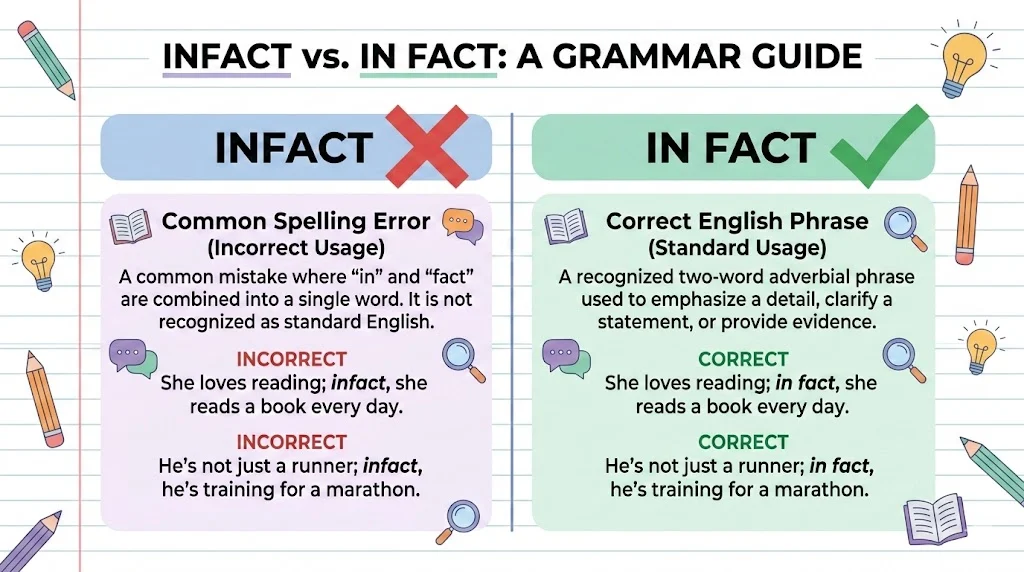
In fact is the correct form and is written as two separate words. Infact is not a standard English word and is considered incorrect in formal and informal writing. Always use in fact when you want to emphasize a statement or add supporting information.
Many writers hesitate when typing infact or in fact because the phrase is spoken quickly and sounds like a single word. This confusion leads people to combine the words and write infact, especially in emails, social media posts, school assignments, and even professional documents. The mistake is common, but the rule is simple once you understand it.
The correct form is in fact, written as two separate words. It is a fixed phrase used to emphasize a statement, correct information, or add clarification. The combined form infact is not accepted in standard English dictionaries and should be avoided in all formal writing.
This article explains everything you need to know about infact or in fact. You will learn grammar rules, why people make this mistake, real-world examples, advanced usage tips, related confusing phrases, practice exercises, and clear explanations to help you write confidently.
Quick Answer
The correct form is in fact.
Infact is incorrect and should not be used.
Examples
- She was tired. In fact, she fell asleep immediately.
- The test was easy. In fact, most students finished early.
Never write:
- She was tired. Infact, she fell asleep.
What Does In Fact Mean?
In fact is a transitional phrase. It is used to:
- Emphasize a statement
- Add stronger information
- Correct something previously mentioned
- Clarify a point
It strengthens what you are saying.
Example for Emphasis
- He is talented. In fact, he won three awards.
For Correction
- I thought it was expensive. In fact, it was quite affordable.
Example for Clarification
- She does not dislike him. In fact, she respects him deeply.
Grammar Rules Explained Clearly
In Fact Is a Fixed Phrase
The phrase in fact consists of two separate words:
- In is a preposition.
- Fact is a noun.
Together, they form an adverbial phrase that modifies a sentence.
It does not function as one combined word. That is why infact is incorrect.
Sentence Placement
You can use in fact at different positions in a sentence:
At the beginning:
- In fact, the results were surprising.
In the middle:
- The results were, in fact, surprising.
At the end:
- The results were surprising, in fact.
All placements are grammatically correct depending on emphasis.
Why People Write Infact Instead of In Fact
Fast Pronunciation
When spoken quickly, “in fact” sounds like one word. This leads writers to combine it.
Typing Habits
People often type quickly and merge common phrases without noticing.
Informal Messaging
In texting and casual writing, spacing rules are often ignored.
Visual Confusion
Since many English words begin with “in,” writers assume infact could be correct.
Lack of Grammar Awareness
Some writers are unaware that in fact is a fixed phrase that must remain separated.
In Fact in Real Life Usage
In Conversation
- I was not upset. In fact, I was happy.
- He is not new here. In fact, he has worked here for years.
Emails
- The project is ahead of schedule. In fact, we may finish early.
- The issue is minor. In fact, it can be fixed today.
In Academic Writing
- The data does not support the theory. In fact, it contradicts it.
- The experiment failed. In fact, it produced opposite results.
In Professional Reports
- Sales increased last quarter. In fact, they doubled.
- The system is stable. In fact, it has had no downtime.
British and American English Usage
Both British and American English use in fact as two words.
There is no variation in spelling.
Correct in both regions:
- In fact, the meeting was postponed.
Incorrect everywhere:
- Infact, the meeting was postponed.
Difference Between In Fact and Similar Phrases
Many writers confuse in fact with other transitional phrases. Understanding the differences improves clarity.
In Fact vs Actually
Both add emphasis, but “actually” often corrects a misunderstanding.
- I thought he was angry. Actually, he was tired.
- He was tired. In fact, he had not slept all night.
In Fact vs Indeed
“Indeed” confirms something strongly.
- She is intelligent. Indeed, she graduated top of her class.
- She is intelligent. In fact, she graduated top of her class.
In Fact vs As a Matter of Fact
“As a matter of fact” is more conversational.
- He did not complain. As a matter of fact, he praised the service.
Common Mistakes and Corrections
Wrong: Infact, I agree with you.
Correct: In fact, I agree with you.
Wrong: He was tired infact exhausted.
Correct: He was tired, in fact, exhausted.
Wrong: Infact the results were surprising.
Correct: In fact, the results were surprising.
Advanced Usage of In Fact
Strengthening Arguments
Writers use in fact to reinforce arguments.
- The policy is effective. In fact, it reduced costs significantly.
Academic Tone
It is commonly used in formal essays.
- The hypothesis was incorrect. In fact, the opposite was proven.
Persuasive Writing
It adds authority and confidence.
- This solution works. In fact, it has been tested worldwide.
Related Confusing Word Pairs
Learning similar mistakes helps prevent errors.
- alot or a lot
- atleast or at least
- everyday or every day
- into or in to
- maybe or may be
Like infact or in fact, many of these involve spacing confusion.
Practice Exercises
Fill in the Blanks
- ______, the results were better than expected.
Answer: In fact - He was not late. ______, he arrived early.
Answer: In fact - I thought it was difficult. ______, it was simple.
Answer: In fact
Correct the Sentence
- Infact, she enjoyed the event.
Answer: In fact, she enjoyed the event. - He was confused infact frustrated.
Answer: He was confused, in fact, frustrated.
Writing Tips to Avoid the Infact Mistake
- Always check spacing when typing quickly.
- Remember that in fact contains two real dictionary words.
- If unsure, search the phrase in a dictionary.
- Proofread professional emails and documents carefully.
FAQs
Is infact ever correct in English?
No, infact is not a standard English word and should not be used.
Why do people write infact instead of in fact?
Because the phrase sounds like one word when spoken quickly.
Can in fact start a sentence?
Yes, in fact can begin, appear in the middle, or end a sentence.
Is in fact formal or informal?
It can be used in both formal and informal writing.
Does in fact need commas?
When used in the middle of a sentence, it is often set off with commas for clarity.
Is there a difference between British and American spelling?
No, both use in fact as two words.
Conclusion
The confusion between infact or in fact is common, but the rule is clear. In fact is always written as two separate words. The combined form infact is incorrect and should not appear in professional, academic, or casual writing.
Understanding this simple spacing rule improves clarity and prevents grammar mistakes. Remember that in fact is a fixed phrase used to emphasize or clarify information. With practice, proofreading, and awareness, this error becomes easy to avoid.
Clear writing builds confidence and professionalism. Always choose in fact, never infact.