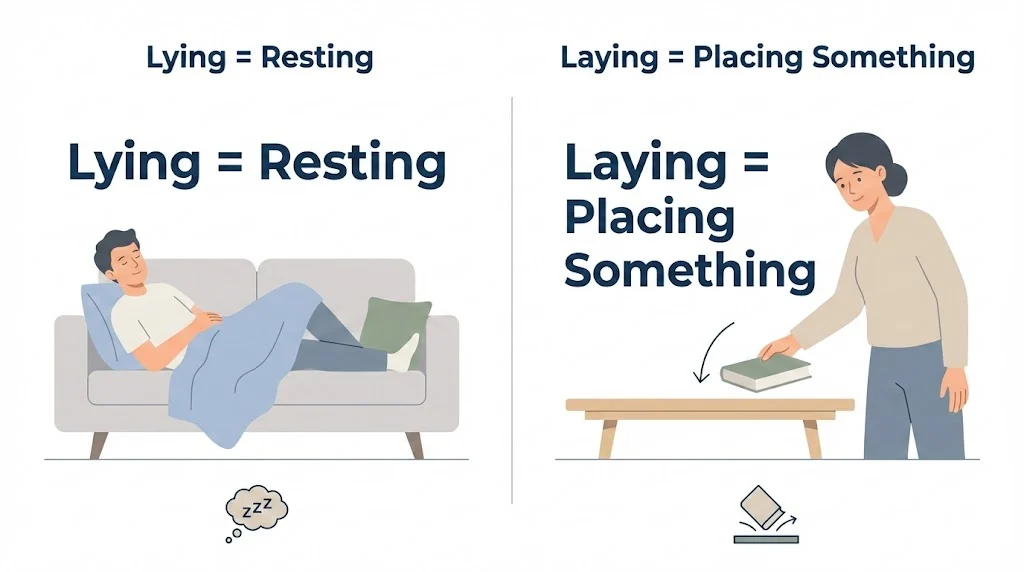
Lying means resting or reclining and does not take a direct object.
Laying means placing something down and always requires a direct object.
If you are putting something somewhere, use laying. If someone is resting, use lying.
Many writers struggle with laying or lying because both words look similar and come from related verbs. The confusion becomes stronger because their past tense forms are also tricky. Even native speakers mix them up in conversation and writing.
People search for “laying or lying” to understand which word is correct in sentences like “I am laying on the bed” or “I am lying on the bed.” The mistake is common in emails, essays, captions, and even professional writing. Using the wrong word can make writing sound careless or grammatically incorrect.
The difference between laying and lying depends on one simple grammar rule. One verb needs an object. The other does not. Once you understand this core rule, the confusion disappears.
This complete guide explains grammar rules in depth, verb forms, real world examples, common mistakes, memory tricks, practice exercises with answers, and frequently asked questions. By the end, you will confidently know when to use laying or lying.
Laying or Lying Quick Answer
Lying means resting or reclining. It does not take an object.
Laying means placing something somewhere. It requires an object.
Examples
- She is lying on the couch.
- He is laying the book on the table.
- The dog is lying on the floor.
- She is laying the baby in the crib.
Quick Test
Ask yourself: Is someone placing something?
If yes, use laying.
If no and someone is resting, use lying.
Grammar Rules Explained Clearly
Understanding the base verbs removes confusion.
The verbs involved are lie and lay.
The Verb Lie
Lie means to rest or recline.
It does not take a direct object.
Principal forms:
- Present: lie
- Present participle: lying
- Past: lay
- Past participle: lain
Examples:
- I lie down every afternoon.
- She is lying on the sofa.
- Yesterday, he lay on the bed.
- He has lain there for hours.
Notice something important. The past tense of lie is lay. This is why confusion increases.
The Verb Lay
Lay means to place or put something down.
It always takes a direct object.
Principal forms:
- Present: lay
- Present participle: laying
- Past: laid
- Past participle: laid
Examples:
- I lay the keys on the table.
- She is laying the plates on the counter.
- Yesterday, he laid the book on the desk.
- He has laid the carpet already.
The key difference is that lay requires something to receive the action.
Why People Confuse Laying or Lying
This confusion happens for several strong reasons.
Similar Spellings
Laying and lying look almost identical. Only one letter changes.
Overlapping Verb Forms
The past tense of lie is lay.
The present tense of lay is lay.
This overlap creates confusion.
Spoken English
In conversation, many speakers misuse these verbs, which spreads incorrect usage.
Weak Grammar Education
Many learners memorize words but do not understand verb transitivity. Without understanding objects, mistakes continue.
Informal Writing
Social media captions like “I am laying in bed” reinforce incorrect grammar.
Deep Grammar Breakdown With Objects
To master laying or lying, you must understand direct objects.
A direct object answers the question “what” or “whom.”
Example With Laying
She is laying the book on the table.
What is she laying?
The book.
This is the object.
Correct.
Example With Lying
She is lying on the table.
What is she lying?
Nothing.
She herself is resting.
Correct.
Incorrect Example
She is laying on the bed.
What is she laying?
Nothing.
This sentence is wrong because laying needs an object.
Correct version:
She is lying on the bed.
Verb Forms Comparison Table
| Base Verb | Meaning | Present | Present Participle | Past | Past Participle | Needs Object |
|---|---|---|---|---|---|---|
| Lie | To rest | lie | lying | lay | lain | No |
| Lay | To place | lay | laying | laid | laid | Yes |
This table is the key to mastering laying or lying.
Real World Usage Examples
Daily Conversation
- I am lying on the sofa.
- She is laying the clothes on the bed.
- The cat is lying in the sun.
- He is laying the tools on the floor.
Emails
- I am lying down due to illness.
- She is laying the documents on your desk.
Social Media
- Just lying in bed watching movies.
- Laying the foundation for a new project.
Formal Writing
- The patient is lying comfortably.
- The worker is laying tiles carefully.
Common Mistakes and Corrections
Wrong: I am laying on the couch.
Correct: I am lying on the couch.
Wrong: She was laying on the floor.
Correct: She was lying on the floor.
Wrong: He is lying the phone on the table.
Correct: He is laying the phone on the table.
Wrong: The book is laying on the shelf.
Correct: The book is lying on the shelf.
Memory Tricks to Remember
Trick One
Laying requires something.
If you can point to the object, use laying.
Trick Two
Lying is for resting.
If someone is resting, use lying.
Trick Three
Lay it down.
Lie down.
Notice the difference.
Related Grammar Confusions
- Sit or set
- Rise or raise
- Affect or effect
- Its or it’s
- Your or you’re
These pairs are confusing because of similar spelling or overlapping verb forms.
Practice Exercises
Fill in the Blanks
- She is ______ on the bed.
Answer: lying - He is ______ the book on the table.
Answer: laying - The dog is ______ in the yard.
Answer: lying - She is ______ the baby in the crib.
Answer: laying - I was ______ on the sofa yesterday.
Answer: lying - He was ______ the carpet carefully.
Answer: laying
Choose the Correct Word
- I am (laying / lying) down.
Answer: lying - She is (laying / lying) the plates on the table.
Answer: laying - The cat is (laying / lying) in the sun.
Answer: lying - He is (laying / lying) the bricks.
Answer: laying
Advanced Usage and Edge Cases
Sometimes confusion increases with continuous tense.
Correct:
She is lying down.
He is laying the bricks.
Incorrect:
She is laying down.
Unless she is placing something down, it is wrong.
FAQs
What is the difference between laying and lying?
Lying means resting and does not need an object. Laying means placing something and requires an object.
Is it correct to say I am laying down?
No. The correct sentence is I am lying down unless you are placing something down.
Why is the past tense confusing?
Because the past tense of lie is lay, which looks like the present tense of lay.
How do I know which one to use?
Check for an object. If there is an object, use laying. If not, use lying.
Can laying ever mean resting?
No. Laying always means placing something.
Is this mistake common among native speakers?
Yes. Many native speakers confuse laying or lying in casual speech.
Does formal writing require strict correctness?
Yes. In academic and professional writing, correct usage is important.
Conclusion
The confusion between laying or lying is common but easy to solve once you understand one core rule. Lying means resting and does not need an object. Laying means placing something and always needs an object. The overlap in verb forms creates confusion, but remembering the object rule removes all doubt.
When you write or speak, pause and ask yourself whether something is being placed. If yes, use laying. If someone is simply resting, use lying. Practice with examples and exercises to strengthen your understanding. Mastering this rule improves grammar accuracy and writing clarity in every situation.