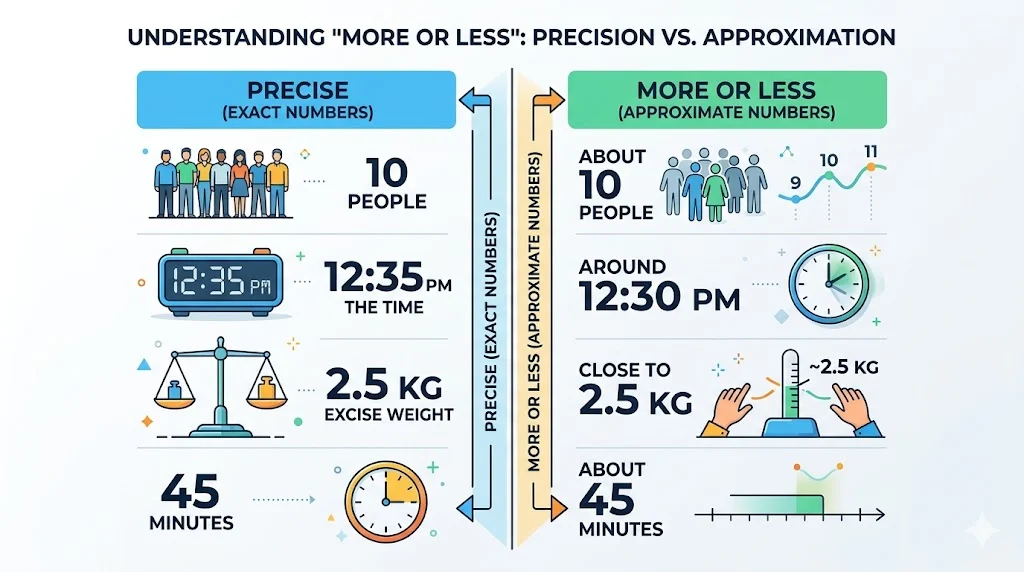

More or less means approximately or almost. It shows something is not exact but close. Example: The work is more or less finished.
I used to feel unsure when using more or less in my writing. Sometimes I used it to mean “almost,” and other times I used it to show “approximation,” but I was not always confident if it sounded right. This confusion became clear when I used it in a report and realized the meaning could change based on context. After studying real examples and practicing daily, I understood that more or less expresses approximation, uncertainty, or partial truth. Once I learned how tone and context affect its meaning, my writing became clearer and more natural. If you face similar confusion, this guide will help you fully understand and use more or less correctly.
More or Less Quick Answer
More or less means approximately, almost, or to some degree.
It is used when something is not exact but close to the truth.
Examples
The project is more or less complete.
There were more or less fifty people at the event.
More or Less Meaning
The phrase more or less has multiple related meanings depending on context.
1. Approximation
It means something is close to a number or value.
Example
There were more or less 100 guests at the wedding.
2. Almost or Nearly
It shows something is nearly complete or true.
Example
The work is more or less done.
3. Partial Agreement
It can mean something is true to some extent.
Example
I more or less agree with your opinion.
More or Less Difference in Meaning
| Usage Type | Meaning | Example |
|---|---|---|
| Approximation | Not exact but close | More or less 20 minutes |
| Nearly | Almost complete | The task is more or less finished |
| Partial Agreement | To some extent | I more or less agree |
Key Idea: The meaning depends on context and tone.
Grammar Rule Depth
More or less is an adverbial phrase. It modifies verbs, adjectives, or entire sentences.
Usage with Verbs
The work is more or less completed.
Usage with Numbers
There were more or less 200 people.
Usage with Opinions
I more or less agree with him.
It does not change form and remains the same in all sentences.
The Origin of More or Less
The phrase comes from Middle English and has been used for centuries.
It originally meant to a greater or smaller degree.
Over time, it developed broader meanings such as approximation and uncertainty.
Today, it is widely used in both formal and informal English.
Why People Confuse More or Less
- It has multiple meanings.
- It depends on tone and context.
- It can sound informal in some situations.
- It overlaps with words like “approximately” and “almost.”
Real World Usage of More or Less
In Daily Life
I will arrive in more or less an hour.
The house is more or less ready.
In Work Communication
The report is more or less complete.
The budget is more or less finalized.
In Academic Context
The results are more or less consistent.
The theory is more or less accepted.
More or Less in Everyday Examples
Emails
The task is more or less finished.
News
The situation is more or less under control.
Social Media
I am more or less done with my work.
Formal Writing
The data is more or less accurate.
Common Mistakes with More or Less
Mistake 1 Overusing It
Using it too often makes writing unclear.
Mistake 2 Using in Formal Precision Context
Incorrect in precise contexts.
Incorrect
The result is more or less 100 percent accurate.
Correct
The result is exactly 100 percent accurate.
Mistake 3 Confusing with “At Least”
Incorrect
There were more or less 50 people (if exact count needed).
Correct
There were approximately 50 people.
More or Less in Different Contexts
Informal Usage
Very common in speech.
Example
I am more or less ready.
Formal Usage
Used carefully.
Example
The results are more or less consistent with previous studies.
Negative Context
It can show uncertainty.
Example
The problem is more or less solved.
Related Words and Expressions
approximately
almost
nearly
roughly
to some extent
These words have similar meanings but different usage contexts.
More or Less vs Similar Expressions
| Phrase | Meaning | Usage |
|---|---|---|
| More or less | Approximate or partial | Informal and flexible |
| Approximately | Close to exact | Formal |
| Almost | Nearly complete | Common |
| Roughly | Estimated | Informal |
Usage Trends
The phrase more or less is widely used in spoken English.
In formal writing, alternatives like approximately or nearly are sometimes preferred.
However, it still appears in professional contexts when expressing flexibility or uncertainty.
Exercise 1 Choose the Correct Phrase
Fill in the blank.
The project is ______ complete.
Answer: more or less
There were ______ 200 people at the event.
Answer: more or less
I ______ agree with your opinion.
Answer: more or less
Exercise 2 Correct the Sentence
Rewrite correctly.
The result is more or less exactly 100 percent.
Answer: The result is exactly 100 percent.
There were more or less exactly 50 people.
Answer: There were approximately 50 people.
FAQs
What does more or less mean?
It means approximately, almost, or to some degree depending on context.
Is more or less formal or informal?
It is mostly informal but can be used in semi formal writing.
Can more or less mean almost?
Yes, it can mean nearly or almost.
Can it be used with numbers?
Yes, it is used for approximation.
Is it correct in academic writing?
It can be used, but more precise words are often preferred.
Why is it confusing?
Because it has multiple meanings depending on context.
Can I replace it with approximately?
Yes, in many cases.
Conclusion
The phrase more or less is simple but powerful. It helps express approximation, partial truth, and uncertainty in a natural way. Although it may seem confusing at first, understanding its meanings and contexts makes it easy to use correctly.
The key is recognizing that it does not give exact information but rather an estimate or general idea. In informal speech, it is very common and useful. In formal writing, it should be used carefully when precision is not required.
By practicing examples, understanding grammar rules, and avoiding common mistakes, you can use more or less confidently in everyday communication, professional writing, and academic contexts.