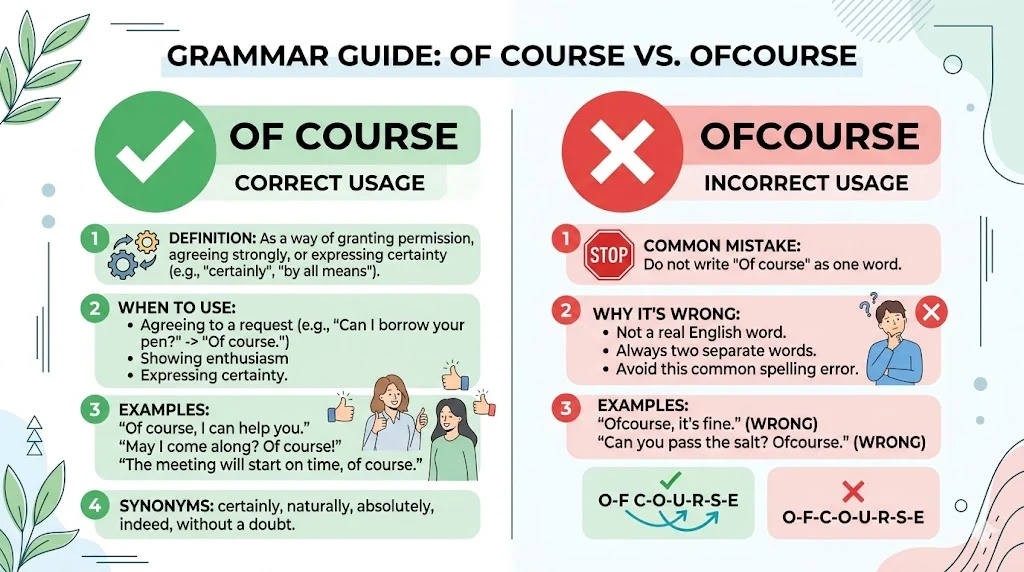
Of course is the correct form and always written as two words. Ofcourse is incorrect in standard English. Use “of course” to show agreement, certainty, or permission in sentences.
I once made the mistake of writing ofcourse in a professional email. It looked fine to me at the time, but later I realized it was incorrect. That small error made me question how often I might be using common phrases the wrong way.
After checking grammar rules and real usage examples, I learned that “of course” is always written as two separate words. Since then, I have paid close attention to similar phrases in my writing. If you have ever typed “ofcourse” without thinking, you are not alone.
This guide will help you clearly understand the difference, avoid mistakes, and use the correct form confidently in everyday and professional writing.
Quick Answer
Of course is correct and always written as two words.
Ofcourse is incorrect and should not be used in standard English.
Examples
Correct: Of course I will help you.
Correct: Yes, of course you can join us.
Incorrect: Ofcourse I agree with you.
Of Course vs Ofcourse Meaning
Of Course
The phrase of course is used to express:
- Agreement
- Certainty
- Permission
- Obviousness
Examples
- Of course I understand your concern.
- Of course you can use my laptop.
- She will succeed, of course.
Ofcourse
Ofcourse has no meaning in standard English because it is not a correct word. It is simply a spelling mistake.
Of Course vs Ofcourse Difference
| Form | Meaning | Correct Usage |
|---|---|---|
| Of course | Shows agreement or certainty | Correct |
| Ofcourse | No meaning | Incorrect |
Key Point
Always write of course as two separate words.
Grammar Rule Depth
Why “Of Course” Is Two Words
The phrase consists of:
- Of → a preposition
- Course → a noun
Together, they form a phrase meaning something is natural or expected.
Why “Ofcourse” Is Incorrect
English grammar does not combine these words into one. Unlike words such as “cannot” or “notebook,” “of course” has never been accepted as a single word.
The Origin of Of Course
The phrase of course comes from older English usage where it meant “following the natural course of events.”
Over time, it evolved into a conversational expression meaning:
- Naturally
- Obviously
- Certainly
Historical Insight
People used “of course” to describe something expected or logical. For example:
Of course the sun rises in the east.
This meaning continues today in both formal and informal English.
Why People Write Ofcourse Instead of Of Course
1. Fast Typing
People often type quickly and combine words without noticing.
2. Informal Writing Habits
Text messages and social media encourage shortcuts.
3. Lack of Awareness
Many learners do not realize that “of course” must be separated.
4. Similar Word Patterns
Some English words are combined, which leads to confusion.
Real World Usage of Of Course
Daily Conversation
- Of course I will call you later.
- Of course that makes sense.
Professional Communication
- Of course we can schedule the meeting tomorrow.
- Of course I will review the document.
Customer Service
- Of course we can assist you with your request.
Of Course in Everyday Examples
Emails
Of course, I will send the report by evening.
News
The team will win, of course, if they continue this performance.
Social Media
Of course I am excited about this trip.
Formal Writing
The results, of course, depend on several factors.
Common Mistakes with Of Course vs Ofcourse
Mistake 1 Writing as One Word
Incorrect: Ofcourse I agree.
Correct: Of course I agree.
Mistake 2 Overusing the Phrase
Using “of course” too often can sound repetitive.
Mistake 3 Wrong Tone
Sometimes “of course” can sound rude if used incorrectly.
Example
Of course you forgot again.
Of Course in Different Contexts
Showing Agreement
Of course I agree with your idea.
Giving Permission
Of course you can leave early today.
Expressing Certainty
Of course this solution will work.
Emphasizing the Obvious
Of course the earth revolves around the sun.
Tone and Politeness with Of Course
The phrase can sound polite or rude depending on tone.
Polite Use
Of course, I would be happy to help.
Slightly Rude Use
Of course you should know this already.
Tip
Always consider context and tone when using the phrase.
Related Expressions
Similar phrases include:
- certainly
- obviously
- naturally
- sure
Examples
Certainly, I will help you.
Naturally, she accepted the offer.
Usage Trends
The phrase of course is extremely common in both spoken and written English.
The incorrect form ofcourse appears mostly in:
- Informal messages
- Social media
- Typing errors
Professional writing always uses of course.
Advanced Usage of Of Course
In Mid Sentence
She will, of course, attend the meeting.
At the Beginning
Of course, we support your decision.
At the End
You will finish the task, of course.
Exercise 1 Choose the Correct Form
Fill in the blank with of course or ofcourse.
I will help you, ______.
Answer: of course
______ you can join us.
Answer: Of course
She will succeed, ______.
Answer: of course
Exercise 2 Correct the Sentence
Rewrite the sentence correctly.
Ofcourse I understand your point.
Answer: Of course I understand your point.
Yes ofcourse you can go.
Answer: Yes, of course you can go.
FAQs
Is ofcourse a correct word?
No, ofcourse is not correct in standard English. The correct form is always “of course.”
Why is of course written as two words?
Because it is a phrase made of a preposition and a noun. English grammar does not combine them into one word.
Can I use of course in formal writing?
Yes, of course is widely used in formal and professional communication.
What does of course mean?
It means certainly, naturally, or obviously, depending on context.
Is it okay to use of course in emails?
Yes, it is commonly used in emails to show agreement or politeness.
Why do people write ofcourse?
Because of fast typing, informal habits, and lack of grammar awareness.
Can of course sound rude?
Yes, depending on tone. It can sound sarcastic if used improperly.
Conclusion
Understanding the difference between of course vs ofcourse is simple but important for clear and professional English. The correct form is always of course, written as two separate words. The incorrect version ofcourse is a common mistake caused by fast typing, informal writing habits, and confusion about word combinations.
The phrase “of course” is widely used to express agreement, certainty, permission, and obviousness. It appears in conversations, emails, news writing, and formal communication. However, tone matters. In some contexts, it can sound polite, while in others it may seem sarcastic or rude.
By remembering that “of course” is a phrase made of two words, you can avoid errors easily. Practice using it in different contexts and pay attention to tone. This small improvement will make your writing more accurate, professional, and natural.