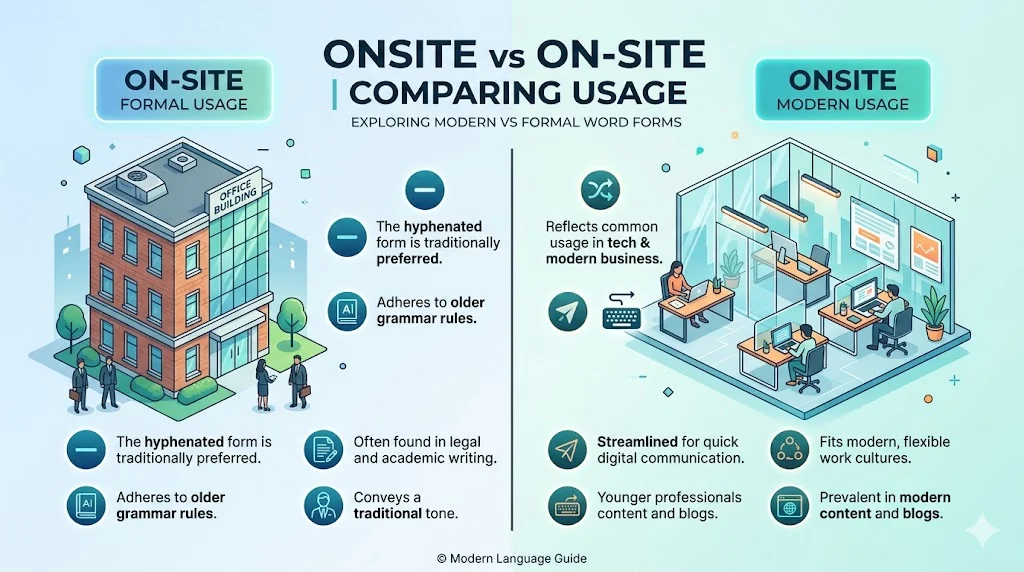

Onsite and on-site both refer to something happening at a physical location. On-site is the standard spelling in formal writing, while onsite is more common in modern and informal usage.
I used to confuse onsite vs on-site while writing professional content, especially in job descriptions and service pages. Sometimes I wrote “on-site,” and other times “onsite,” without knowing which one was correct. This inconsistency made my writing look unprofessional.
After researching style guides and real-world usage, I learned that both forms are correct, but their usage depends on context and audience. By applying a simple consistency rule and understanding how each form is used, I fixed the issue completely.
If you’ve faced the same confusion, this guide will help you understand the difference clearly and use the right form every time.
Quick Answer
Both onsite and on-site are correct.
On-site is the traditional and more formal spelling.
Onsite is a modern, simplified version used in digital content and business writing.
Examples
The technician will provide on-site support.
We offer onsite services across the city.
Onsite vs On-Site Meaning
Both words have the same meaning.
They describe something that happens at a physical location instead of remotely or online.
Examples
On-site meeting → Meeting held at a location
Onsite training → Training conducted at the workplace
Key Idea
There is no difference in meaning, only a difference in spelling and usage style.
Onsite vs On-Site Difference
| Word | Meaning | Usage Style | Example |
|---|---|---|---|
| On-site | At a physical location | Formal, traditional | On-site inspection |
| Onsite | At a physical location | Modern, informal | Onsite support |
Key Point
On-site is more formal.
Onsite is more modern and simplified.
Grammar Rule Depth
Understanding the grammar helps remove confusion.
On-Site as a Compound Modifier
When used before a noun, on-site is often hyphenated.
Example
On-site training session
On-site support team
On Site Without Hyphen
When used after a verb, it is often written as two words.
Example
The team is working on site.
Onsite as a Closed Compound
Modern usage combines the words into onsite, especially in business and digital writing.
Example
We provide onsite services.
Verb and Sentence Structure Usage
As an Adjective
On-site or onsite modifies a noun.
Example
On-site inspection
Onsite repair
As an Adverb
Used to describe where something happens.
Example
The engineer will work on site.
The Origin of Onsite and On-Site
The phrase comes from combining:
On → indicating location
Site → a place or physical location
Originally, it was written as two words: on site.
Later, it became hyphenated as on-site to improve clarity.
In modern English, many compound words evolve into single words, which is how onsite became popular.
Why Both Onsite and On-Site Exist
English often allows multiple forms of compound words.
Examples
e-mail → email
on-line → online
on-site → onsite
Over time, language becomes simpler, and hyphens are often removed.
Why On-Site Is Still Preferred in Formal Writing
Style Guides
Many formal style guides prefer on-site, especially in:
Technical writing
Academic documents
Government reports
Clarity
The hyphen helps avoid confusion in complex sentences.
Why Onsite Is Popular in Modern Usage
Digital Content
Websites and blogs often use onsite because it looks cleaner.
Business Writing
Companies prefer shorter and simpler forms.
Example
Onsite support sounds more modern than on-site support.
SEO and Search Behavior
Users often search without hyphens, making onsite more visible online.
Which Spelling Should You Use
Formal Writing
Use on-site
Business and Marketing
Use onsite
General Rule
Choose one form and stay consistent throughout your content.
Real World Usage of Onsite vs On-Site
Business
We provide onsite installation services.
The company offers on-site technical support.
Education
Students attend on-site classes.
The training is conducted onsite.
Healthcare
Doctors provide on-site medical services.
The clinic offers onsite testing.
Onsite vs On-Site in Everyday Examples
Emails
We will send a technician for on-site inspection.
Our team will provide onsite support tomorrow.
News
The company expanded its onsite services.
The government announced on-site inspections.
Social Media
We now offer onsite repairs.
Book your on-site appointment today.
Formal Writing
The organization provides on-site assistance.
The program includes onsite evaluation.
Common Mistakes with Onsite vs On-Site
Mixing Both Forms
Incorrect
We offer onsite and on-site services.
Correct
We offer onsite services.
Wrong Hyphen Usage
Incorrect
On site training session
Correct
On-site training session
Overusing One Form Incorrectly
Using onsite in formal reports may look unprofessional.
Onsite vs On-Site in Different Contexts
Job Descriptions
On-site role → Work at office
Onsite job → Same meaning but modern tone
IT and Tech
On-site support → Formal
Onsite support → Common in business
Construction
On-site inspection → Standard usage
Related Words and Expressions
Understanding related terms improves clarity.
Similar Terms
Remote → Not at physical location
Offsite → Away from main location
In-house → Within organization
Examples
Remote work is becoming popular.
The meeting was held offsite.
The company has an in-house team.
Usage Trends
Language trends show:
On-site → Preferred in formal writing
Onsite → Growing in digital and business use
Over time, onsite may become the dominant form, similar to online.
Exercise 1 Choose the Correct Form
Fill in the blanks with onsite or on-site.
The company offers ______ support services.
Answer: onsite
We conducted an ______ inspection.
Answer: on-site
The technician will arrive for ______ repair.
Answer: onsite
Exercise 2 Correct the Sentence
Rewrite correctly.
We provide on site training.
Answer: We provide on-site training.
The company offers on-site and onsite services.
Answer: The company offers onsite services.
FAQs
What is the difference between onsite and on-site?
There is no difference in meaning. On-site is formal, while onsite is modern and commonly used in business writing.
Is onsite a correct word?
Yes, onsite is correct and widely used, especially in digital and marketing content.
When should I use on-site?
Use on-site in formal writing, academic content, and technical documents.
Is on site also correct?
Yes, when used as an adverb, it is often written as two words, like “work on site.”
Which spelling is better for professional writing?
On-site is generally safer for formal and professional documents.
Can I use onsite in SEO content?
Yes, onsite is commonly used in web content because it is simpler and matches user search behavior.
Should I use both onsite and on-site together?
No, choose one form and stay consistent.
Conclusion
Understanding the difference between onsite vs on-site is important for clear and professional writing. Both forms have the same meaning and refer to something happening at a physical location. The difference lies in style and usage.
The hyphenated form on-site is more traditional and widely accepted in formal writing such as reports, academic content, and technical documents. On the other hand, the closed form onsite is modern, simpler, and commonly used in business communication, marketing, and digital content.
The key to using these terms correctly is consistency. Choose the form that matches your audience and purpose, and use it throughout your writing. This ensures clarity, professionalism, and better readability.
As language continues to evolve, onsite may become more dominant, but for now, both forms remain correct when used appropriately.