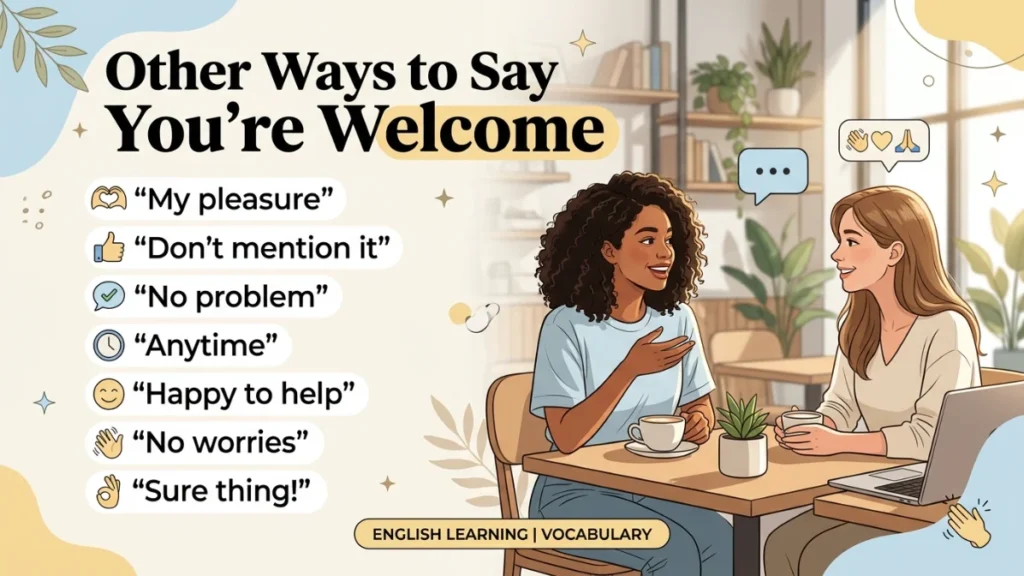

If you’re looking for other ways to say you’re welcome, here are common alternatives: No problem, You’re most welcome, My pleasure, Don’t mention it, Happy to help. These expressions help you sound more natural in both casual and professional English.
“You’re welcome” is one of the most common responses after someone thanks you. It shows politeness and acknowledgment of gratitude.
However, using the same phrase repeatedly can sound mechanical or limited. Native speakers often vary their responses depending on tone, context, and relationship.
Learning alternatives to you’re welcome improves your fluency and helps you respond more naturally in conversations while also allowing you to better express excitement in English in a polite way.
“How you respond to thanks shapes how natural your English sounds.”
Quick Categories
Formal alternatives to “other ways to say you’re welcome”
You are most welcome, It was my pleasure, I’m glad I could assist you
Casual alternatives
No problem, Sure thing, Anytime
Professional alternatives
Happy to help, Glad I could assist, I’m pleased to help
Informal expressions
Don’t mention it, No worries, Of course
Formal Alternatives to “You’re Welcome”
These are suitable for polite, respectful, or official communication.
Pro Tips: Use formal responses in emails, customer service, and professional settings.
“Formal responses reinforce professionalism and respect.”
Casual Alternatives
Best for friends, family, and everyday conversations.
Pro Tips: Keep responses light and natural in informal settings.
Professional Alternatives
Ideal for workplace communication, emails, and service interactions.
Pro Tips: Maintain politeness and clarity without sounding too casual.
“Professional English values helpfulness expressed simply.”
Informal Expressions
Used in relaxed and friendly conversations.
Pro Tips: Tone and relationship matter more than exact wording.
Common Mistakes When Using “You’re Welcome”
- Overusing only one phrase
Example: You’re welcome, you’re welcome, you’re welcome. - Using informal replies in formal emails
Example: No problem (in client email) - Incorrect spelling or contraction errors
Example: Your welcome - Using it sarcastically in professional context
Example: Yeah, you’re welcome… - Ignoring tone matching
Example: too casual reply to senior authority
What Does “You’re Welcome” Mean?
It is a polite response to someone thanking you, showing that you are happy to help or acknowledge appreciation.
Grammar Note:
“You’re” is a contraction of “you are.”
Example:
You’re welcome. I’m glad I could help.
When to Use “You’re Welcome”
- After someone says thank you
- In conversations, emails, and messages
- In both formal and informal situations
Spoken vs Written: Both
Formal vs Informal: Neutral
Is It Professional or Polite to Say “You’re Welcome”?
- Polite? ✔️ Yes
- Professional? ✔️ Yes
Business-style example:
You are most welcome. Please let me know if you need further assistance.
Pros and Cons of Using “You’re Welcome”
Pros
- Universally understood
- Polite and safe
- Works in all contexts
- Simple and clear
Cons
- Can sound repetitive
- Lacks emotional variety
- May feel formal in casual chats
- Overused in daily speech
“Variety makes even simple replies sound more natural.”
Other Ways to Say “You’re Welcome” (With Examples)
These other ways to say you’re welcome help you sound more fluent, natural, and confident. Use them based on tone, setting, and relationship to respond appropriately in English.
1. Phrase: No problem
Meaning: It was not an issue
Explanation: Very common casual response
Example Sentence: No problem, happy to help!
Best Use: Casual
Worst Use: Formal emails
Tone: Relaxed, friendly
Context Variability: spoken
2. Phrase: You’re most welcome
Meaning: Polite emphasis
Explanation: Formal and respectful
Example Sentence: You’re most welcome, anytime.
Best Use: Formal
Worst Use: Slang conversations
Tone: Polite, warm
Context Variability: written
3. Phrase: My pleasure
Meaning: I was happy to help
Explanation: Professional and polite
Example Sentence: My pleasure to assist you.
Best Use: Professional
Worst Use: Casual slang
Tone: Formal, courteous
Context Variability: spoken, written
4. Phrase: Don’t mention it
Meaning: It’s nothing important
Explanation: Humble response
Example Sentence: Don’t mention it, really.
Best Use: Casual
Worst Use: Formal business
Tone: Friendly
Context Variability: spoken
5. Phrase: Happy to help
Meaning: Willing assistance
Explanation: Very common professional phrase
Example Sentence: Happy to help anytime.
Best Use: Workplace
Worst Use: Emotional context
Tone: Professional, polite
Context Variability: written
6. Phrase: Anytime
Meaning: Always willing
Explanation: Very casual response
Example Sentence: Anytime, just ask!
Best Use: Friends
Worst Use: Formal writing
Tone: Friendly
Context Variability: spoken
7. Phrase: No worries
Meaning: It’s okay
Explanation: Relaxed tone
Example Sentence: No worries at all.
Best Use: Casual
Worst Use: Formal emails
Tone: Informal, relaxed
Context Variability: spoken
8. Phrase: Sure thing
Meaning: Gladly accepted
Explanation: Informal agreement
Example Sentence: Sure thing, happy to help.
Best Use: Casual
Worst Use: Professional
Tone: Friendly
Context Variability: spoken
9. Phrase: Glad I could help
Meaning: Satisfaction in helping
Explanation: Neutral professional tone
Example Sentence: Glad I could help you today.
Best Use: Professional
Worst Use: Slang chat
Tone: Polite
Context Variability: written
10. Phrase: It was nothing
Meaning: Downplaying effort
Explanation: Humble response
Example Sentence: It was nothing, really.
Best Use: Casual
Worst Use: Formal settings
Tone: Modest
Context Variability: spoken
11. Phrase: Of course
Meaning: Naturally
Explanation: Confident response
Example Sentence: Of course, happy to assist.
Best Use: General
Worst Use: Overly formal letters
Tone: Neutral
Context Variability: spoken
12. Phrase: Don’t worry about it
Meaning: No issue at all
Explanation: Relaxed reassurance
Example Sentence: Don’t worry about it.
Best Use: Friends
Worst Use: Business
Tone: Casual
Context Variability: spoken
13. Phrase: It’s all good
Meaning: Everything is fine
Explanation: Very informal
Example Sentence: It’s all good!
Best Use: Friends
Worst Use: Formal communication
Tone: Relaxed
Context Variability: spoken
14. Phrase: You’re very welcome
Meaning: Strong polite response
Explanation: Emphasized gratitude
Example Sentence: You’re very welcome.
Best Use: Formal
Worst Use: Casual slang
Tone: Polite
Context Variability: written
15. Phrase: I’m glad I could assist
Meaning: Professional help acknowledgment
Explanation: Formal workplace tone
Example Sentence: I’m glad I could assist you.
Best Use: Business
Worst Use: Informal chat
Tone: Professional
Context Variability: written
16. Phrase: No big deal
Meaning: Not important
Explanation: Casual understatement
Example Sentence: No big deal, really.
Best Use: Informal
Worst Use: Formal
Tone: Relaxed
Context Variability: spoken
17. Phrase: Always happy to help
Meaning: Continuous willingness
Explanation: Friendly and professional
Example Sentence: Always happy to help you.
Best Use: Workplace
Worst Use: Slang
Tone: Polite
Context Variability: written
18. Phrase: That’s alright
Meaning: It’s okay
Explanation: Neutral response
Example Sentence: That’s alright, no issue.
Best Use: Casual
Worst Use: Professional emails
Tone: Neutral
Context Variability: spoken
19. Phrase: You got it
Meaning: Affirmative response
Explanation: Informal and friendly
Example Sentence: You got it!
Best Use: Friends
Worst Use: Formal writing
Tone: Casual
Context Variability: spoken
20. Phrase: I’m here to help
Meaning: Supportive presence
Explanation: Service-oriented tone
Example Sentence: I’m here to help anytime.
Best Use: Professional
Worst Use: Informal slang
Tone: Supportive, polite
Context Variability: written
“A natural response to thanks can make conversations feel warmer and more human.”
Mini Quiz: Self-Check
- Which is best for professional email replies?
A. It’s all good
B. Happy to help
C. You got it - Which is most informal?
A. My pleasure
B. No worries
C. You’re most welcome - Which shows strong politeness?
A. Don’t mention it
B. You’re very welcome
C. No big deal
Comparison Table: Top Alternatives
| Phrase | Tone | Best Use |
|---|---|---|
| No problem | Casual | Friends |
| My pleasure | Formal | Professional |
| Happy to help | Professional | Work |
| Don’t mention it | Casual | Friends |
| Anytime | Informal | Friends |
| No worries | Relaxed | Casual |
| You’re most welcome | Formal | Polite writing |
| Glad I could help | Professional | Emails |
| Of course | Neutral | General |
| I’m here to help | Professional | Support |
FAQs
1. What are the best professional ways to say you’re welcome?
Use Happy to help or My pleasure.
2. Is “no problem” professional?
No, it is best for casual conversations.
3. What is the most polite alternative?
You’re most welcome is highly polite.
4. Can I use these in emails?
Yes, but choose formal or professional options.
5. Why learn other ways to say you’re welcome?
It improves fluency, tone flexibility, and conversational variety.
Conclusion
Learning other ways to say you’re welcome helps you respond naturally, confidently, and appropriately in different situations. It improves your ability to match tone with context and avoid repetition.
Practice these expressions regularly and notice how native speakers vary their responses. This will significantly improve your English fluency.
CTA: Try using 3 new responses the next time someone thanks you.