
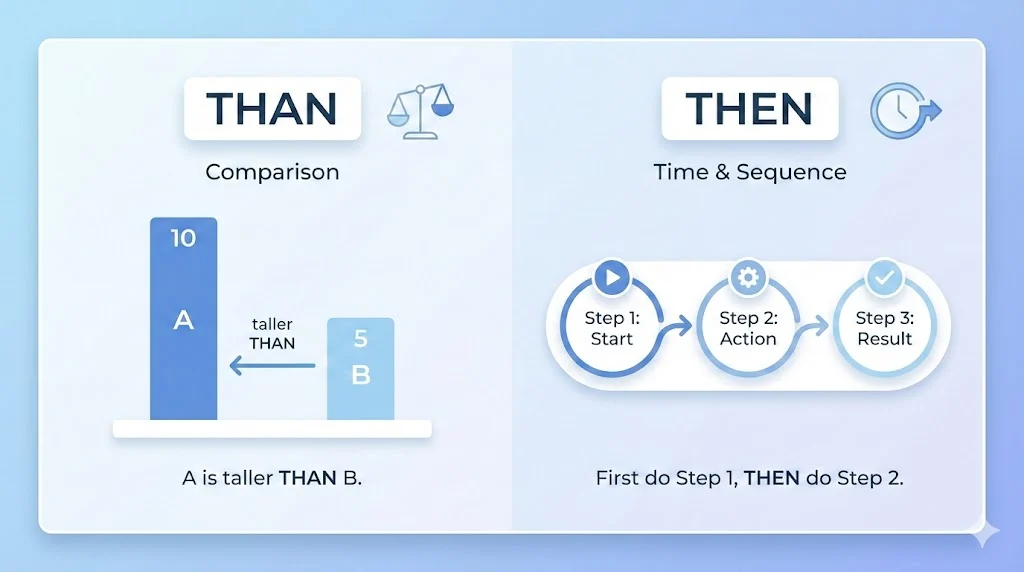
Than is used to compare two things, while then is used to talk about time, order, or what happens next. Use than when making comparisons and then when referring to time, sequence, or results.
Many people struggle with than or then because both words look similar and sound almost the same when spoken. This confusion appears everywhere, from school essays and emails to social media posts and professional documents. A single wrong letter can change the meaning of a sentence completely.
People often search for “than or then” because they want to know which word is correct and how to use it properly. Even fluent English speakers make this mistake, especially when typing quickly or writing casually. Unfortunately, using the wrong word can make writing confusing and reduce clarity.
This article explains the difference between than and then in a simple and clear way. You will learn grammar rules in depth, understand why people make this mistake, see real-life examples, correct common errors, practice with exercises, and read helpful tips to remember the difference forever.
Quick Answer
Than is used for comparison.
Then is used for time, order, or results.
Simple Examples
- She is taller than her sister.
- We ate dinner and then watched a movie.
- This book is better than the last one.
- Finish your work then leave.
Easy Memory Trick
If you are comparing things, use than.
If you are talking about time or what happens next, use then.
Grammar Rules Explained Clearly
Meaning and Rule of Than
Than is a conjunction and sometimes a preposition.
It is always used for comparison between two things.
It answers the question: Which one is more or less?
Examples
- He is smarter than me.
- This road is shorter than the other one.
- I would rather walk than wait.
Meaning and Rule of Then
Then is usually an adverb.
It talks about time, sequence, or result.
It answers the question: When or what happened next?
Examples
- We finished school then went home.
- Back then, life was simpler.
- If you study hard, then you will succeed.
Key Difference
- Than compares
- Then shows time or sequence
Why People Confuse Than or Then
Similar Pronunciation
Than and then sound very similar when spoken, especially in fast speech.
One Letter Difference
Only one letter separates the two words, which makes typing errors common.
Fast Writing Habits
In texting and online writing, people type quickly and do not double-check spelling.
Weak Grammar Awareness
Many writers do not clearly understand comparison versus time usage.
Informal Online Content
Seeing incorrect usage repeatedly on social media normalizes the mistake.
Than or Then in Real Life Usage
Daily Conversation
- She runs faster than me.
- Eat first, then rest.
- This task is easier than yesterday’s work.
- Call me then explain the issue.
Emails
- This option is cheaper than the previous one.
- Please submit the form, then wait for approval.
- I would rather discuss this now than later.
Social Media
- Better late than never.
- Start today, then stay consistent.
- This update is better than the last one.
Formal Writing
- The results were higher than expected.
- The experiment was conducted, then analyzed.
- This method is more effective than traditional approaches.
British and American English Usage
There is no difference between British and American English.
Both use:
- Than for comparison
- Then for time or sequence
Examples
- UK: She is older than him.
- US: She is older than him.
- UK: Finish your tea then leave.
- US: Finish your tea then leave.
Which One Should You Use
Ask yourself one simple question.
Am I comparing two things?
- Yes → use than
- No → use then
Quick Test
Replace the word with next.
If it works, then is correct.
- We ate and next left → then
- He is taller next me → incorrect, use than
Common Mistakes and Corrections
Wrong: She is smarter then him.
Correct: She is smarter than him.
Wrong: I will call you than we meet.
Correct: I will call you then we meet.
Wrong: This job is harder then the last one.
Correct: This job is harder than the last one.
Wrong: Finish your homework than play.
Correct: Finish your homework then play.
Than or Then in More Sentences
Simple Sentences
- He is younger than me.
- Sit down then listen.
Medium Sentences
- This movie is better than the previous one.
- Wash your hands then eat your meal.
Complex Sentences
- She would rather study at night than wake up early.
- The report was reviewed, then approved by management.
Special Uses of Than
Rather Than
Used to show preference.
- I prefer tea rather than coffee.
Other Than
Used to show exception.
- No one other than him knew the truth.
More Than
Used to show amount or emphasis.
- This took more than an hour.
Special Uses of Then
Back Then
Used to talk about the past.
- Back then, we had no smartphones.
If Then Statements
Used to show results.
- If you work hard, then you will succeed.
Just Then
Used to show something happened suddenly.
- Just then, the phone rang.
Than or Then Compared Side by Side
| Than | Then |
|---|---|
| Used for comparison | Used for time or sequence |
| Talks about difference | Talks about order |
| Taller than me | Eat then sleep |
| Better than before | Finish work then rest |
Related Confusing Word Pairs
Learning similar pairs improves accuracy.
- than or then
- your or you’re
- its or it’s
- their or there
- affect or effect
These mistakes often happen for the same reasons.
Practice Exercises
Fill in the Blanks
- She is faster ______ me.
Answer: than - Finish the task ______ take a break.
Answer: then - This phone is cheaper ______ that one.
Answer: than - We talked and ______ left early.
Answer: then - I would rather stay home ______ go out.
Answer: than
Choose the Correct Word
- He is taller (than / then) his brother.
Answer: than - Complete the form (than / then) submit it.
Answer: then - This exam was easier (than / then) expected.
Answer: than - Eat dinner (than / then) watch TV.
Answer: then
FAQs
What is the main difference between than and then?
Than is used for comparison, while then is used for time or sequence.
Can than and then be used interchangeably?
No, they have different meanings and cannot replace each other.
Why do people confuse than or then so often?
Because they sound similar and differ by only one letter.
Is then ever used for comparison?
No, then is never correct in comparisons.
Is than ever related to time?
No, than is only used for comparison.
Does this mistake affect professional writing?
Yes, using the wrong word can reduce clarity and credibility.
How can I remember the difference easily?
Remember that than compares and then relates to time or order.
Conclusion
The confusion between than and then is common but easy to fix once you understand their roles. Than is always used for comparison, while then refers to time, order, or results. Mixing them up can change meaning and weaken writing clarity.
By learning the grammar rules, understanding why mistakes happen, and practicing with examples, you can avoid this error completely. Always pause and ask yourself whether you are comparing or talking about sequence. That single step will guide you to the correct word every time.
Clear usage of than or then improves writing quality, confidence, and communication in every situation, from casual messages to formal documents.