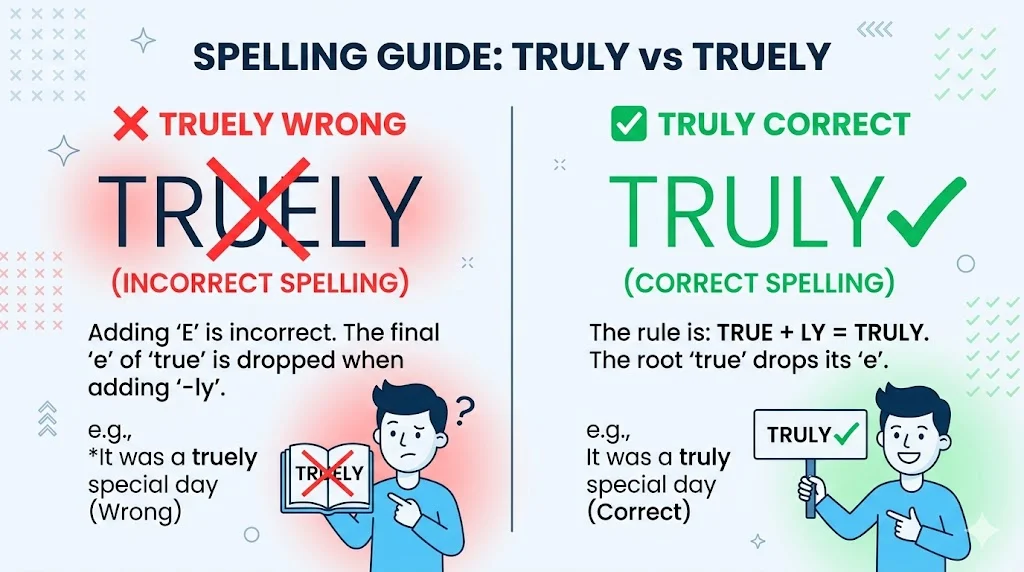
Truly is the correct spelling. Truely is incorrect. Truly means honestly or genuinely. The word drops the letter e from true before adding ly, following standard English spelling rules.
I once wrote “truely” in an important email, thinking it was correct because it looked natural from the word true. Later, I noticed the mistake while proofreading, and it made me question the spelling rule. After digging deeper, I learned that “truly” drops the letter e before adding ly. Since then, I have paid close attention to similar words and avoided repeating this mistake.
If you have ever felt unsure about truely vs truly, you are not alone. This is a very common spelling confusion in English. In this guide, you will learn the correct spelling, grammar rule, origin, real-world usage, common mistakes, and practical examples so you can use truly confidently in any situation.
Quick Answer
Truly is the correct spelling.
Truely is incorrect and should not be used in standard English.
Examples
Correct
I truly appreciate your help.
Incorrect
I truely appreciate your help.
Truely vs Truly Meaning
Truly
Truly is an adverb that means:
- honestly
- genuinely
- sincerely
- in a real or accurate way
Examples
- I truly believe in your abilities.
- She was truly happy with the results.
- This is truly an amazing experience.
Truely
Truely is not a correct word in English. It is a spelling mistake caused by misunderstanding how adverbs are formed.
Truely vs Truly Difference
| Word | Meaning | Correct Usage |
|---|---|---|
| Truly | Honestly, genuinely | Correct |
| Truely | No meaning | Incorrect |
Key Point
Only truly should be used in writing.
Grammar Rule Depth
The confusion between truely vs truly comes from how adverbs are formed.
Rule: Drop the Silent E
When a word ends in e, we usually remove the e before adding ly.
True → Truly
Why This Happens
English spelling rules simplify words for smoother pronunciation.
Keeping the extra e would make the word longer and unnecessary.
Examples Following the Same Rule
- due → duly
- whole → wholly
- true → truly
Why People Write Truely Instead of Truly
1. Spelling Assumption
People assume that adding ly keeps the original word unchanged.
2. Visual Habit
Since “true” ends with e, “truely” looks correct at first glance.
3. Lack of Rule Awareness
Many learners are not taught the drop-e rule clearly.
The Origin of Truly
The word truly comes from the Old English word treowe, meaning faithful or true.
Over time:
- true became common in Middle English
- adding ly created the adverb truly
The spelling evolved to remove the extra e for simplicity.
Truly in Real World Usage
In Emails
I truly appreciate your quick response.
In Business Writing
We are truly committed to delivering quality service.
In Academic Writing
This result is truly significant for the study.
In Daily Conversation
I truly enjoyed the movie.
Truly in Emotional Expression
The word truly is often used to express sincerity.
Examples
- I am truly sorry for the mistake.
- She is truly grateful for your help.
- He truly cares about his work.
Truly in Formal and Informal Writing
Formal Writing
We are truly honored to receive this award.
Informal Writing
That was truly awesome.
Common Mistakes with Truely vs Truly
Mistake 1 Adding Extra E
Incorrect
I truely understand your concern.
Correct
I truly understand your concern.
Mistake 2 Overgeneralizing Rules
Not all words keep the e before ly.
Mistake 3 Typing Errors
Truely is often a typing habit rather than a grammar mistake.
Similar Words That Follow the Same Rule
| Word | Adverb |
|---|---|
| true | truly |
| due | duly |
| whole | wholly |
Words That Keep E
Not all words drop the e.
Example
nice → nicely
This difference is why learners get confused.
Truly in Different Contexts
Positive Statements
I am truly happy for you.
Professional Tone
We truly value your feedback.
Emphasis
This is truly the best solution.
Truly vs Very vs Really
These words are often used together but have slight differences.
| Word | Meaning | Example |
|---|---|---|
| Truly | Honestly or genuinely | I truly care |
| Very | Degree or intensity | Very good |
| Really | Emphasis | Really important |
Truly in Popular Usage
The word appears in speeches, movies, and writing.
Example
This is truly a historic moment.
It is widely used because it adds emotional emphasis.
Usage Trends
Modern English strongly favors truly.
The incorrect spelling truely appears mostly in:
- typing mistakes
- informal writing
- beginner-level English
Professional writing always uses truly.
Exercise 1 Choose the Correct Word
Fill in the blank with truely or truly
I ______ appreciate your help.
Answer: truly
She is ______ happy today.
Answer: truly
This is ______ an important moment.
Answer: truly
Exercise 2 Correct the Sentence
Rewrite the sentence correctly
I truely understand your situation.
Answer: I truly understand your situation.
She was truely excited about the trip.
Answer: She was truly excited about the trip.
FAQs
Is truely a correct word?
No, truely is incorrect. The correct spelling is truly.
Why is truly spelled without e?
Because English drops the silent e before adding ly.
What does truly mean?
Truly means honestly, genuinely, or sincerely.
Is truly an adverb?
Yes, truly is an adverb formed from the adjective true.
Why do people write truely?
Because they assume the original spelling stays the same when adding ly.
Can truely ever be used?
No, it is always considered a spelling mistake.
What is the rule for truly?
Drop the e from true and add ly to form truly.
Conclusion
The confusion between truely vs truly is very common, but the rule is simple once you understand it. The correct spelling is truly, and it follows a standard English pattern where the silent e is dropped before adding ly. The spelling truely is incorrect and should be avoided in all types of writing.
By learning this rule and practicing examples, you can avoid common spelling mistakes and improve your writing accuracy. Whether you are writing emails, academic papers, or social media posts, using truly correctly will make your communication clearer and more professional.
Remember the simple rule: true becomes truly, not truely.