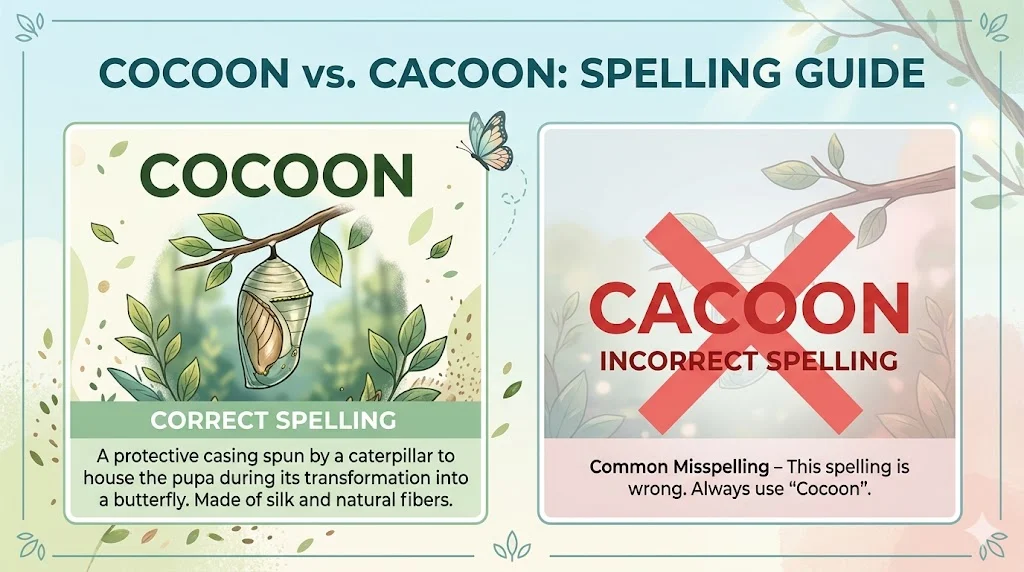
Cocoon is the correct spelling for the protective covering of insects. Cacoon is a common misspelling. Always use cocoon in writing, as it is the standard and accepted English word.
I remember once writing “cacoon” in a blog draft and feeling unsure if it was correct. It looked right at first glance, but something felt off. When I checked a dictionary, I realized the correct spelling is cocoon, not cacoon.
That small mistake showed me how easy it is to confuse similar-looking words, especially when they sound the same. After that, I made it a habit to double-check tricky spellings and understand their origins.
If you have ever hesitated between cacoon vs cocoon, this guide will clear your confusion completely and help you use the correct spelling with confidence in both casual and professional writing.
Quick Answer
Cocoon is the correct spelling.
Cacoon is incorrect and should not be used in standard English.
Examples
Correct
The caterpillar formed a cocoon.
Incorrect
The caterpillar formed a cacoon.
Cocoon vs Cacoon Meaning
Cocoon
A cocoon is a protective covering made by insects like caterpillars during their transformation stage. It is also used metaphorically to describe a safe or comfortable environment.
Cacoon
The word cacoon has no recognized meaning in English. It is simply a spelling mistake of cocoon.
Cocoon vs Cacoon Difference
| Word | Meaning | Correct Usage |
|---|---|---|
| Cocoon | Protective covering or safe space | Correct |
| Cacoon | No meaning | Incorrect |
Key Point
Only cocoon is a valid English word.
Grammar Rule Depth
Cocoon as a Noun
The word cocoon is mainly used as a noun.
Example
The insect stayed inside its cocoon.
Cocoon as a Verb
Cocoon can also be used as a verb, meaning to wrap or protect.
Example
She cocooned herself in a warm blanket.
Incorrect Form
Cacoon cannot be used as a noun or verb because it is not a real word.
The Origin of Cocoon
The word cocoon comes from the French word cocon, which means a protective shell made by insects.
It entered English in the 17th century and has kept the same spelling and meaning since then.
Because of its French origin, the spelling may look unusual, which is why people sometimes misspell it as cacoon.
Why People Write Cacoon Instead of Cocoon
Similar Sound
Both spellings sound the same when spoken, leading to confusion.
Spelling Assumptions
People often assume the word follows simple phonetic rules and replace “co” with “ca”.
Typing Errors
Fast typing or lack of familiarity leads to mistakes like cacoon.
Lack of Awareness
Many people have seen the word but never learned the correct spelling.
Real World Usage of Cocoon
Biology
In science, a cocoon is part of an insect’s life cycle.
Example
The butterfly emerged from its cocoon.
Everyday Life
The word is often used metaphorically.
Example
She stayed in her cocoon of comfort at home.
Fashion and Design
Cocoon is used to describe shapes or styles that feel enclosed or protective.
Example
The cocoon jacket provides warmth and comfort.
Cocoon in Everyday Examples
Emails
I stayed in my cocoon all weekend to relax.
News
The insect forms a cocoon before transforming into a butterfly.
Social Media
Sometimes you just need a cocoon day at home.
Formal Writing
The larva creates a cocoon as part of its developmental process.
Cocoon as a Metaphor
The word cocoon is widely used beyond biology.
Emotional Meaning
It can describe a feeling of safety or protection.
Example
He lived in a cocoon away from stress.
Personal Growth
It can also represent transformation.
Example
She came out of her cocoon stronger and more confident.
Common Mistakes with Cocoon vs Cacoon
Mistake 1 Wrong Spelling
Incorrect
The butterfly stayed in its cacoon.
Correct
The butterfly stayed in its cocoon.
Mistake 2 Mixing Forms
Incorrect
She cacooned herself in a blanket.
Correct
She cocooned herself in a blanket.
Mistake 3 Assuming Both Are Correct
Only cocoon is correct in English.
Cocoon in Different Contexts
Science
The caterpillar spins a cocoon before transformation.
Lifestyle
She created a cocoon of comfort at home.
Literature
Writers often use cocoon to describe change or protection.
Related Words and Expressions
Understanding related words helps expand vocabulary.
Biology Related
larva
pupa
metamorphosis
Similar Ideas
protective shell
safe space
comfort zone
Usage Trends
The spelling cocoon is used worldwide in books, articles, and academic writing.
The spelling cacoon appears only as an error in informal writing.
Search data shows that people often look for “cacoon vs cocoon” because they are unsure about the correct spelling.
Exercise 1 Choose the Correct Word
Fill in the blank with cocoon or cacoon.
The caterpillar formed a ______.
Answer: cocoon
She stayed in her ______ of comfort.
Answer: cocoon
The butterfly emerged from the ______.
Answer: cocoon
Exercise 2 Correct the Sentence
Rewrite the sentence correctly.
The insect stayed inside its cacoon.
Answer: The insect stayed inside its cocoon.
She cacooned herself in a blanket.
Answer: She cocooned herself in a blanket.
FAQs
What is the correct spelling, cacoon or cocoon?
The correct spelling is cocoon. Cacoon is a common mistake and should not be used in standard English.
What does cocoon mean?
Cocoon refers to a protective covering made by insects and can also mean a safe or comfortable space.
Is cacoon a real word?
No, cacoon is not a recognized English word.
Why do people misspell cocoon?
People misspell it due to pronunciation similarity, typing errors, and lack of familiarity with its spelling.
Can cocoon be used as a verb?
Yes, cocoon can be used as a verb meaning to wrap or protect oneself.
Where is cocoon used in real life?
It is used in biology, everyday language, literature, and metaphorical expressions.
How can I remember the correct spelling?
Remember that cocoon has double “o” in the middle, like a soft protective shell.
Conclusion
The difference between cocoon vs cacoon is simple but important. The word cocoon is the correct and accepted spelling in English, while cacoon is just a common mistake. Although both forms may sound the same, only cocoon has a real meaning and proper usage.
Cocoon is widely used in biology to describe the protective covering formed by insects, but it also has strong metaphorical meanings related to safety, comfort, and personal transformation. Because of its unique spelling and foreign origin, it is easy to misspell, especially for learners and even experienced writers.
By understanding its meaning, origin, and correct usage, you can avoid common errors and improve your writing. A simple tip is to remember the double “o” in cocoon, which reflects its soft and protective nature.
With regular practice and awareness, you can confidently use the correct spelling in all types of writing, from casual messages to professional documents.