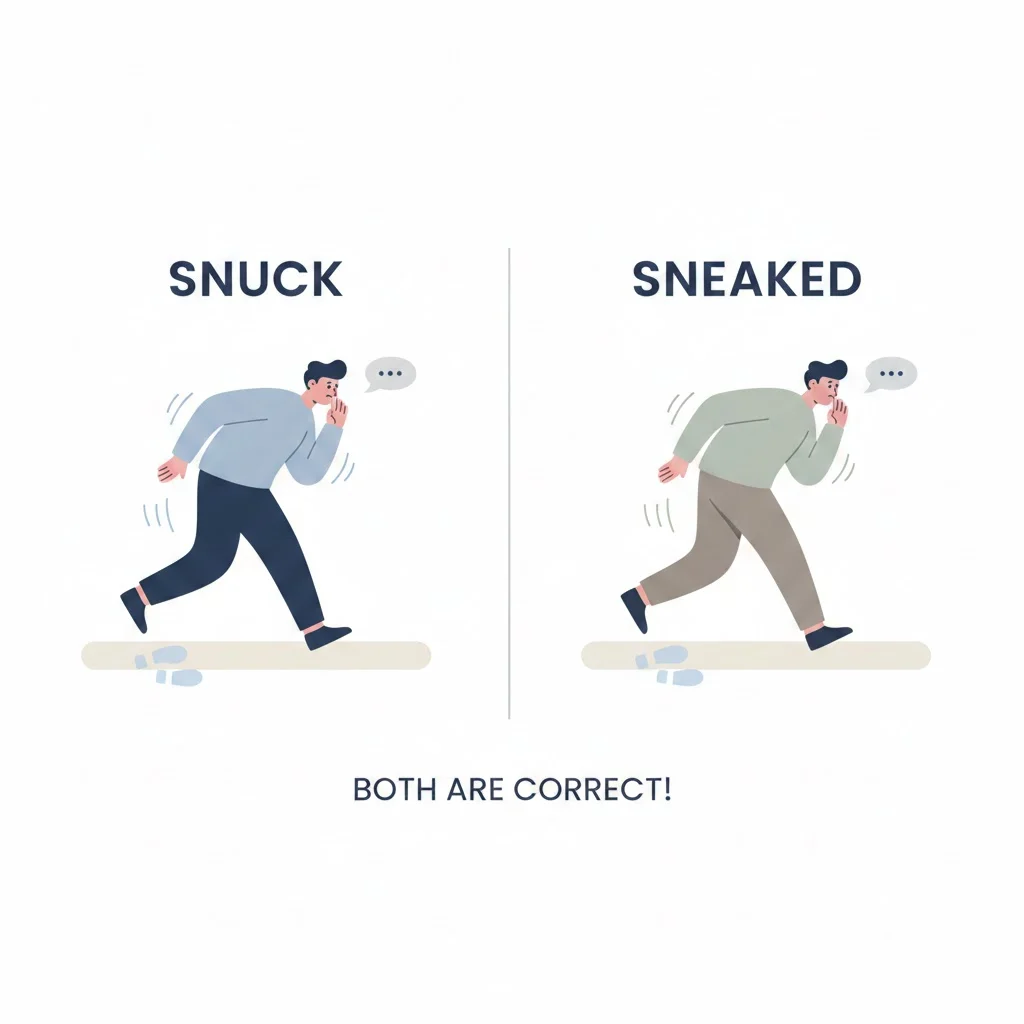
Snuck and sneaked are both past tense forms of the verb sneak. Sneaked is the traditional and older form, while snuck is an accepted modern variation used mainly in informal speech and writing. Both are correct in modern English, but choosing between them depends on tone, audience, and writing style.
Many people stop while writing and wonder whether they should use snuck or sneaked. Both words seem correct, and both appear in books, movies, and daily conversation. This creates confusion for students, writers, and even native speakers who want to use proper grammar.
The verb sneak means to move quietly or secretly, and its past tense has changed over time. Some people strongly prefer sneaked, while others naturally say snuck. Because both forms exist, writers often worry about which one sounds more correct or professional.
This guide explains the difference clearly. You will learn grammar rules, history, real life usage, why people disagree, examples for different situations, common mistakes, exercises with answers, and helpful tips to choose the right word confidently every time.
Snuck or Sneaked Quick Answer
Both snuck and sneaked are correct past tense forms of sneak.
- Sneaked is the traditional and older form.
- Snuck is a newer form that became popular through everyday speech.
Simple Examples
- He sneaked into the room quietly.
- She snuck out after midnight.
Easy Tip
Use sneaked for formal or academic writing.
Use snuck in casual conversation or informal writing.
Grammar Rules Explained
The Verb Sneak
The base verb is sneak, which means to move secretly or quietly.
Examples:
- I sneak into the kitchen late at night.
- They sneak around the house silently.
The confusion begins when changing the verb into past tense.
Sneaked Meaning and Rule
Sneaked is the original past tense form. It follows the regular grammar rule of adding ed to the base verb.
Examples:
- He sneaked behind the curtain.
- The cat sneaked into the room.
Because it follows regular grammar patterns, many teachers and style guides prefer this form.
Snuck Meaning and Rule
Snuck is an irregular past tense variation that developed over time through spoken English.
Examples:
- He snuck into the theater without a ticket.
- She snuck a snack before dinner.
Although it began as informal speech, snuck is now widely accepted in modern English dictionaries.
Why Two Correct Forms Exist
English changes constantly. Some verbs develop irregular forms because people use them often in speech. Over time, these spoken forms become accepted.
Examples of similar changes:
- Dive → dove
- Hang → hung
- Stick → stuck
Snuck followed a similar pattern, influenced by words like stuck and struck.
Why People Confuse Snuck or Sneaked
Both Are Accepted
Unlike many grammar mistakes, both words are technically correct. This makes choosing difficult.
School Rules vs Real Life Speech
Many schools teach sneaked as the correct form, while real conversations often use snuck.
Regional Differences
Some regions naturally use one form more than the other.
Influence of Media
Movies, television shows, and social media frequently use snuck, making it feel natural to many speakers.
Style Guide Differences
Some editors prefer traditional grammar, while others accept modern usage.
History and Evolution of Snuck and Sneaked
Understanding history helps explain why this debate exists.
Early English Usage
The word sneak appeared in English around the late 1500s. The past tense was consistently sneaked.
Appearance of Snuck
The form snuck began appearing in the 1800s in American English speech. It was initially criticized as incorrect.
Growth in Popular Usage
During the twentieth century, snuck became more common in everyday conversation and literature.
Modern Acceptance
Today, major dictionaries recognize both forms. Language experts now consider snuck informal but valid.
Snuck or Sneaked in Real Life Usage
Daily Conversation
- He snuck out last night.
- She sneaked into the kitchen quietly.
Most casual speech favors snuck because it sounds natural and short.
Emails
- She sneaked a look at the report before the meeting.
- He snuck into the call late.
In professional emails, sneaked often sounds safer and more polished.
News and Journalism
News writing usually prefers sneaked, though snuck occasionally appears in quotations.
Example:
- The suspect sneaked into the building unnoticed.
Books and Fiction
Fiction often uses snuck because it reflects natural dialogue.
Example:
- The child snuck downstairs after bedtime.
Academic Writing
Academic and formal writing strongly favors sneaked.
Example:
- Participants sneaked a glance at the instructions.
British and American English Usage
American English
- Snuck is very common in speech.
- Sneaked remains acceptable in formal writing.
British English
- Sneaked is preferred.
- Snuck is understood but less common.
Global Usage
Writers often choose based on audience expectations.
Which One Should You Use
Ask yourself two questions:
Is the writing formal or informal?
Who is the audience?
Use Sneaked When
- Writing essays
- Writing reports
- Academic or professional contexts
- Formal publications
Use Snuck When
- Writing dialogue
- Casual blogs
- Social media posts
- Everyday conversation
Common Mistakes and Corrections
Wrong: He sneakeded into the room.
Correct: He sneaked into the room.
Wrong: She snucked out quietly.
Correct: She snuck out quietly.
Wrong: I have sneaked yesterday.
Correct: I sneaked yesterday.
Wrong: The cat sneakeded inside.
Correct: The cat sneaked inside.
Snuck or Sneaked in More Sentences
Simple Sentences
- He snuck out after dinner.
- She sneaked behind the door.
Medium Sentences
- The students snuck into the classroom before the teacher arrived.
- The dog sneaked into the kitchen for food.
Formal Sentences
- The assistant sneaked into the archive to retrieve files.
- The report stated that participants sneaked unauthorized notes into the exam room.
Similar Verbs With Multiple Past Forms
Learning similar verbs helps understand why snuck exists.
- Dreamed or dreamt
- Learned or learnt
- Burned or burnt
- Spelled or spelt
English allows variation, especially when language evolves naturally.
Style and Tone Differences
Sneaked Tone
- Traditional
- Formal
- Neutral
- Preferred by editors
Snuck Tone
- Casual
- Conversational
- Natural sounding
- Common in storytelling
Choosing the right tone strengthens writing clarity.
Pronunciation and Sound Patterns
Many linguists believe snuck became popular because it sounds similar to other irregular verbs.
Examples:
- Stick → stuck
- Strike → struck
This sound pattern made snuck feel natural to speakers.
Frequent Writer Concerns
Is snuck wrong grammar
No. It is accepted in modern English.
Will teachers mark snuck wrong
Some may prefer sneaked in formal assignments.
Does snuck sound informal
Yes, usually.
Should I avoid snuck in professional writing
If unsure, choose sneaked.
Practice Exercises
Fill in the Blanks
- He ______ into the room quietly.
Answer: sneaked or snuck - The child ______ out after bedtime.
Answer: sneaked or snuck - She ______ a look at the surprise gift.
Answer: sneaked or snuck - The cat ______ into the kitchen.
Answer: sneaked or snuck - They ______ away before anyone noticed.
Answer: sneaked or snuck
Choose the Correct Word
- The boy (snuck / sneaked) into the theater.
Answer: snuck or sneaked - She (snuck / sneaked) a glance at the answer sheet.
Answer: snuck or sneaked - The reporter (snuck / sneaked) into the event secretly.
Answer: sneaked (formal tone) - He (snuck / sneaked) out of the house late at night.
Answer: snuck (casual tone)
FAQs
Is snuck or sneaked more correct?
Both are correct, but sneaked is traditional and preferred in formal writing while snuck is more informal.
Is snuck proper English?
Yes, snuck is accepted in modern English dictionaries and common in everyday speech.
Which is older, snuck or sneaked?
Sneaked is older and historically the original past tense form.
Do teachers prefer sneaked?
Many teachers and editors prefer sneaked in academic or formal writing.
Is snuck American English?
Snuck is more common in American English, while sneaked is more common in British English.
Can I use snuck in professional writing?
It depends on tone, but sneaked is usually safer for professional contexts.
Why does English allow both forms?
Language changes over time, and frequent spoken usage made snuck widely accepted.
Conclusion
The choice between snuck or sneaked can feel confusing because both forms are correct in modern English. Sneaked is the traditional and more formal choice, while snuck developed through everyday speech and is now widely accepted, especially in informal contexts. Understanding tone, audience, and writing purpose helps you choose the right option.
If you are writing something formal or academic, sneaked is the safest choice. If you are writing dialogue, stories, or casual content, snuck sounds natural and conversational. Both forms communicate the same meaning, so the decision depends mainly on style.
By understanding grammar history, real usage, and common mistakes, you can confidently use either word without hesitation. Language evolves, and knowing when and why forms change helps you become a stronger, more flexible writer.