
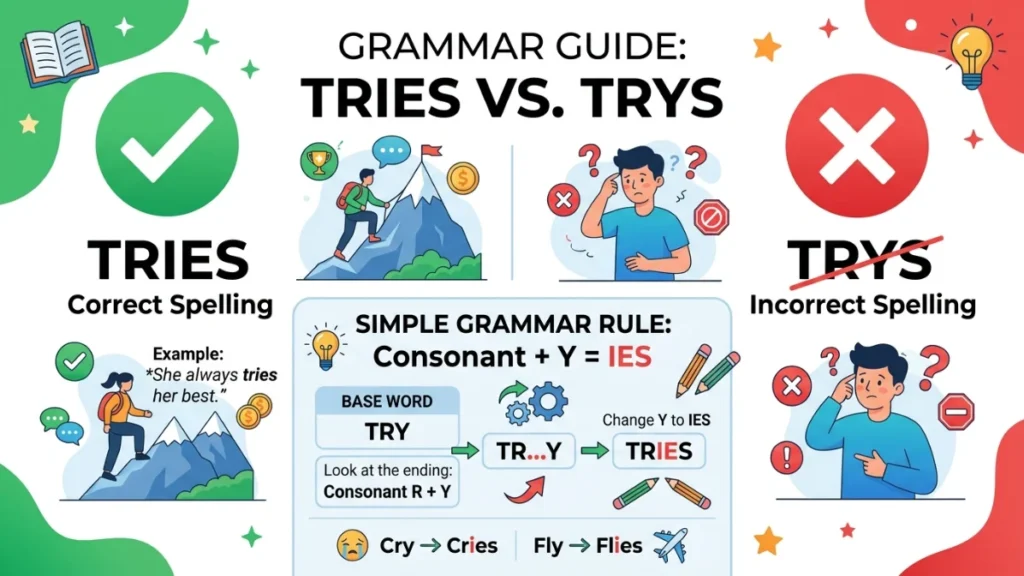

Tries is the correct spelling of the verb form from “try.” Trys is incorrect in standard English. Example: She tries hard every day.
I once wrote “he trys to help everyone” in an email and did not notice the mistake until someone corrected it later. That small error made me realize how confusing English spelling rules can be, especially with words ending in “y.”
I started studying why some words change from “y” to “ies,” while others simply add “s.” After practicing grammar patterns and reviewing examples daily, I stopped making this mistake completely.
If you also feel confused between tries or trys, this guide will help you understand the correct spelling, grammar rules, common mistakes, real world examples, and easy memory tricks so you can use the word confidently in writing and conversation.
Tries or Trys Quick Answer
Tries is the correct spelling.
Trys is not a correct English word.
When a verb ends with a consonant + “y,” the “y” changes to “i” before adding “es.”
Examples
She tries her best every day.
He tries to finish work on time.
Incorrect: He trys to help.
Correct: He tries to help.
Tries or Trys Meaning
The word tries comes from the verb try.
The verb try means:
To make an effort
To attempt something
To test or examine something
Examples
She tries to learn new skills.
He tries different foods when traveling.
The company tries new marketing ideas each year.
The spelling trys has the same intended meaning, but it is grammatically incorrect.
Tries vs Trys Difference
| Word | Correct or Incorrect | Meaning | Example |
|---|---|---|---|
| Tries | Correct | Makes an effort | She tries every day |
| Trys | Incorrect | Not standard English | Incorrect spelling |
Key Point
Only tries should be used in professional, academic, and everyday writing.
Grammar Rule Depth
The confusion between tries or trys comes from English spelling rules for verbs ending in “y.”
Rule for Verbs Ending in Consonant + Y
When a verb ends with:
Consonant + y
Change the “y” to “i” and add “es.”
Formula
try → tries
cry → cries
fly → flies
study → studies
Why This Happens
English spelling rules developed to make pronunciation smoother and easier to read.
Without the “i,” some words would look awkward or unclear.
Why Trys Is Incorrect
The spelling trys breaks the standard grammar rule.
Since try ends with a consonant + y:
t + r + y
The “y” must change to “i” before adding “es.”
Incorrect Pattern
try + s = trys ❌
Correct Pattern
try → tries ✅
Verb Forms of Try
Understanding all verb forms helps avoid spelling mistakes.
| Verb Form | Word |
|---|---|
| Base Form | try |
| Third Person Singular | tries |
| Past Tense | tried |
| Past Participle | tried |
| Present Participle | trying |
Examples
She tries every morning.
He tried to solve the problem.
They are trying to improve.
The Origin of the Word Try
The word try comes from Old French and Latin roots related to testing, judging, or examining something.
Over time, English adopted the word and applied regular grammar rules for verbs ending in “y.”
That is why the third person singular form became tries.
Why People Confuse Tries and Trys
Several reasons cause this confusion.
Simple Addition Habit
Many English words form plurals or verb forms by simply adding “s.”
Examples
runs
walks
plays
People assume “try” follows the same pattern.
Y Ending Confusion
English spelling rules for “y” words can feel complicated.
Fast Typing Mistakes
Many people accidentally type “trys” while writing quickly online or in messages.
Real World Usage of Tries
The word tries appears in everyday English constantly.
At School
The student tries to improve his grades.
At Work
She tries to complete every task carefully.
In Sports
The team tries hard to win every game.
In Relationships
He always tries to support his friends.
Tries in Everyday Examples
Emails
She tries to answer all emails quickly.
News
The government tries to reduce inflation.
Social Media
He tries to stay positive every day.
Formal Writing
The company tries new strategies to increase productivity.
Common Mistakes with Tries or Trys
Mistake 1 Using Trys
Incorrect
She trys to help everyone.
Correct
She tries to help everyone.
Mistake 2 Forgetting the Y Rule
Incorrect
He studys every night.
Correct
He studies every night.
Mistake 3 Mixing Verb Forms
Incorrect
They tries to finish early.
Correct
They try to finish early.
Similar Words Following the Same Rule
Many English verbs follow the same grammar pattern.
| Base Word | Correct Form |
|---|---|
| cry | cries |
| fly | flies |
| study | studies |
| worry | worries |
| carry | carries |
These examples help reinforce the spelling rule.
Exception to the Rule
Not all words ending in “y” change to “ies.”
If the word ends with:
Vowel + y
Simply add “s.”
Examples
play → plays
enjoy → enjoys
stay → stays
Why
The vowel before “y” changes the spelling pattern.
Tries in Professional Writing
Correct spelling matters in professional communication.
Business Emails
Incorrect spelling can reduce professionalism.
Incorrect
She trys to respond quickly.
Correct
She tries to respond quickly.
Academic Writing
Teachers and examiners expect proper grammar usage.
Job Applications
Grammar mistakes may create a poor impression.
Tries in Spoken English
In spoken English, people usually pronounce “tries” correctly even if they spell it wrong in writing.
This is why many learners make spelling mistakes but not pronunciation mistakes.
British English vs American English
Unlike some English words, tries has the same spelling in both British and American English.
| Region | Correct Spelling |
|---|---|
| American English | tries |
| British English | tries |
The spelling trys is incorrect everywhere.
Why Correct Spelling Matters
Using correct spelling improves:
Clarity
Professionalism
Grammar accuracy
Reader trust
Small grammar mistakes can make writing appear careless, especially in formal settings.
Memory Trick to Remember Tries
Use this simple trick:
Consonant + y = change y to ies
Examples
try → tries
cry → cries
study → studies
This pattern helps you remember the correct spelling quickly.
Usage Trends and Language Data
Search data shows that many people search “tries or trys” because of spelling confusion.
However, dictionaries, grammar books, and professional writing standards recognize only tries as correct.
The spelling trys appears mainly in typing mistakes and informal online writing.
Tries in Different Contexts
Parenting
She tries to teach good habits.
Healthcare
The doctor tries to help every patient.
Technology
The software tries to detect errors automatically.
Education
The teacher tries to explain the lesson clearly.
Related Grammar Rules
Understanding connected grammar rules improves accuracy.
Changing Y to IES
This rule also appears in nouns.
baby → babies
city → cities
lady → ladies
Third Person Singular Verbs
English often adds “s” or “es” for he, she, and it.
Examples
runs
watches
tries
Common Sentences Using Tries
She tries every day.
He tries to stay calm.
The company tries new methods.
My friend tries to help everyone.
The athlete tries to improve performance.
Tries in Formal and Informal Writing
Formal Writing
The organization tries to maintain high standards.
Informal Writing
She tries so hard every day.
The spelling remains the same in both contexts.
Exercise 1 Choose the Correct Word
Fill in the blank with tries or trys.
She ______ to arrive early every morning.
Answer: tries
The company ______ to improve customer service.
Answer: tries
He ______ hard to understand grammar rules.
Answer: tries
Exercise 2 Correct the Sentence
Rewrite the sentence correctly.
She trys to help everyone.
Answer: She tries to help everyone.
The student trys hard in class.
Answer: The student tries hard in class.
My brother trys new recipes often.
Answer: My brother tries new recipes often.
Exercise 3 Complete the Pattern
Write the correct word form.
cry → ______
Answer: cries
study → ______
Answer: studies
fly → ______
Answer: flies
try → ______
Answer: tries
FAQs
Is tries or trys correct?
Tries is correct. Trys is not a standard English spelling.
Why is trys incorrect?
Because verbs ending in consonant + y change the y to i before adding es.
What does tries mean?
Tries means makes an effort or attempts something.
How do you spell tries correctly?
The correct spelling is t r i e s.
Do British and American English use different spellings?
No. Both use the spelling tries.
What grammar rule explains tries?
Words ending in consonant + y change y to ies in third person singular forms.
Can trys ever be correct?
No. Standard English grammar considers trys incorrect.
Conclusion
Understanding the difference between tries or trys is simple once you learn the grammar rule. The correct spelling is always tries, because verbs ending in a consonant plus “y” change the “y” to “i” before adding “es.” The spelling trys breaks this rule and is considered incorrect in standard English.
This small spelling detail matters more than many people realize. Correct grammar improves clarity, professionalism, and reader confidence in emails, academic work, business communication, and everyday writing. Since the word “tries” appears frequently in English, learning the correct form helps strengthen overall language skills.
A useful memory trick is to remember:
Consonant + y = ies
This simple pattern works for many other words like cries, studies, and flies. With practice and awareness, you can avoid this common mistake and write with greater accuracy and confidence.