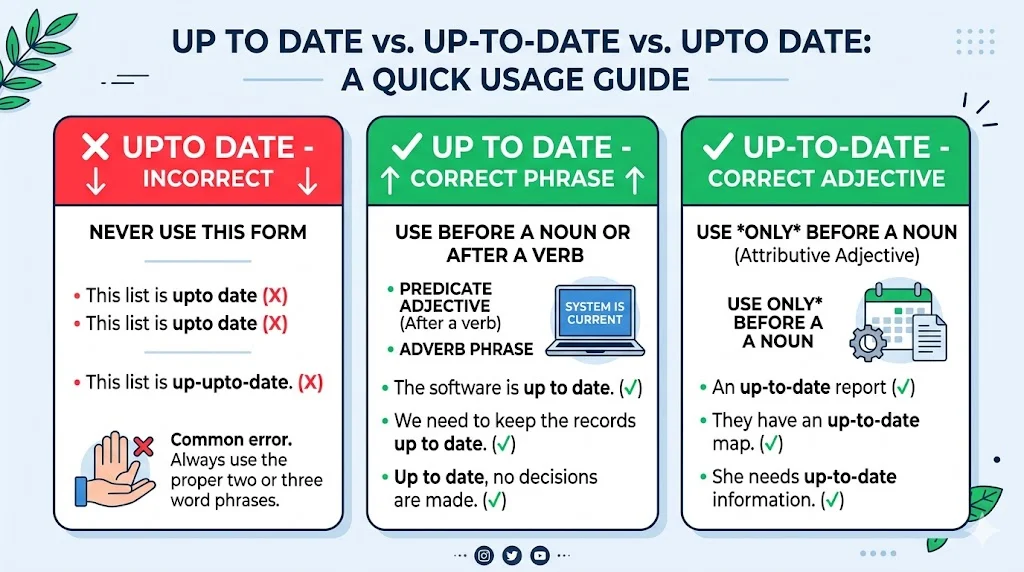

Up-to-date is the correct spelling when used as an adjective. Up to date is correct as a phrase. Upto date is incorrect and should not be used in standard English.
Many writers and English learners get confused between upto date, up to date, and up-to-date. These variations look similar, sound the same, and often appear in both formal and informal writing. Because of this, people frequently use the wrong form without realizing it.
The confusion usually comes from spacing and hyphenation. Some people combine the words into upto date, others write up to date, and many use up-to-date. Each version may look acceptable at first glance, but only two are correct in standard English, and they are used in different grammatical situations.
Understanding the difference is important for clear and professional communication. Whether you are writing emails, blog posts, academic papers, or business reports, using the correct form improves readability and credibility.
In this complete guide, you will learn the exact difference between upto date and up-to-date, when to use each form, common mistakes, grammar rules, real world examples, and how to avoid errors in your writing.
Quick Answer
There are three forms, but only two are correct.
Up to date is correct as a phrase.
Up-to-date is correct as an adjective.
Upto date is incorrect and should not be used.
Examples
Correct
Your information is up to date.
Correct
This is an up-to-date report.
Incorrect
Your information is upto date.
Upto Date vs Up-to-Date Meaning
All correct forms share a similar meaning.
They describe something that is:
Current
Modern
Updated
Accurate with the latest information
Examples
The database is up to date.
We need an up-to-date system.
Both sentences express the idea of being current or updated.
Upto Date vs Up-to-Date Difference
| Form | Type | Usage | Correct |
|---|---|---|---|
| Up to date | Phrase | Used after verbs | Yes |
| Up-to-date | Adjective | Used before nouns | Yes |
| Upto date | Incorrect form | Not used in standard English | No |
Key Rule
Use up to date after verbs.
Use up-to-date before nouns.
Avoid upto date completely.
Grammar Rule Depth
Understanding the grammar behind these forms makes usage easier.
Up to Date as a Phrase
This is a prepositional phrase. It usually appears after a verb.
Example
The records are up to date.
Here, the phrase describes the state of the records.
Up-to-Date as an Adjective
When the phrase comes before a noun, it becomes a compound adjective and needs hyphens.
Example
We use an up-to-date system.
The hyphens connect the words to act as a single descriptive unit.
Why Hyphens Matter
Hyphens improve clarity. Without them, the sentence may become confusing or unclear.
The Origin of Up to Date
The phrase up to date originated in the 19th century.
The word date refers to time or a specific point in time. When something is “up to date,” it means it has reached the current point in time.
Over time, the phrase evolved into a common expression used in everyday English.
Later, writers began using the hyphenated form up-to-date to describe nouns more clearly.
British English vs American English Spelling
Both British and American English follow the same rules for this phrase.
There is no difference in spelling between regions.
| Usage | British English | American English |
|---|---|---|
| Up to date | Correct | Correct |
| Up-to-date | Correct | Correct |
| Upto date | Incorrect | Incorrect |
Key Point
The rules for spacing and hyphenation remain the same worldwide.
Which Spelling Should You Use
Choosing the correct form depends on sentence structure.
Use Up to Date
When the phrase comes after a verb.
Example
Your profile is up to date.
Use Up-to-Date
When describing a noun directly.
Example
We need an up-to-date report.
Avoid Upto Date
This form is not accepted in standard English writing.
Why People Make This Mistake
This mistake is very common due to several reasons.
Confusion with Similar Words
Words like into, onto, and upto (in informal usage) create confusion.
Fast Typing
Writers often combine words while typing quickly.
Lack of Grammar Awareness
Many people are not aware of the rule about hyphenated adjectives.
Visual Similarity
All three forms look similar, which makes it easy to choose the wrong one.
Common Mistakes with Upto Date vs Up-to-Date
Mistake 1 Using Upto Date
Incorrect
The system is upto date.
Correct
The system is up to date.
Mistake 2 Missing Hyphens
Incorrect
We need an up to date report.
Correct
We need an up-to-date report.
Mistake 3 Overusing Hyphens
Incorrect
The system is up-to-date.
Correct
The system is up to date.
Upto Date vs Up-to-Date in Everyday Examples
Emails
Please make sure your records are up to date.
News
The company uses an up-to-date system for tracking data.
Social Media
Keep your profile up to date for better visibility.
Formal Writing
The report includes up-to-date information on market trends.
Upto Date vs Up-to-Date in Professional Writing
Using the correct form is important in professional contexts.
Business Communication
Managers expect accurate and updated information.
Example
Ensure all files are up to date before submission.
Academic Writing
Research must reflect current knowledge.
Example
This paper uses up-to-date sources.
Technical Documentation
Clarity is essential.
Example
Install the latest up-to-date version of the software.
Upto Date vs Up-to-Date Usage Trends
Language usage shows that:
Up to date and up-to-date are widely used in books, articles, and online content.
Upto date appears mostly in incorrect or informal writing.
Search data confirms that correct forms dominate professional and published content.
Related Words and Similar Expressions
Understanding related phrases helps improve vocabulary.
Similar Expressions
current
updated
modern
latest
recent
Examples
The system is current.
The data is updated.
We need the latest version.
Exercise 1 Choose the Correct Form
Fill in the blank with the correct form.
The database is ______.
Answer: up to date
We need an ______ report.
Answer: up-to-date
Her knowledge is ______.
Answer: up to date
Exercise 2 Correct the Sentence
Rewrite the sentence using the correct form.
The report is upto date.
Answer: The report is up to date.
We need an up to date system.
Answer: We need an up-to-date system.
FAQs
What is the difference between upto date and up-to-date?
Upto date is incorrect. Up to date is a phrase used after verbs, and up-to-date is an adjective used before nouns.
Is upto date ever correct?
No, upto date is not correct in standard English and should be avoided in all types of writing.
When should I use up-to-date with hyphens?
Use up-to-date when the phrase comes before a noun, such as in up-to-date information or up-to-date system.
When should I use up to date without hyphens?
Use up to date when it comes after a verb, such as in the system is up to date.
Do British and American English differ in this rule?
No, both British and American English follow the same rules for using up to date and up-to-date.
Why do people write upto date?
People often combine the words due to typing habits, confusion with similar words, or lack of awareness of grammar rules.
Is up-to-date formal or informal?
Up-to-date is used in both formal and informal writing when describing nouns.
Conclusion
The difference between upto date and up-to-date is simple once you understand the rules. While all forms may look similar, only two are correct in standard English.
Up to date is used as a phrase and usually appears after verbs. It describes something that is current or updated. Up-to-date is a compound adjective used before nouns, and it requires hyphens for clarity. The form upto date is incorrect and should always be avoided.
These small differences can have a big impact on the clarity and professionalism of your writing. Whether you are writing emails, reports, articles, or social media posts, using the correct form shows attention to detail and improves readability.
By remembering this simple rule about spacing and hyphenation, you can confidently choose the correct version every time. Consistent and accurate usage will help you communicate more effectively in both professional and everyday situations.