
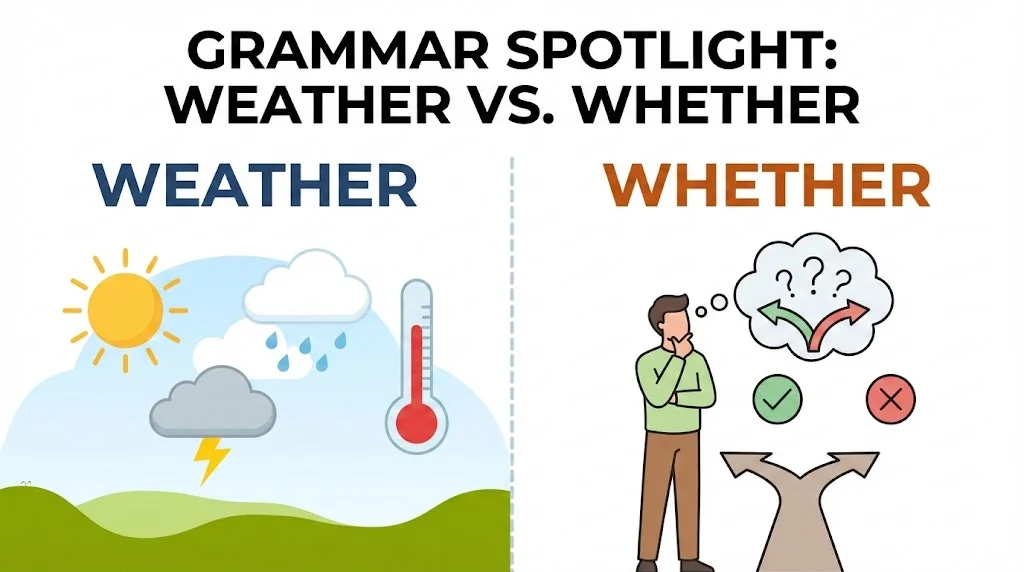
Do you often stop while writing and think, “Should I write weather or whether?” If yes, you are not alone. This is one of the most searched and confusing word pairs in English. Even fluent speakers mix them up because weather and whether sound exactly the same when spoken. However, their meanings are completely different.
People search for “weather or whether” because both words are used very often in daily life. We talk about the weather every day. At the same time, we use whether when asking questions or showing choices. Since they sound identical, many writers accidentally use the wrong word, especially in emails, exams, blog posts, and professional writing.
In this article, you will learn the clear difference between weather and whether. You will understand grammar rules in depth, why people make this mistake, real-world usage examples, common errors, exercises with answers, and practical tips to remember the correct word every time.
Quick Answer
Weather refers to climate conditions like rain, heat, or wind.
Whether is used to show a choice, doubt, or condition.
Simple Examples
- The weather is hot today.
- I don’t know whether he will come.
Easy Trick to Remember
- If you are talking about rain, sun, or temperature → weather
- If you are talking about a choice or question → whether
Grammar Rule Depth: Weather vs Whether Explained Clearly
Understanding the grammar role of each word removes all confusion.
Weather – Grammar Explanation
Weather is a noun.
It talks about atmospheric conditions.
It can also be used as a verb, meaning to survive or endure something.
Examples
- The weather is cold today.
- The ship weathered the storm.
Whether – Grammar Explanation
Whether is a conjunction.
It introduces choices, possibilities, or uncertainty.
It often appears with words like or not, if, or decide.
Examples
- I don’t know whether to stay or leave.
- She asked whether he was ready.
Key Grammar Difference
- Weather = thing or condition
- Whether = connector for choices
Why People Confuse Weather or Whether
This mistake is extremely common, and there are clear reasons behind it.
1. Same Pronunciation
Weather and whether sound exactly the same when spoken. This makes it hard for learners to differentiate them in writing.
2. Fast Typing and Autocorrect
When typing quickly, writers choose the wrong word without noticing. Autocorrect does not always catch this mistake.
3. Weak Grammar Foundation
Many people learn English through speaking first, not grammar rules. This causes confusion with homophones.
4. Overuse in Daily Writing
Both words are used very frequently, increasing the chance of errors.
5. Informal Online Writing
Social media and chats ignore grammar rules, which spreads incorrect usage.
Weather or Whether in Real-World Usage
Seeing real-world examples helps fix the difference in your mind.
Usage in Daily Conversation
- The weather is nice today.
- I am not sure whether he agrees.
Usage in Emails
- Please check the weather before traveling.
- Let me know whether you are available tomorrow.
Usage in News
- Severe weather warnings were issued.
- Officials are deciding whether to close schools.
Usage in Academic Writing
- Climate change affects global weather patterns.
- The study examines whether the method is effective.
British English vs American English Usage
There is no spelling or meaning difference between British and American English.
Both use:
- Weather for climate
- Whether for choices
Examples
- UK: The weather is unpredictable.
- US: The weather is unpredictable.
- UK: We are unsure whether to proceed.
- US: We are unsure whether to proceed.
Which Word Should You Use?
Ask yourself one simple question:
👉 Am I talking about climate or temperature?
Use weather.
👉 Am I talking about a choice, doubt, or decision?
Use whether.
Quick Test
If you can replace the word with if, then whether is correct.
- I don’t know if he will come → whether
Common Mistakes and Corrections
Wrong: I don’t know weather he is coming.
Correct: I don’t know whether he is coming.
Wrong: The whether is very cold today.
Correct: The weather is very cold today.
Wrong: Check whether conditions before travel.
Correct: Check weather conditions before travel.
Weather or Whether in Sentences (More Examples)
Simple Sentences
- The weather is rainy.
- I wonder whether she knows.
Medium-Level Sentences
- Bad weather delayed the flight.
- He asked whether the plan would work.
Formal Writing
- Extreme weather affects agriculture.
- The report analyzes whether the policy is effective.
Related Confusing Word Pairs
Learning similar homophones improves grammar accuracy.
- Weather vs Whether
- Their vs There vs They’re
- Your vs You’re
- Then vs Than
- Affect vs Effect
These pairs are commonly confused in English writing.
Weather or Whether – Practice Exercises
Exercise 1: Fill in the Blanks
- The ______ is very hot today.
Answer: weather - I don’t know ______ he will agree.
Answer: whether - Bad ______ caused delays.
Answer: weather - She asked ______ to continue.
Answer: whether
Exercise 2: Choose the Correct Word
- The (weather / whether) is cloudy.
Answer: weather - He asked (weather / whether) I was ready.
Answer: whether - Check the (weather / whether) forecast.
Answer: weather - I’m unsure (weather / whether) to go.
Answer: whether
FAQs
Is weather and whether interchangeable?
No. They have completely different meanings.
Can whether mean if?
Yes. Whether often replaces if in formal writing.
Is weather only a noun?
Mostly yes, but it can also be a verb.
Is there a spelling difference by region?
No. Both US and UK use the same spelling.
Why is this mistake so common?
Because both words sound the same.
Does Google penalize such grammar errors?
Poor grammar can reduce content quality and trust.
Conclusion
The confusion between weather and whether exists because they sound identical but serve very different purposes in English grammar. Weather talks about climate and atmospheric conditions, while whether introduces choices, doubts, or possibilities. Mixing them up can change the meaning of a sentence and reduce writing quality.
By understanding the grammar roles, real-world usage, and common mistakes, you can easily avoid this error. Always ask yourself whether the sentence refers to climate or a decision. This simple check solves the problem instantly.
Correct usage is important for students, professionals, bloggers, and anyone who writes in English. Clean grammar improves clarity, trust, and SEO performance. Now that you know the difference clearly, you can write with confidence and accuracy.