
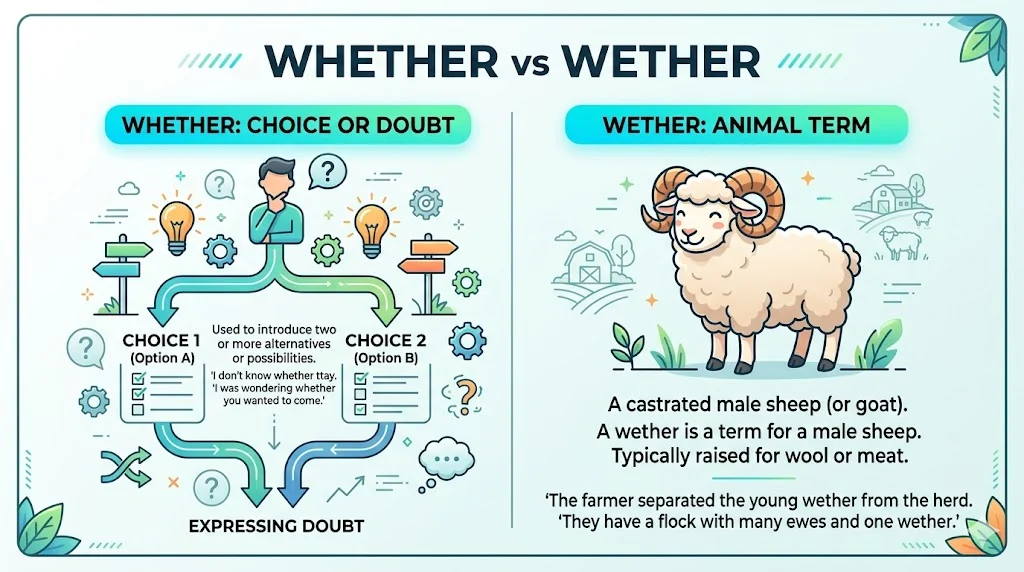

Whether is a conjunction used to show choice or uncertainty. Wether is a noun meaning a castrated male sheep. Whether is common in writing, while wether is rare and used in farming contexts.
I once wrote “I’m not sure wether to go or stay” in an important message, thinking it was correct. Later, I realized the mistake and learned that whether and wether are completely different words. That small error made me dig deeper into grammar and usage.
I discovered that whether is widely used in everyday English, while wether is a rare farming term. After practicing and understanding the difference, I never made that mistake again. If you’ve ever been confused between these two similar-looking words, this guide will help you understand their meanings, usage, grammar rules, and real-life examples clearly.
Whether or Wether Quick Answer
Whether is used to show a choice or uncertainty.
Wether is a noun that means a castrated male sheep.
Examples
I don’t know whether he will come.
The farmer kept a wether in the field.
Whether or Wether Meaning
Whether
Whether is a conjunction used to introduce alternatives or express doubt.
Examples:
- I am not sure whether to call him.
- She asked whether we were ready.
- Decide whether you want tea or coffee.
Wether
Wether is a noun used in agriculture. It means a castrated male sheep.
Examples:
- The farmer raised a wether for wool.
- The wether grazed quietly in the field.
Whether or Wether Difference
| Word | Meaning | Part of Speech | Usage Frequency | Example |
|---|---|---|---|---|
| Whether | Shows choice or doubt | Conjunction | Very common | I don’t know whether to go |
| Wether | Castrated male sheep | Noun | Rare | The wether is in the field |
Key Point:
Whether is used in everyday English. Wether is a specialized farming term.
Grammar Rule Depth
Whether as a Conjunction
Whether connects clauses and introduces options or uncertainty.
Structure:
Whether + clause
Examples:
- I don’t know whether he is coming.
- She asked whether we were ready.
Whether with “or”
Often used to show two choices.
Examples:
- Decide whether you want tea or coffee.
- I don’t know whether to stay or leave.
Whether vs If
Whether is often used instead of if when showing choices.
Examples:
- Correct: I don’t know whether he will come.
- Also correct: I don’t know if he will come.
But in formal writing, whether is preferred, especially with choices.
Verb and Sentence Patterns with Whether
Whether + Infinitive
- I don’t know whether to go.
- She is deciding whether to study abroad.
Whether + Clause
- I wonder whether he understands.
- We are unsure whether the plan will work.
Whether + or Not
- I will go whether or not it rains.
- She will attend whether or not she is invited.
The Origin of Whether and Wether
Whether
Comes from Old English hwæther, meaning “which of two.” It has always been used to show choice or uncertainty.
Wether
Comes from Old English wether, referring to a sheep. The meaning has remained the same for centuries.
Why People Confuse Whether and Wether
- Similar Spelling – Only one letter difference
- Same Pronunciation – They sound identical
- Lack of Awareness – Many people do not know wether exists
- Autocorrect Errors – Typing tools sometimes fail to correct it
Real World Usage of Whether
Daily Conversation
- I don’t know whether I should go.
- She asked whether I was busy.
Emails
- Please confirm whether you can attend the meeting.
- Let me know whether the report is ready.
News
- Officials are unsure whether the policy will succeed.
Academic Writing
- Researchers studied whether the method was effective.
Real World Usage of Wether
Wether is rarely used outside farming or agriculture.
Examples
- The farmer sold a wether at the market.
- The wether grazed peacefully.
Whether in Everyday Examples
Social Media
- I can’t decide whether to travel or stay home.
Formal Writing
- The company must decide whether to expand.
Business
- Let us know whether you accept the offer.
Common Mistakes with Whether or Wether
Mistake 1 Using Wether Instead of Whether
Incorrect
I don’t know wether to go.
Correct
I don’t know whether to go.
Mistake 2 Confusing Whether with If
Sometimes “if” cannot replace “whether.”
Incorrect
I don’t know if to go.
Correct
I don’t know whether to go.
Mistake 3 Spelling Errors
People often type “wether” accidentally instead of “whether.”
Whether vs If Difference
| Feature | Whether | If |
|---|---|---|
| Shows choice | Yes | Sometimes |
| Used with “or not” | Yes | No |
| Formal writing | Preferred | Less preferred |
Related Words and Expressions
Words Related to Whether
- if
- either
- or
- choice
- decision
Words Related to Wether
- sheep
- livestock
- farming
- agriculture
Whether in Different Contexts
Decisions
- Decide whether to accept the offer.
Doubt
- I am unsure whether he knows the answer.
Conditions
- I will go whether it rains or not.
Usage Trends
Whether is extremely common in all types of English writing.
Wether is rare and mostly used in agricultural contexts.
Search data shows that most users searching “whether or wether” are looking for the correct spelling and usage of whether.
Exercise 1 Choose the Correct Word
- I don’t know ______ to go or stay.
Answer: whether - The farmer raised a ______ for wool.
Answer: wether - She asked ______ we were ready.
Answer: whether
Exercise 2 Correct the Sentence
- I don’t know wether to leave.
Answer: I don’t know whether to leave. - The whether is grazing in the field.
Answer: The wether is grazing in the field.
FAQs
What is the difference between whether and wether?
Whether is a conjunction used to show choice or uncertainty, while wether is a noun meaning a castrated male sheep.
Is wether a correct word?
Yes, but it is rarely used and mainly appears in farming contexts.
When should I use whether?
Use whether when expressing doubt, choice, or alternatives in a sentence.
Can whether and if be used interchangeably?
Sometimes, but whether is preferred in formal writing and when showing choices.
Why do people confuse whether and wether?
Because they look similar and sound the same, but have completely different meanings.
Is wether used in daily English?
No, it is rarely used outside agriculture.
What is the correct spelling for uncertainty?
The correct word is whether.
Conclusion
Understanding the difference between whether and wether is important for clear and accurate English. While both words look similar and sound the same, their meanings are completely different. Whether is a common conjunction used to express choice, doubt, or alternatives, and it appears in everyday conversation, emails, academic writing, and professional communication. On the other hand, wether is a rare noun used in agriculture to describe a castrated male sheep.
Most confusion happens because of spelling similarity and pronunciation. However, once you remember that whether relates to decisions and choices, the confusion becomes easy to avoid. In almost all writing situations, you will use whether, not wether.
By practicing examples, understanding grammar rules, and applying the correct usage in real situations, you can eliminate this common mistake. This will improve your writing clarity, professionalism, and confidence in English communication.