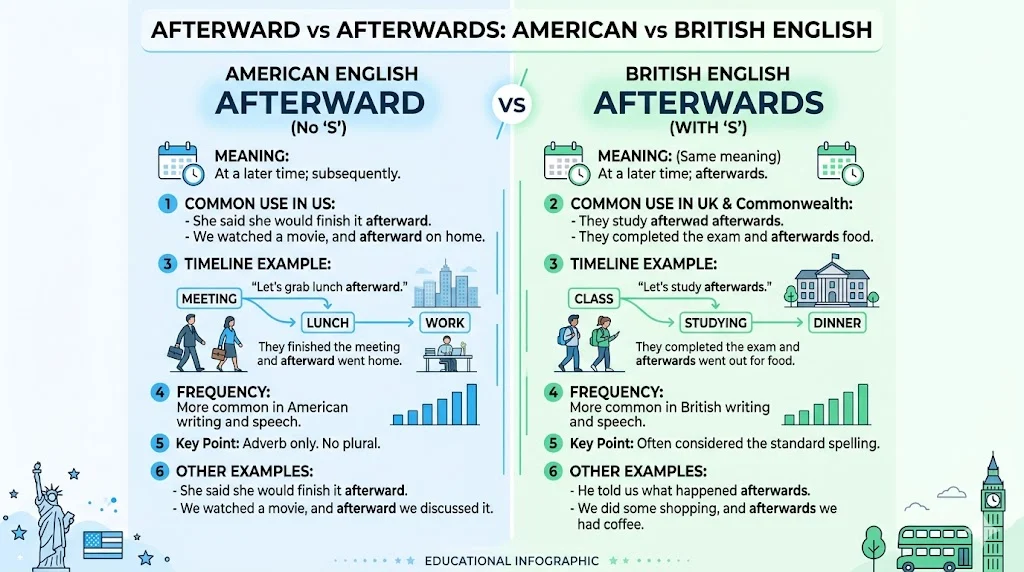

Afterward and afterwards both mean “at a later time.” Afterward is preferred in American English, while afterwards is common in British English. Both are correct and interchangeable in most contexts.
I remember struggling with afterward vs afterwards while writing a blog post for an international audience. I used “afterwards” in one paragraph and “afterward” in another. It looked inconsistent, and a reader pointed it out.
That moment made me realize that even small differences in spelling can affect clarity and professionalism. I researched the rule and learned that both forms are correct, but usage depends on region and consistency. Since then, I always choose one style based on my audience and stick with it throughout my writing.
If you have faced the same confusion, this guide will help you fully understand the difference and use both forms confidently.
Quick Answer
Both afterward and afterwards mean “later” or “after that.”
- Afterward is more common in American English
- Afterwards is more common in British English
Examples
We went to dinner, and afterward we watched a movie.
She finished her work and relaxed afterwards.
Afterward vs Afterwards Meaning
Both words are adverbs used to describe time.
Afterward
Means something happens later or following a previous event.
Example
He completed the task and afterward took a break.
Afterwards
Has exactly the same meaning as afterward.
Example
She called her friend and afterwards went to sleep.
Key Point: There is no difference in meaning, only in regional usage.
Afterward vs Afterwards Difference
| Word | Meaning | Region | Usage |
|---|---|---|---|
| Afterward | Later | American English | Preferred in US |
| Afterwards | Later | British English | Preferred in UK |
Grammar Rule Depth
Both afterward and afterwards are adverbs of time.
They answer the question: When did something happen?
Sentence Structure
Subject + verb + afterward/afterwards
Examples
- He finished his homework and afterward went outside.
- She spoke to the manager and afterwards sent an email.
Position in Sentence
These words can appear in different positions:
Beginning
Afterward, we went home.
Middle
We afterward realized the mistake.
End
We went home afterward.
The Origin of Afterward and Afterwards
Both words come from Old English roots:
The word originally meant “toward a later time.”
The variation afterwards developed later with the addition of “s,” which was common in British English adverbs.
Examples of similar patterns:
toward vs towards
forward vs forwards
backward vs backwards
Why Two Spellings Exist
English has evolved differently in different regions.
American English
Tends to drop the “s” in adverbs.
Examples: afterward, forward, toward
British English
Often keeps the “s.”
Examples: afterwards, forwards, towards
Both forms are correct, but consistency matters.
Which Spelling Should You Use
For American Audience
Use afterward
For British or International Audience
Use afterwards
For Global Content
Either is correct, but choose one and stay consistent
Real World Usage of Afterward and Afterwards
In Daily Conversation
We finished dinner and afterward went for a walk.
He completed the meeting and relaxed afterwards.
In Work Emails
Please review the report and afterward send feedback.
We will discuss the plan and afterwards finalize the details.
In Academic Writing
The experiment was conducted, and afterward results were recorded.
In News Writing
The event ended, and afterwards the audience left the venue.
Afterward vs Afterwards in Everyday Examples
Emails
I will call you afterward.
We can discuss this afterwards.
Social Media
I went to the gym and afterward felt great.
She studied hard and afterwards celebrated.
Formal Writing
The team completed the project and afterward presented results.
Common Mistakes with Afterward vs Afterwards
Mistake 1 Mixing Both Forms
Incorrect
He finished work afterward and went home afterwards.
Correct
Use one form consistently
Mistake 2 Thinking One Is Wrong
Both forms are correct
Mistake 3 Using in Wrong Context
Incorrect
Afterward the book.
Correct
Set proper sentence structure
Afterward vs Afterwards in Different Contexts
Storytelling
He entered the room, and afterward everything changed.
Instructions
Complete the form and afterward submit it.
Narration
She spoke confidently and afterwards received applause.
Related Words and Similar Patterns
Understanding similar word pairs helps learning:
toward vs towards
forward vs forwards
backward vs backwards
These follow the same rule as afterward vs afterwards.
Usage Trends and Language Patterns
Language data shows:
- Afterward is more common in the United States
- Afterwards is more common in the UK and Commonwealth
Online content shows both forms widely used, but professional writing maintains consistency based on audience.
Exercise 1 Choose the Correct Word
Fill in the blank with afterward or afterwards.
We went to lunch and ______ returned to work.
Answer: afterward
She finished her homework and ______ watched TV.
Answer: afterwards
He called me and ______ sent a message.
Answer: afterward
Exercise 2 Correct the Sentence
Rewrite correctly.
He completed the task afterward and relaxed afterwards.
Answer: He completed the task afterward and relaxed afterward.
She went home afterwards and called me afterward.
Answer: She went home afterwards and called me afterwards.
FAQs
What is the difference between afterward and afterwards?
There is no difference in meaning. Afterward is used in American English, while afterwards is preferred in British English.
Is afterward or afterwards correct?
Both are correct. The choice depends on regional preference and consistency.
Which spelling should I use?
Use afterward for American audiences and afterwards for British or international audiences.
Can I use both in one sentence?
No, you should use only one form consistently within a document.
Are afterward and afterwards interchangeable?
Yes, they have the same meaning and can be used interchangeably.
Why does British English add s?
British English often uses s in adverbs, which is why afterwards is common there.
Is afterward formal or informal?
Both forms can be used in formal and informal writing.
Conclusion
The difference between afterward vs afterwards is simple but important. Both words mean the same thing and function as adverbs of time. The only real difference lies in regional preference. American English favors afterward, while British English prefers afterwards.
Understanding this distinction helps maintain consistency and professionalism in writing. Whether you are writing emails, academic papers, blog posts, or social media content, choosing the right form based on your audience improves clarity and readability.
The key takeaway is not just knowing the difference, but applying it consistently. Once you decide which version to use, stick with it throughout your content. This small detail can make a big difference in how your writing is perceived.